
Genus: Succulents
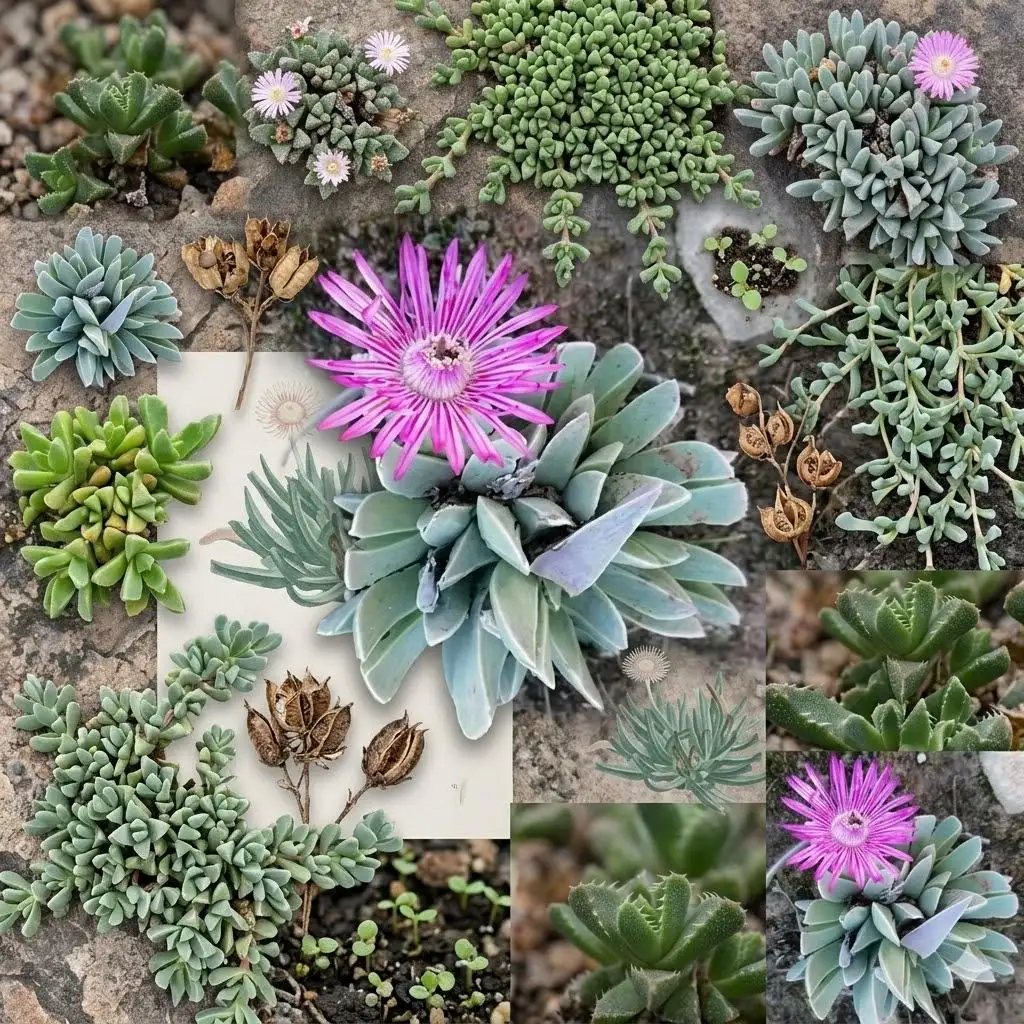
Acrodon
Acrodon
Monotypic genus of the Aizoaceae family native to the Western Cape of South Africa. Its plants are low-growing succulents forming small shrubs with triquetrous leaves. Flowers have white to pink petals very similar to daisies.
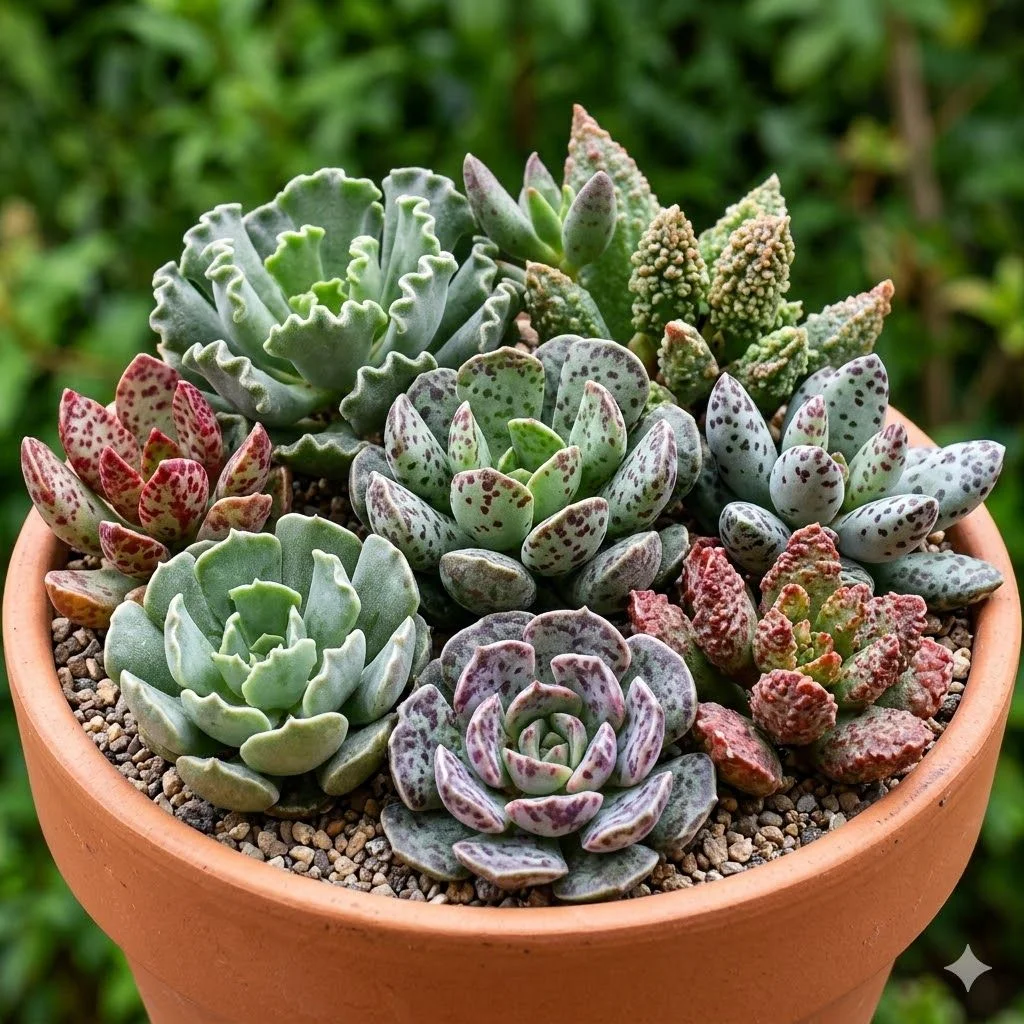
Adromischus
Adromischus
Adromischus is a genus of small perennial succulents native to southern Africa, distinguished by their striking, often spotted, blotched, or unusually textured succulent leaves that vary enormously between species, from smooth and shiny to tuberculate or papillose surfaces. Plants form small clumps of short, branching stems bearing generally obovate, spatulate, or tubular leaves frequently decorated with distinctive dark markings unique to each taxon. Their tubular, whitish-green to pinkish flowers appear on erect spikes during the summer months. The remarkable morphological variability among its 29 accepted species has made Adromischus an active subject of taxonomic study and a favourite among specialist succulent collectors.
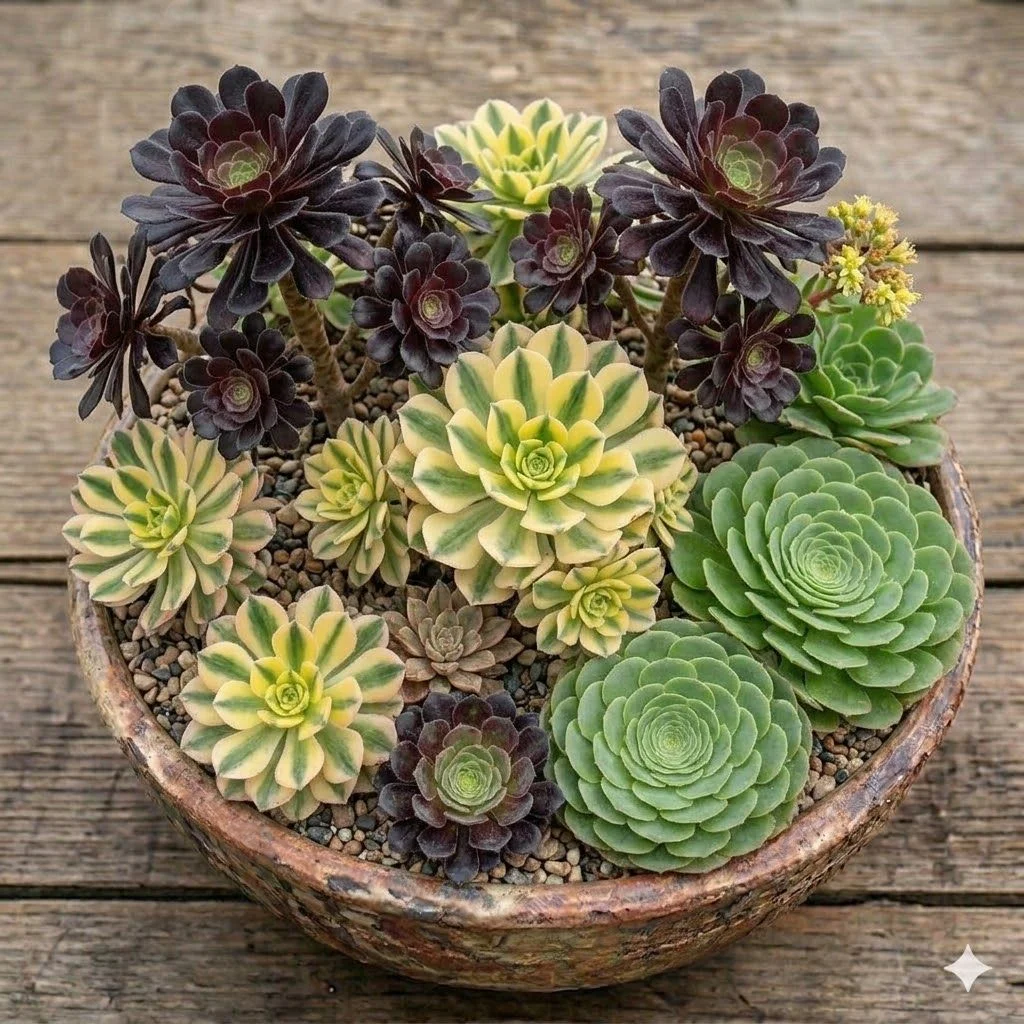
Aeonium
Aeonium
Genus comprising approximately 35 accepted species, mostly endemic to the Canary Islands, with some in Morocco, East Africa, and the Arabian Peninsula. They form terminal rosettes on woody stems and are distinguished from other Crassulaceae genera by their monocarpic rosettes (the rosette dies after flowering, but the plant persists through branching).
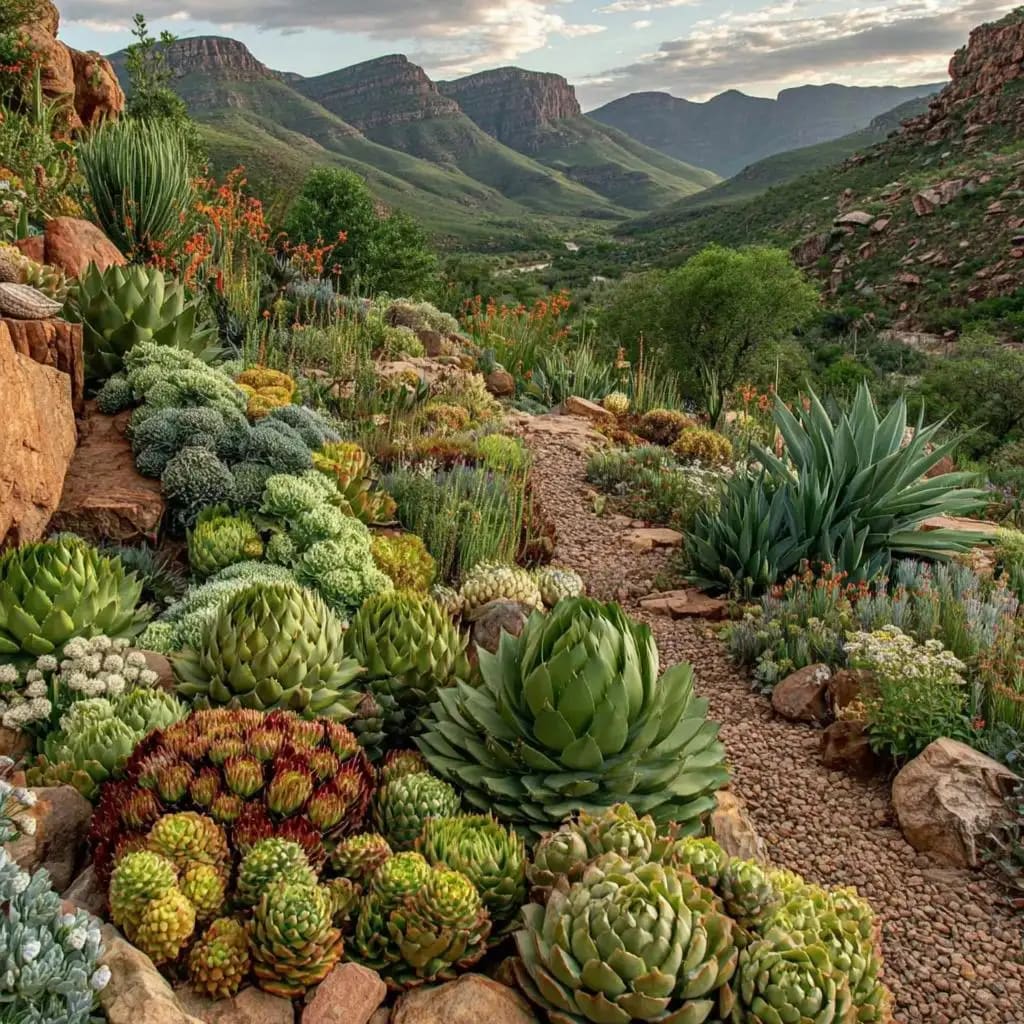
Agave
Agave
Agave is a genus of monocarpic succulent plants native primarily to Mexico and the southwestern United States, with some species extending into Central America and the Caribbean. Their fleshy, fibrous leaves—often armed with terminal and marginal spines—form dense rosettes that may take 10 to 30 years to flower; after producing a towering inflorescence, the mother plant dies, leaving behind offsets (pups). The genus comprises approximately 270 recognized species and holds immense cultural and economic importance: it provides fibers (sisal, henequen), alcoholic beverages (tequila, mezcal, pulque), and is widely used as an ornamental plant.
Aichryson
Aichryson
Genus of annual and biennial succulent plants endemic to Macaronesia, principally the Canary Islands, with some species in Madeira, the Azores, and Cape Verde. They form rosettes of small, fleshy, hairy leaves ranging from green to reddish, with yellow star-shaped flowers. They grow in humid, shaded areas of ravines, laurel forests, and rocky volcanic slopes.

Aizoon
Aizoon
Small genus of annual and perennial succulent plants in the family Aizoaceae, native to the Mediterranean region, Macaronesia, and North Africa. Plants form prostrate or erect stems with fleshy leaves and small flowers with numerous stamens. They inhabit arid coastal zones, beaches, and saline soils.
Alluaudia
Alluaudia
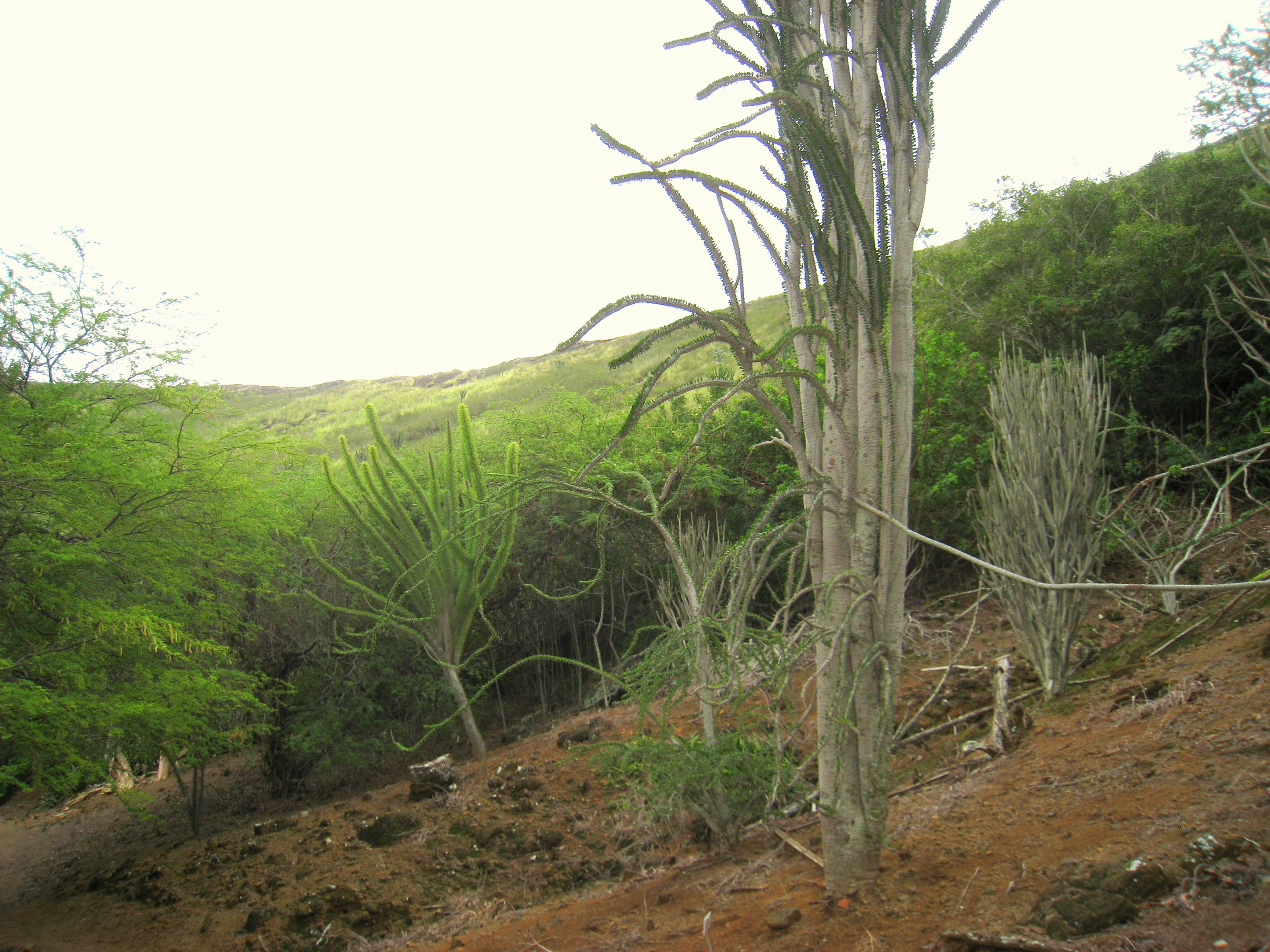
Genus of columnar succulent plants endemic to Madagascar, belonging to the Didiereaceae family. Alluaudias produce erect stems with small, deciduous oval leaves and long spines emerging in pairs from tubercles. They can reach several meters in height and are iconic elements of Madagascar's southern spiny forest.
Aloe
Aloe
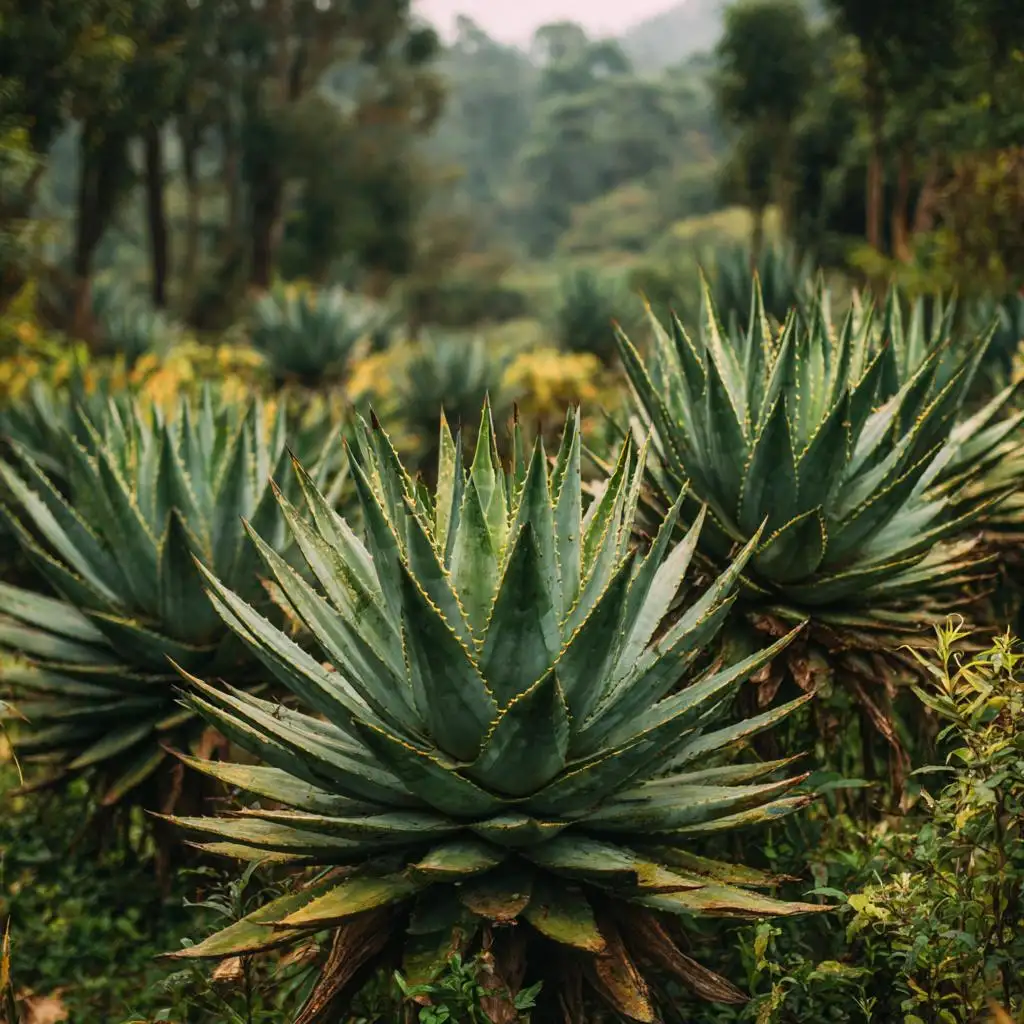
Genus comprising over 500 accepted species, with a diversity center in southern and eastern Africa. Species range from small stemless rosettes to trees exceeding 10 meters. Succulent leaves typically have toothed margins and contain a mucilaginous gel historically used in traditional medicine. Tubular flowers, usually orange or red, are arranged in erect racemes.
Aloiampelos
Aloiampelos
Genus of scrambling or procumbent aloes segregated from Aloe. Includes the scrambling aloe species originally classified as Aloe ciliaris, among others.
Aloidendron
Aloidendron
Genus of large arborescent aloes segregated from Aloe; includes the world's largest aloe tree.
Aloinopsis
Aloinopsis
Genus of succulent plants belonging to the family Aizoaceae, comprising about 12–15 species endemic mainly to southern Africa (Karoo and Namaqualand). They are geophytic winter-growing plants forming compact rosettes with thick, fleshy leaves, often covered in tubercles. They produce large taproot systems to store water and nutrients. The daisy-like flowers are yellow or pink with darker stripes and open only in bright sunlight.
Anacampseros
Anacampseros
Genus of small succulents in the family Anacampserotaceae, native to the arid regions of southern Africa. Characterized by fleshy leaves partially covered by silky filaments or axillary hairs, and ephemeral pink or white flowers that open for only a few hours per day. Highly sought by succulent collectors.
Angolluma
Angolluma
Genus of stapeliad succulents in the family Apocynaceae, segregated from Caralluma. Native to eastern and southern Africa, the Arabian Peninsula, and southern Asia. Characterized by leafless angular succulent stems that photosynthesize directly. Their flowers have complex structures to attract pollinators through carrion-like odors.
Antegibbaeum
Antegibbaeum
Monotypic genus of succulent plants in the family Aizoaceae, endemic to the Western Cape of South Africa. Forms small clumps of paired glaucous succulent leaves with a pronounced keel, producing diurnal pink flowers in winter.
Antimima
Antimima
Genus of small succulents in the family Aizoaceae, native to the arid regions of South Africa and Namibia. Form small clumping shrublets with cylindrical or triquetrous succulent leaves, producing generally white or pink flowers. Segregated from Ruschia and related genera.
Aptenia
Aptenia
Genus of small trailing succulents in the family Aizoaceae, native to southern Africa and widely naturalized in the Mediterranean and coastal areas. Notable for their pendulous stems with fleshy heart-shaped leaves and abundant pink, red, or white flowers. Widely used as hanging plants and groundcovers.
Apteranthes
Apteranthes
Genus of stapeliad succulents in the family Apocynaceae (tribe Ceropegieae), distributed from the Canary Islands and the Mediterranean to the Middle East and Central Asia. Characterized by angular leafless succulent stems and star-shaped colorful flowers with a frequent unpleasant odor to attract fly pollinators.
Argyroderma
Argyroderma
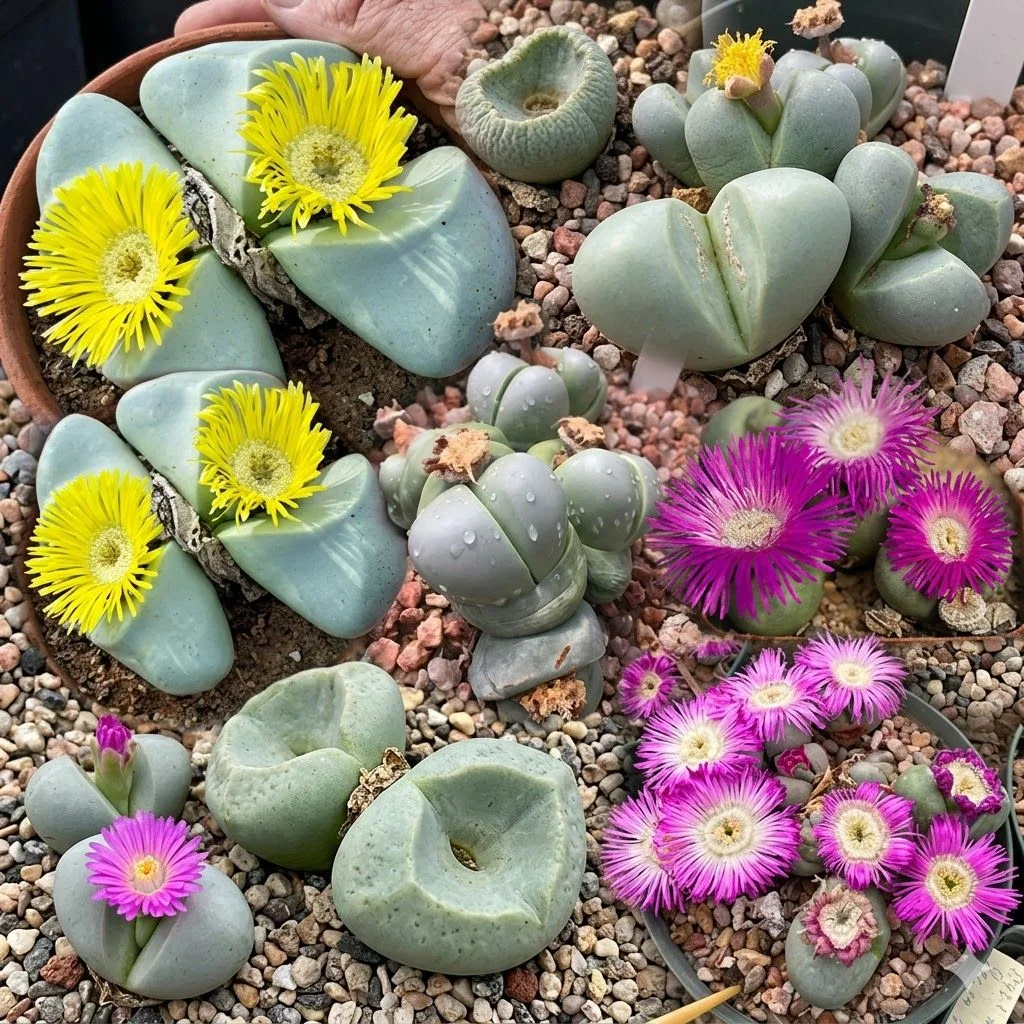
Argyroderma is a genus of highly specialized mesembs in the Aizoaceae family, characterised by plant bodies consisting of one or two pairs of very succulent, semicircular-in-section leaves in silver-grey to grey-green tones that precisely mimic the semi-translucent quartz pebbles among which they grow. The generic name derives from the Greek argyros (silver) and derma (skin), referencing the striking metallic colouration of the leaves. The flowers emerging from the central fissure are violet-pink, magenta, or white depending on the species, and represent some of the most intense floral colours in the family. The genus is strictly restricted to the quartz fields of the Western Cape Province, an ecosystem of exceptional endemic richness.
Aridaria
Aridaria
Genus of succulent mesembs in the family Aizoaceae, endemic to the arid regions of the Cape of South Africa. Characterized by long-tubed flowers, opposite fleshy leaves, and adaptations to the quartz fields of Namaqualand. Segregated from related genera.
Aristaloe
Aristaloe
Monotypic genus in the family Asphodelaceae, segregated from Aloe. Contains only Aristaloe aristata, the lace aloe, one of the world's most popular ornamental succulents thanks to its finely toothed leaves with white tubercles and tubular orange flowers. Native to South Africa and Lesotho, it is more cold-hardy than most aloes, tolerating down to −7 °C. The segregation from Aloe was proposed by Boatwright and Manning based on molecular phylogenetic analyses.
Asterosedum
Asterosedum
Genus of small succulents in the family Crassulaceae, segregated from Sedum. Includes mat-forming plants from mountainous areas of Europe and Asia, with star-shaped pink flowers and opposite or alternate fleshy leaves. The best-known species is Asterosedum spurium, widely grown as a groundcover.
Astridia
Astridia
Genus of succulent shrubs in the family Aizoaceae, native to Namibia and northern South Africa. Form small shrubs with triquetrous succulent leaves and pink or white multi-petalled flowers. Grow in arid rocky and sandy habitats with coastal fog.
Astroloba
Astroloba
Genus of small succulents in the family Asphodelaceae, endemic to the south-western Cape of South Africa. Form compact rosettes with rigid triangular leaves arranged in 5 spiral rows. Morphologically similar to Haworthiopsis, with tubular white or cream flowers. Very popular among collectors for their elegant spiral symmetry.
Baynesia
Baynesia
Monotypic genus of stapeliad succulents in the family Apocynaceae, endemic to Namibia. The single species, Baynesia lophophora, produces leafless cylindrical succulent stems and small flowers with a complex corona. Grows on quartzite rock outcrops under conditions of extreme aridity.
Bergeranthus
Bergeranthus
Genus of succulent mesembs in the family Aizoaceae, endemic to the Eastern Cape of South Africa. Form rosettes of triangular or semicylindrical fleshy leaves, producing many-petalled diurnal yellow flowers. Distinguished from related genera by their characteristic fruits. Named in honour of German botanist Alwin Berger.
Bijlia
Bijlia
Genus of succulent mesembs in the family Aizoaceae, endemic to south-western South Africa. Form small clumps of glaucous triquetrous fleshy leaves and produce bright yellow flowers. Adapted to sandy soils and extreme drought conditions.
Boucerosia
Boucerosia
Historical genus of succulents in the family Apocynaceae, subfamily Asclepiadoideae, now largely considered synonymous with genera such as Caralluma, Orbea and Quaqua. The included species are spineless cactiform plants with fleshy 4–6-ribbed stems and fetid-smelling flowers to attract fly pollinators. Native to Africa, the Arabian Peninsula, the Mediterranean and India.
Brachystelma
Brachystelma
Genus of geophytes and small succulents in the family Apocynaceae, subfamily Asclepiadoideae, with about 100 species native mainly to southern and eastern Africa, with a few in India and Australia. They develop a subterranean tuber or caudex from which thin annual stems emerge bearing structurally complex flowers that are often fetid to attract insect pollinators. They are seasonal plants that disappear completely in the dry season.
Braunsia
Braunsia
Small genus of mesemb succulents in the family Aizoaceae, subfamily Ruschioideae, endemic to the Western Cape of South Africa. They form small creeping shrublets with very fleshy, fusiform, glaucous green leaves and bright pink to magenta flowers. Typical of the Fynbos and Succulent Karoo.
Bryophyllum
Bryophyllum
Genus of succulents in the family Crassulaceae, subfamily Kalanchoideae, now largely included within the genus Kalanchoe. The species are native mainly to Madagascar and southern Africa, although several are invasive plants in tropical and subtropical regions worldwide. Their most notable feature is the production of adventitious plantlets (propagules) on leaf margins, giving them common names such as "good luck plant", "mother of thousands" or "miracle leaf". Several are potentially invasive and toxic to livestock.
Bulbine
Bulbine
Genus of succulent and semi-succulent plants in the family Asphodelaceae, subfamily Asphodeloideae, with about 70 species native mainly to South Africa, Namibia and Australia. They form rosettes or clumps of fleshy lanceolate or cylindrical leaves and produce spikes of small six-petalled yellow or orange flowers with hairy stamens. B. frutescens is the most widely cultivated species, popularly known as "bulbine" and used in xeriscaping and as a medicinal plant.
Bulliarda
Bulliarda
Small historical genus of the family Crassulaceae, now considered synonymous with Crassula. It included small aquatic and semi-aquatic herbs of temperate and subtropical regions. The name was proposed by Augustin Pyramus de Candolle in honour of botanist Pierre Bulliard. Species are distributed in Europe, southern Africa and temperate regions of the southern hemisphere.
Byrnesia
Byrnesia
Small genus of succulents in the family Crassulaceae, native to Mexico. The species form rosettes of fleshy leaves and have been reclassified several times among genera such as Dudleya, Echeveria and Graptopetalum. The genus was established by Nathan Lord Britton and Joseph Nelson Rose.
Cacalia
Cacalia
Cacalia is a historical genus of the family Asteraceae, now largely obsolete in modern taxonomy. Species formerly classified under Cacalia have been redistributed mainly to the genera Kleinia, Curio, Caputia, and Senecio following molecular and morphological revisions. Historically it included succulent plants with articulated stems, glaucous or woolly foliage, and yellow to orange capitulate flowers. Species are native to Africa, the Canary Islands, and North Africa.
Calandrinia
Calandrinia
Genus of perennial and annual succulents of the Montiaceae family, distributed mainly in North and South America and Australia. Characterized by fleshy leaves and magenta, red, or deep pink petals, opening only during sunny hours.
Cameraria
Cameraria
A genus of shrubs and small trees in the family Apocynaceae, native to the Caribbean and Central America. Characterized by toxic milky latex. The best-known species is Cameraria latifolia, the poison dogwood or beach manchineel of the Caribbean.
Caputia
Caputia
A genus of succulents in the family Asteraceae, recently segregated from Senecio. Caputia species are succulent shrubs from southern Africa with silver, bluish or grey-green leaves covered in waxy trichomes. Formerly known as "silver Senecio", they are highly prized in Mediterranean and xerophytic gardening.
Caralluma
Caralluma
Genus of succulent plants in the family Apocynaceae (subfamily Asclepiadoideae). Distinguished by their angled, fleshy, branching stems and 5-lobed star-shaped flowers that typically emit a carrion odor to attract fly pollinators. Historically included over 100 species, many of which have since been reclassified into segregate genera such as Boucerosia, Desmidorchis and Tromotriche.
Carpobrotus
Carpobrotus
Genus of creeping succulents in the family Aizoaceae, native mainly to South Africa. Known as "Hottentot fig" or "ice plant", their very fleshy triangular leaves and large showy flowers make them instantly recognisable. Several species are highly invasive on Mediterranean, Californian and Australian coastlines.
Carruanthus
Carruanthus
Caruncularia
Caruncularia
Catevala
Catevala
Historical genus created by Otto Kuntze (1891) as a replacement name for Haworthia Duval. All taxa are heterotypic synonyms of Haworthia species. Plants are rosulate succulents belonging to subfamily Asphodeloideae, native to South Africa and endemic mainly to the Cape region.
Conophytum
Conophytum
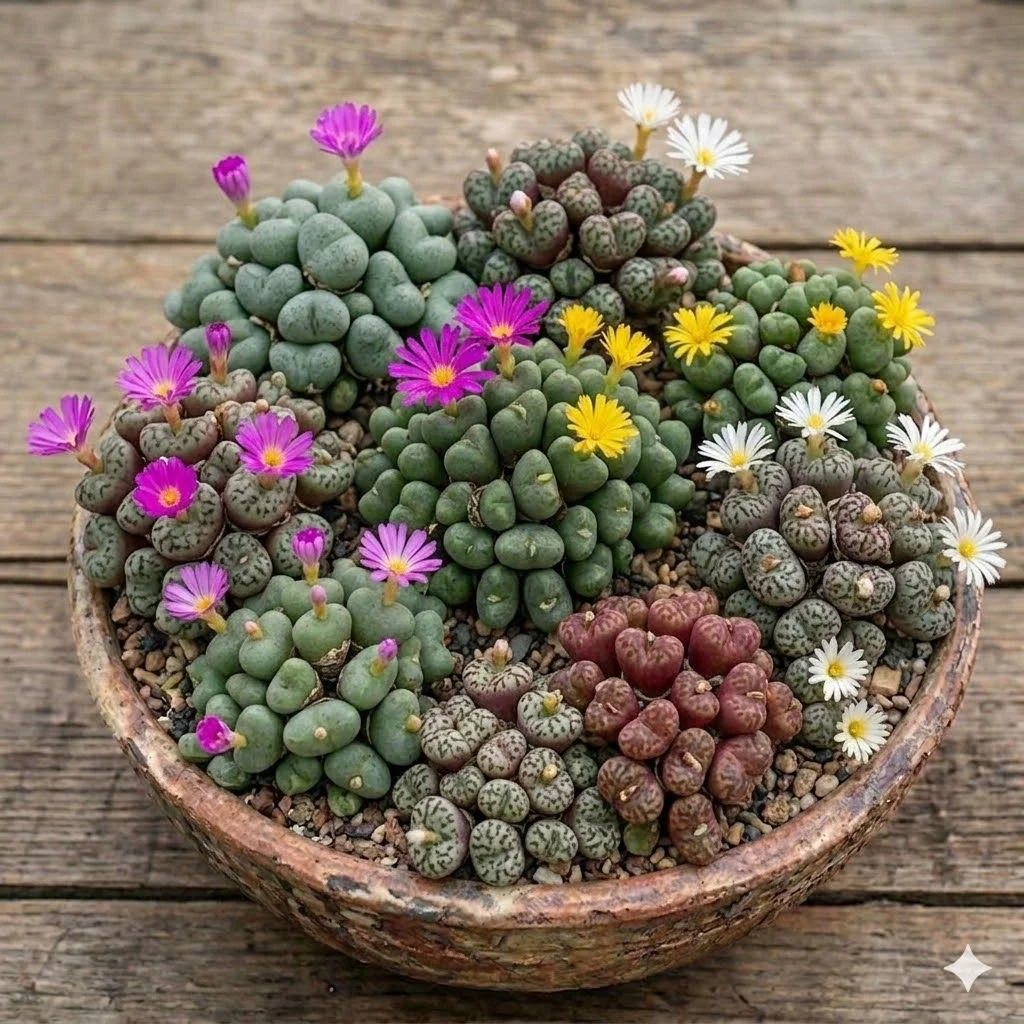
Genus of dwarf succulent plants native to southern Africa, with over 100 accepted species. Related to Lithops, it forms tiny bodies (1–5 cm) composed of pairs of fused leaves in spherical, conical, or bilobed shapes. Unlike Lithops, many species form dense clusters. They are winter-growing plants that enter summer dormancy, when the dried cover from the previous season protects new leaves.
Cotyledon
Cotyledon
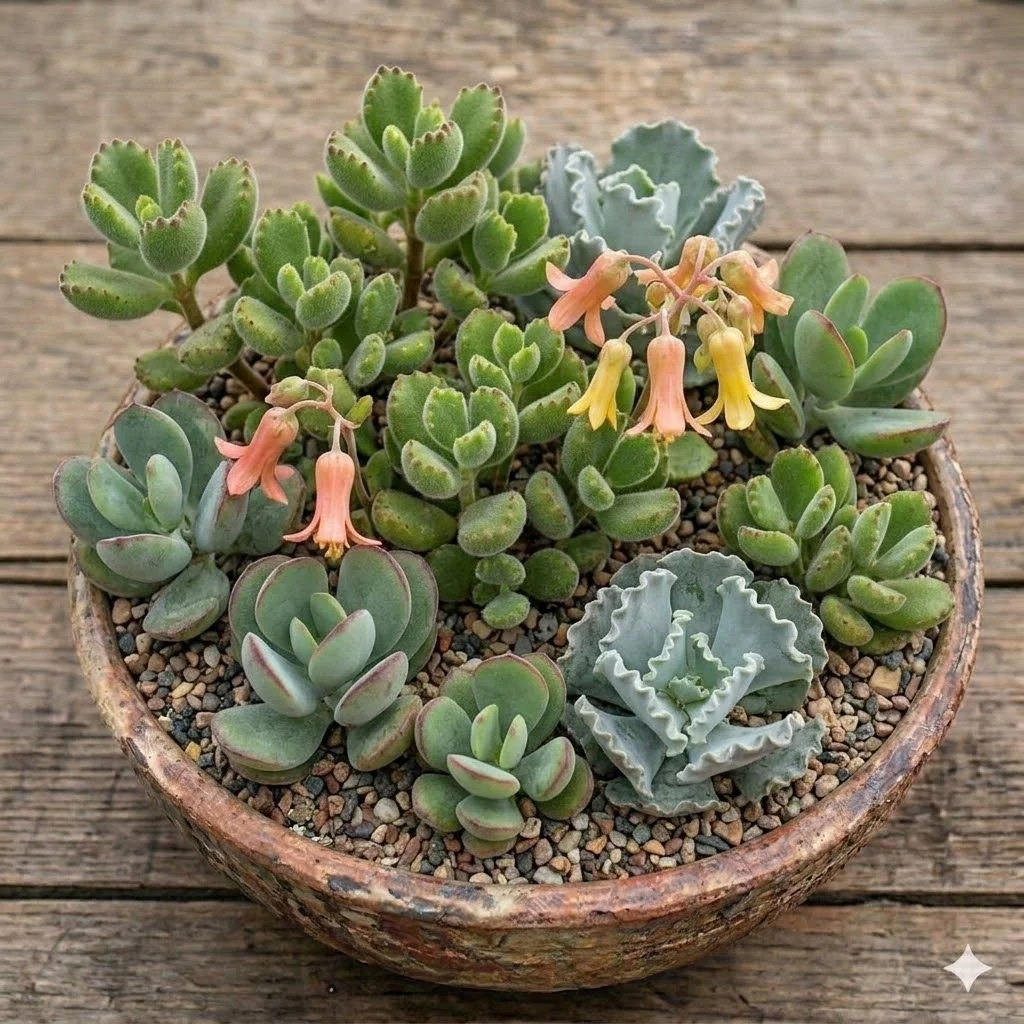
Cotyledon is a genus of succulent shrubs and subshrubs native to southern Africa and parts of the Arabian Peninsula, characterised by thick leaves arranged spirally or in opposite pairs, frequently pruinose, felted, or papillose. Their tubular, pendant flowers in vivid orange, red, and yellow emerge on tall floral stems in spring and summer. The genus occupies arid and subtropical habitats from the Karoo to East African coastal slopes, growing primarily on rocky outcrops and quartzite soils with excellent drainage. Several species are widely popular in horticulture for their ornamental forms and drought tolerance.
Crassula
Crassula
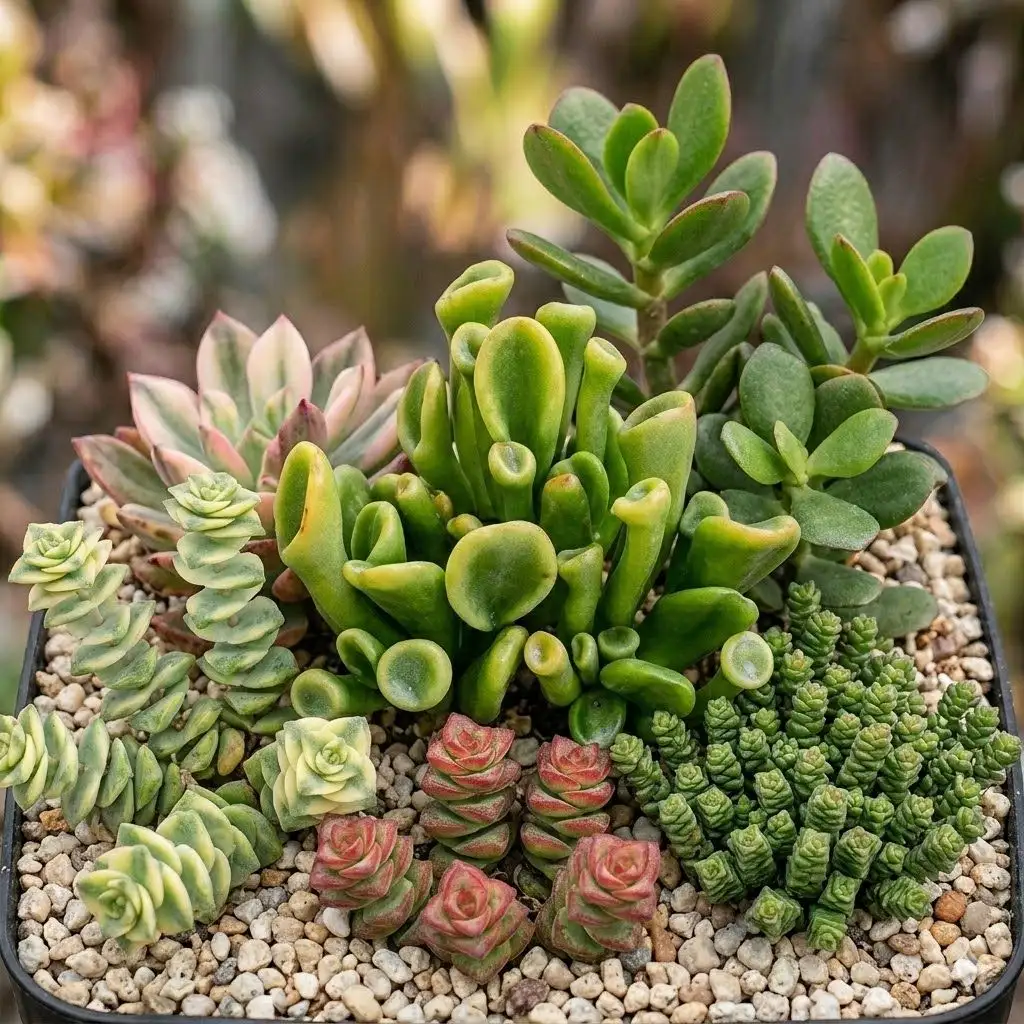
Crassula is the second-largest genus in the family Crassulaceae, encompassing annual, biennial, and perennial succulents ranging from tiny creeping herbs to multi-branched shrubs, all united by fleshy leaves in opposite pairs and often connate at the base. Flowers are small — typically white, pink, or red — gathered in cymes or panicles and usually consisting of five petals. The genus name derives from the Latin crassus (thick), referring to the water-storing leaf tissue that allows these plants to endure prolonged drought. Most species inhabit succulent scrublands, fynbos, rocky outcrops, and semi-arid landscapes of the Cape region, where free-draining, nutrient-poor soils predominate.
Dudleya
Dudleya
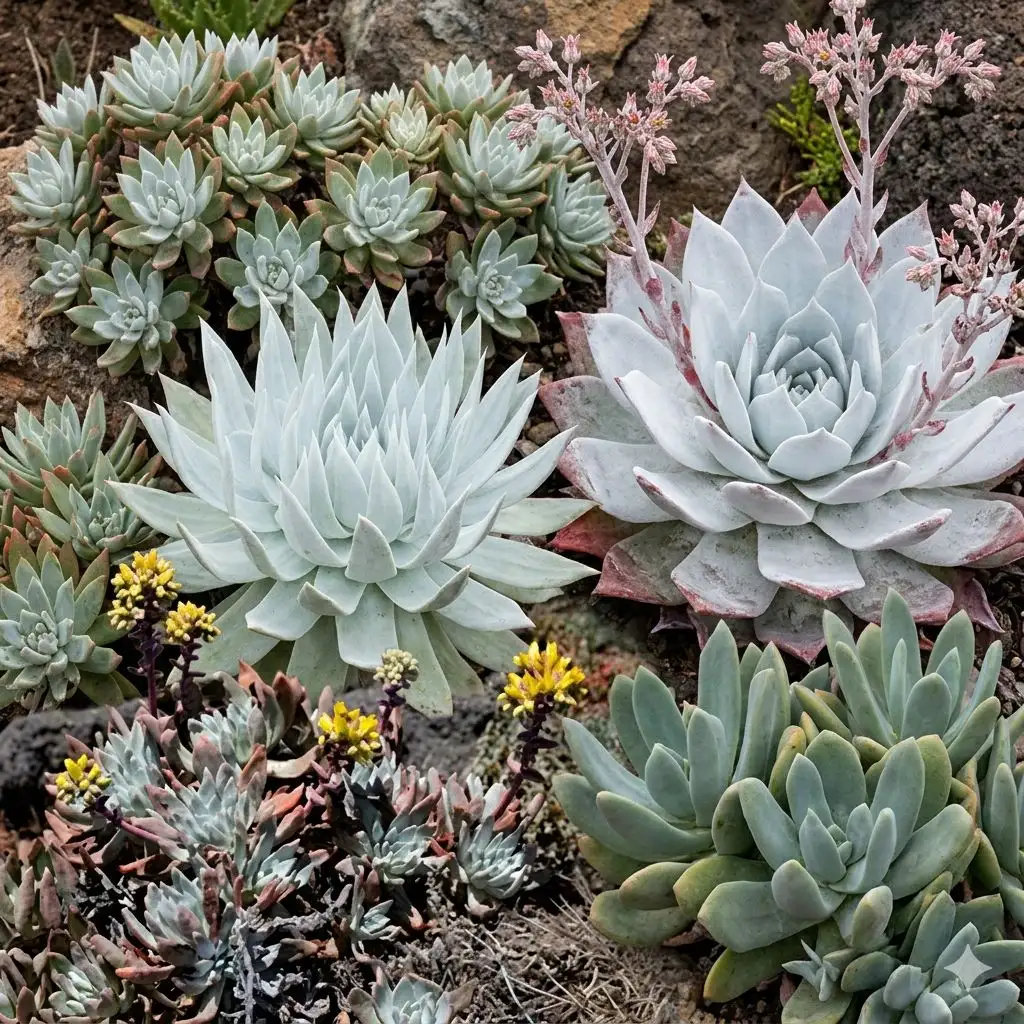
Dudleya is a genus of perennial rosette-forming succulents native to the Pacific coastline from southwestern Oregon to Baja California, Mexico, with the greatest diversity concentrated in California. Their rosettes bear lanceolate or spatulate leaves ranging from matte green to silver-grey or chalky white with a heavy pruinose coating, producing star-shaped flowers in yellow, pink, or red on branching floral stems. Species typically inhabit coastal cliffs, rocky outcrops, and stony chaparral slopes, tolerating salt-laden winds, prolonged drought, and extremely poor soils. Their ornamental appeal and high valuation in the Asian succulent market have made them the primary target of illegal poaching, prompting the passage of California law AB-223 (2021) to protect wild populations.
Echeveria
Echeveria
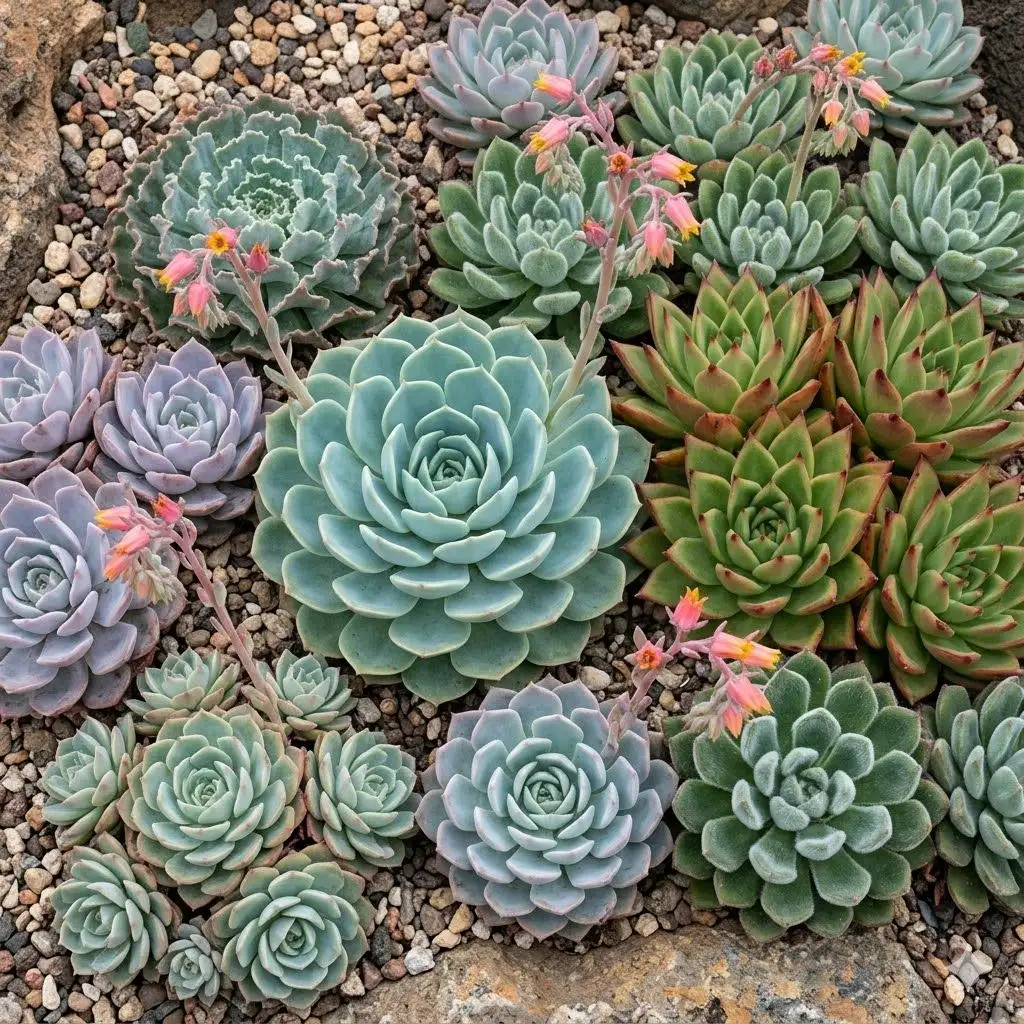
Genus of succulents native to Mexico and Central America, with approximately 150 accepted species. They form compact, symmetrical rosettes with thick, waxy leaves in shades of green, blue, pink, and purple. Their lateral inflorescences bear bell-shaped, brightly colored flowers. They are slow-growing plants that thrive in well-drained soils and bright indirect light.
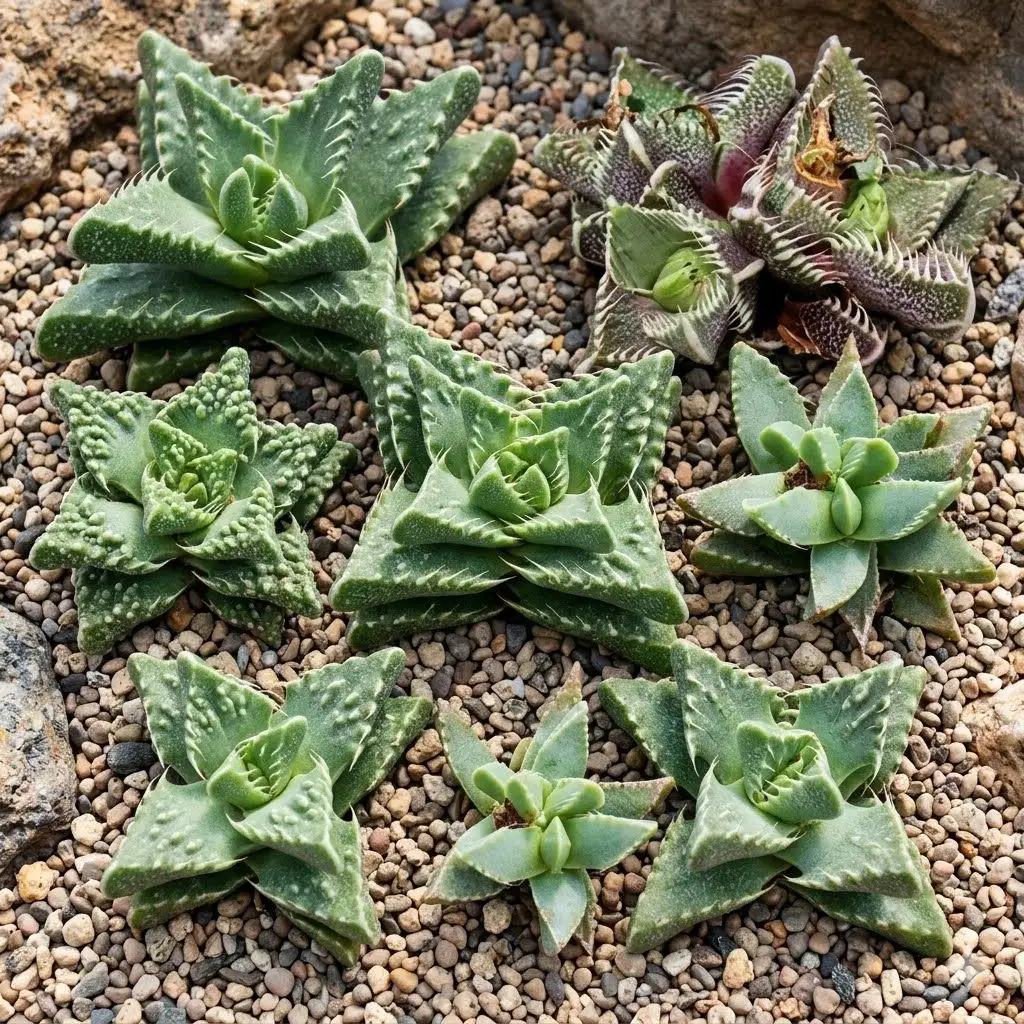
Faucaria
Faucaria
Faucaria is a genus of small mat-forming or clump-forming succulents in the Aizoaceae family, immediately recognisable by their triangular, fleshy leaves in basal rosettes with toothed or soft-ciliate margins resembling open jaws — the source of the generic name from the Latin fauces (throat, jaws). The flowers are a deep golden yellow, relatively large for the plant's size, and bloom primarily in autumn. A recent taxonomic revision reduced the accepted species count through synonymisation of several previously recognised taxa. All species are endemic to the subtropical shrublands of South Africa's Cape Province.
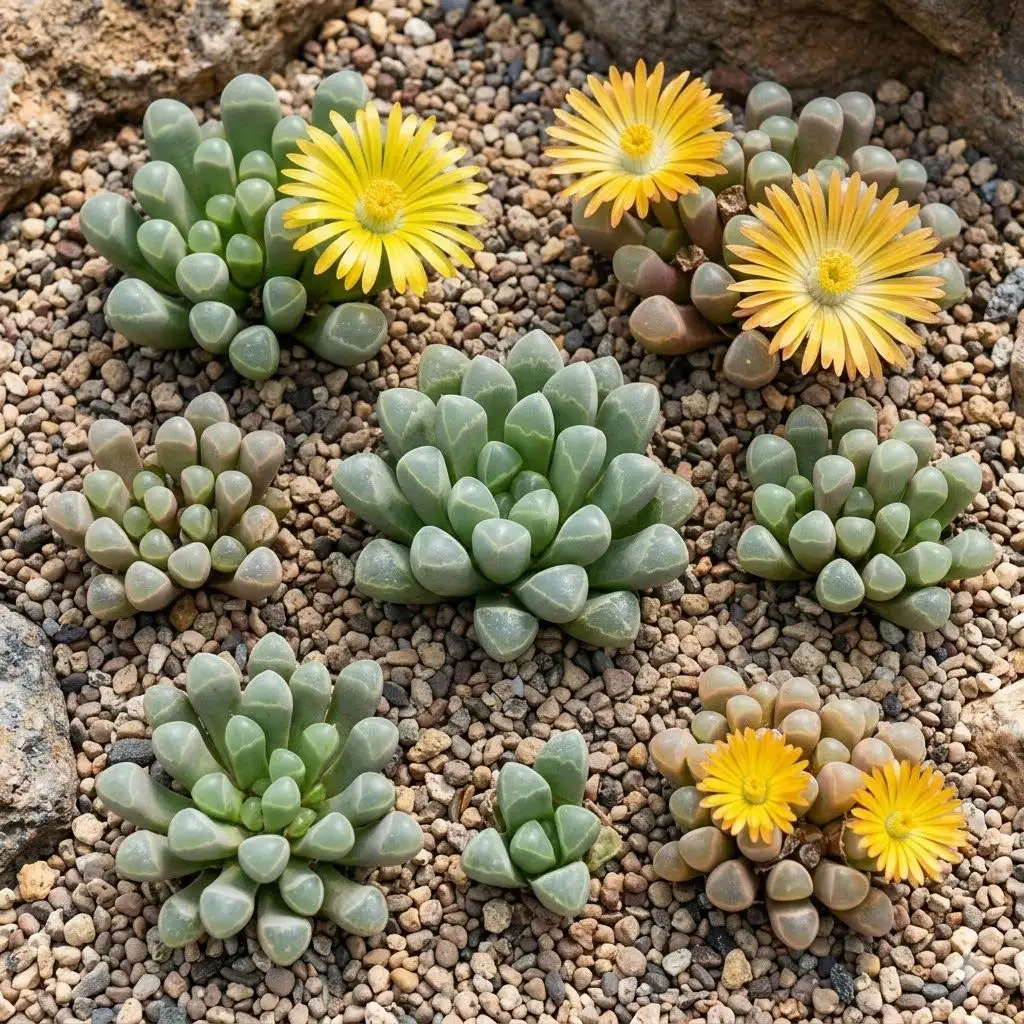
Fenestraria
Fenestraria
Monotypic genus or with two forms (F. rhopalophylla) native to Namibia and South Africa. Cylindrical leaves grow partially buried with only the translucent tip ("window") exposed, allowing photosynthesis while protecting tissues from excess solar radiation. Flowers are large, white or yellow, daisy-like.
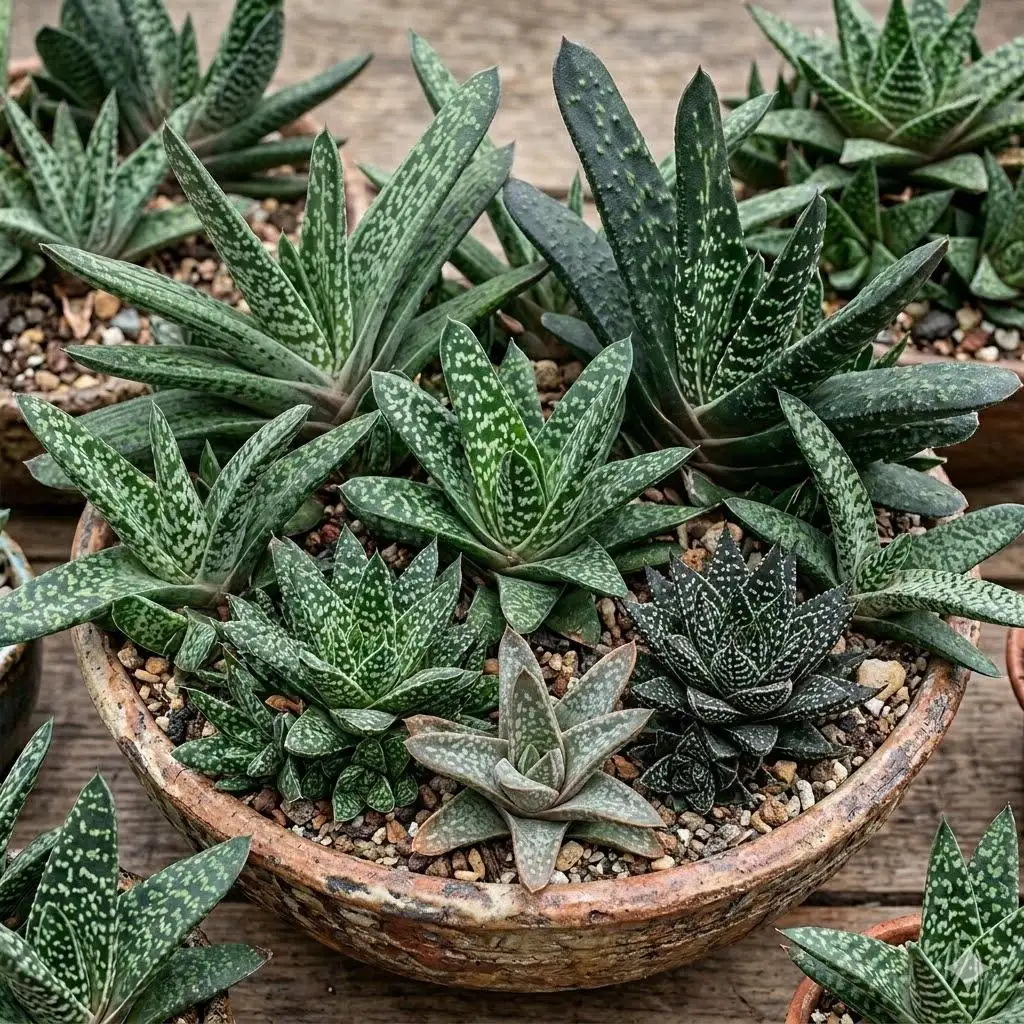
Gasteria
Gasteria
Genus of succulents endemic to South Africa, with about 23 accepted species. They are characterized by thick leaves, distichous (arranged in two rows) or rosulate, frequently with rough texture and white spots. The tubular, curved flowers with an inflated base resemble a stomach, giving the genus its name (from Latin "gaster"). They tolerate partial shade better than most succulents.
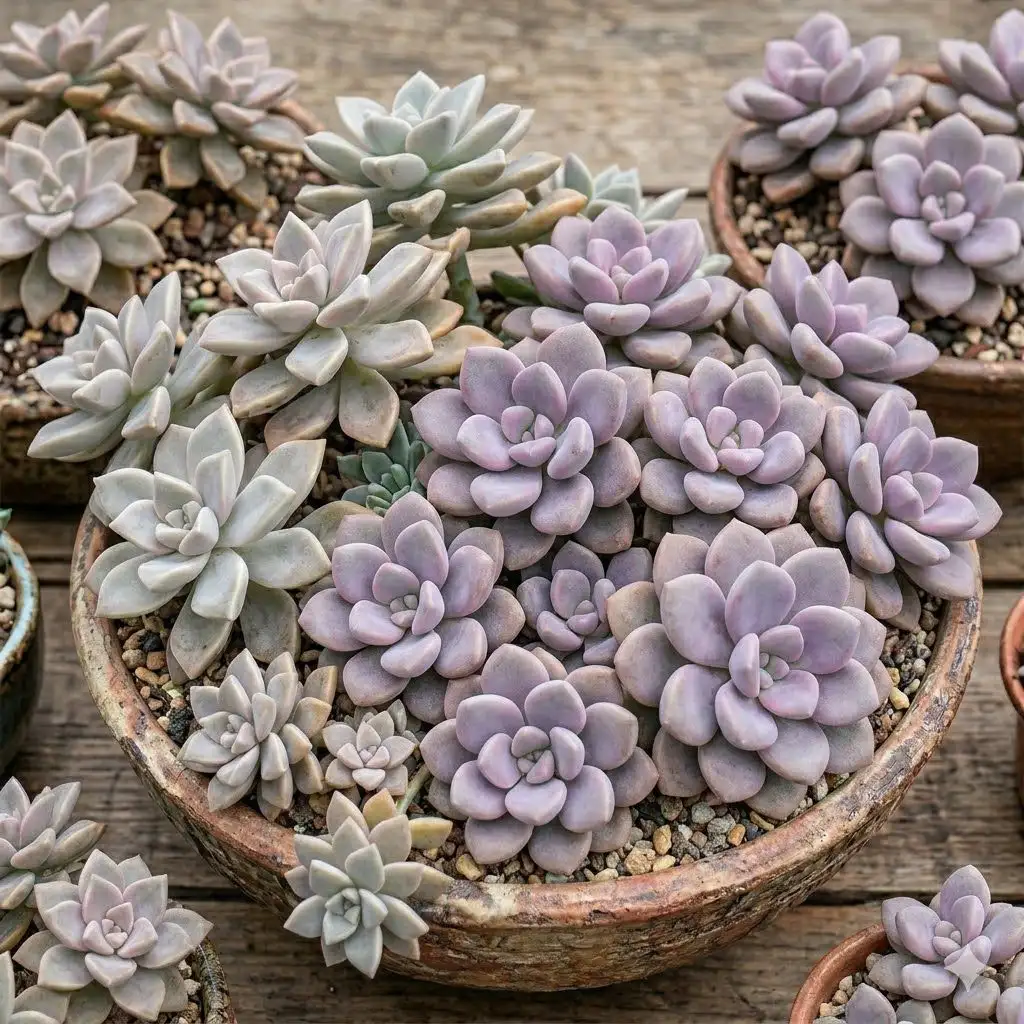
Graptopetalum
Graptopetalum
Genus of succulents native to Mexico and Arizona (USA), with approximately 19 accepted species. They form rosettes with thick leaves in grey, pink, and lavender tones. They are phylogenetically close to Echeveria and frequently produce intergeneric hybrids (× Graptoveria). Flowers are star-shaped with red or purple-spotted petals.
Haworthia
Haworthia
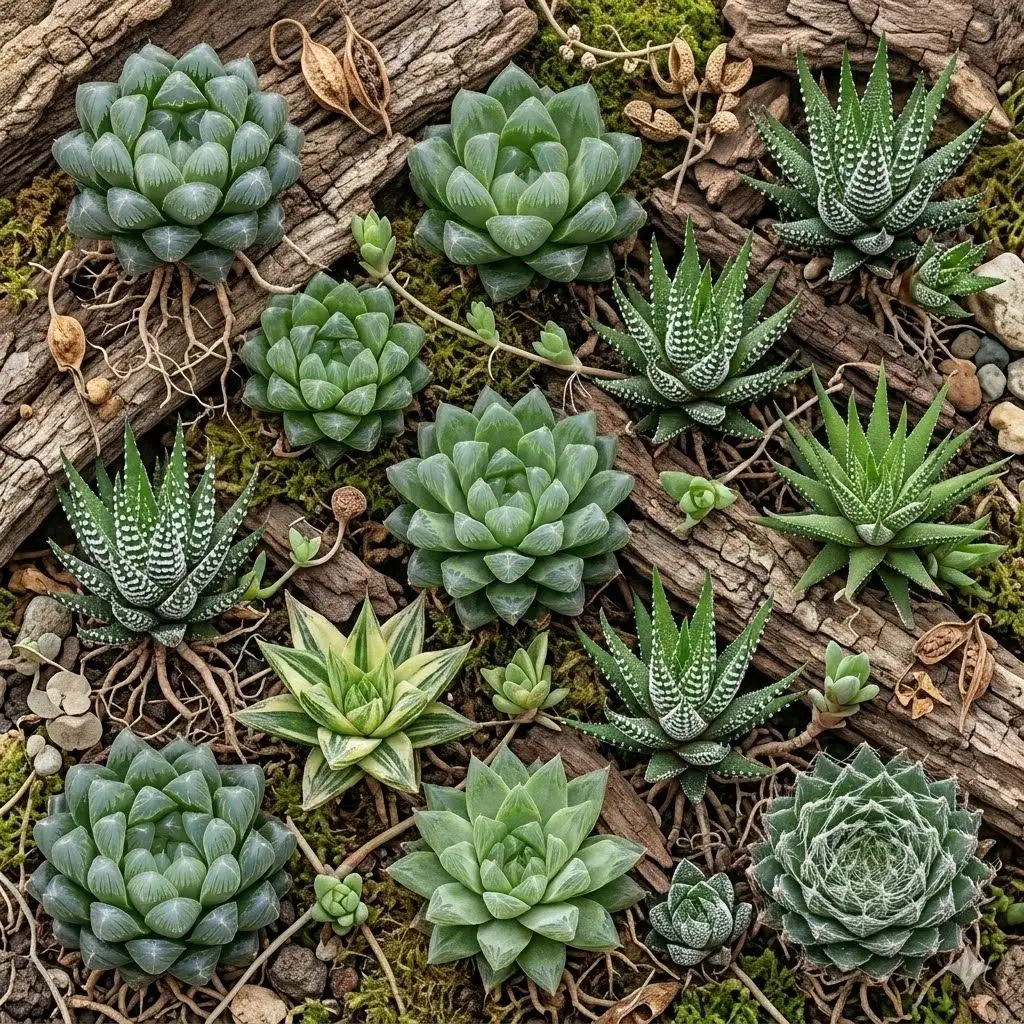
Genus of small succulents native to South Africa, with approximately 150 accepted species (sensu lato). They are characterized by compact rosettes of firm leaves, often with translucent markings called "windows" that allow light to enter the leaf interior. They grow in shaded environments among rocks and under shrubs, adapted to low direct light.
Haworthiopsis
Haworthiopsis
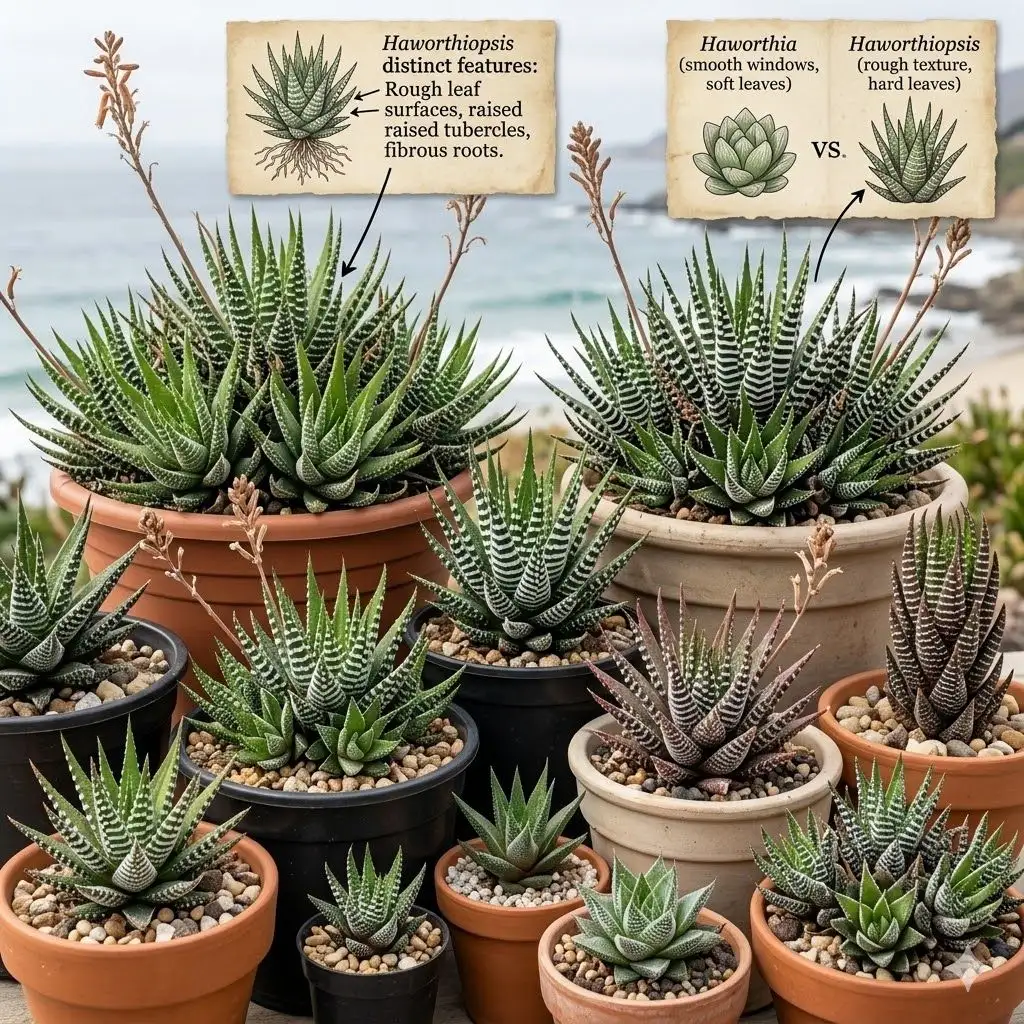
Haworthiopsis is a genus of dwarf succulents from southern Africa, segregated from Haworthia in 2013 on the basis of molecular phylogenetic studies. Its members bear small rosettes of fleshy leaves with a thicker, tougher epidermis than their close relatives, enabling survival through prolonged drought and even fire. The flowers are bilabiate, white or whitish with dark central veins, borne on slender erect inflorescences. The centre of diversity lies in South Africa's Eastern Cape Province, where ten of the genus's nineteen species are endemic.
Kalanchoe
Kalanchoe
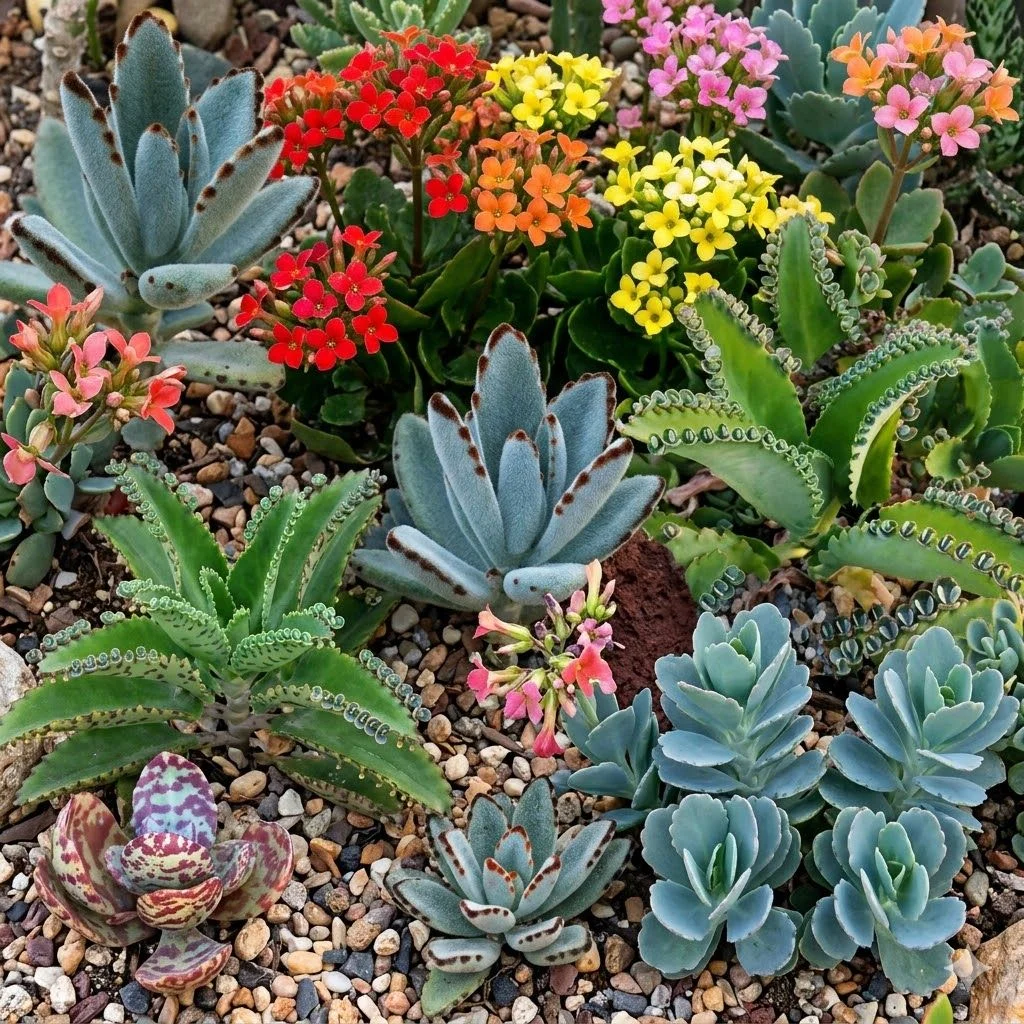
Kalanchoe Adans. is a genus of succulent plants in the family Crassulaceae, comprising approximately 176 accepted species of shrubs, subshrubs, and perennial or biennial herbs. The leaves are fleshy, opposite, and highly variable in shape — ranging from flat and spatulate to cylindrical or strongly crenate — often coated with a waxy bloom or dense pubescence. Flowers are tubular and four-merous, arranged in cymose or thyrsoid terminal inflorescences in colors ranging from white and yellow to deep red and orange. The genus is particularly notable for the ability of many species in the subgenus Bryophyllum to produce vegetative propagules (adventitious plantlets) along leaf margins, a trait unique among flowering plants.
Lithops
Lithops
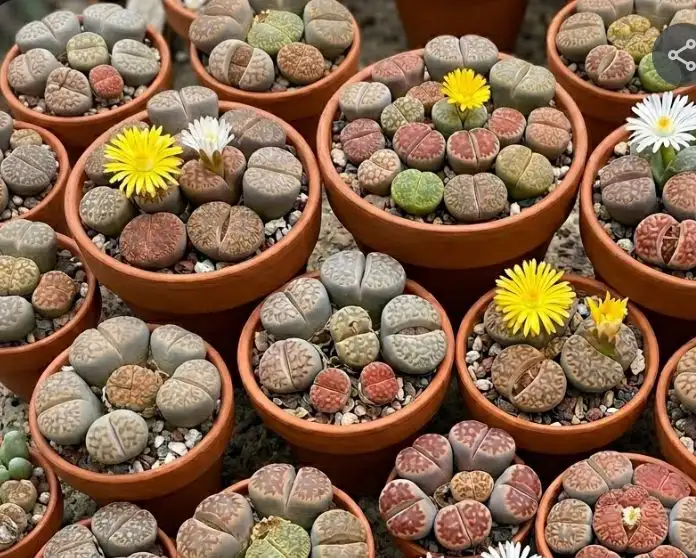
Genus comprising approximately 37 accepted species, all native to southern Africa. They are extremely succulent plants composed of a pair of fused leaves forming a rounded body that mimics surrounding stones. They grow almost entirely below the soil surface, with only the top exposed, which has translucent windows for photosynthesis. They produce a solitary daisy-like flower that emerges from the fissure between the leaves.
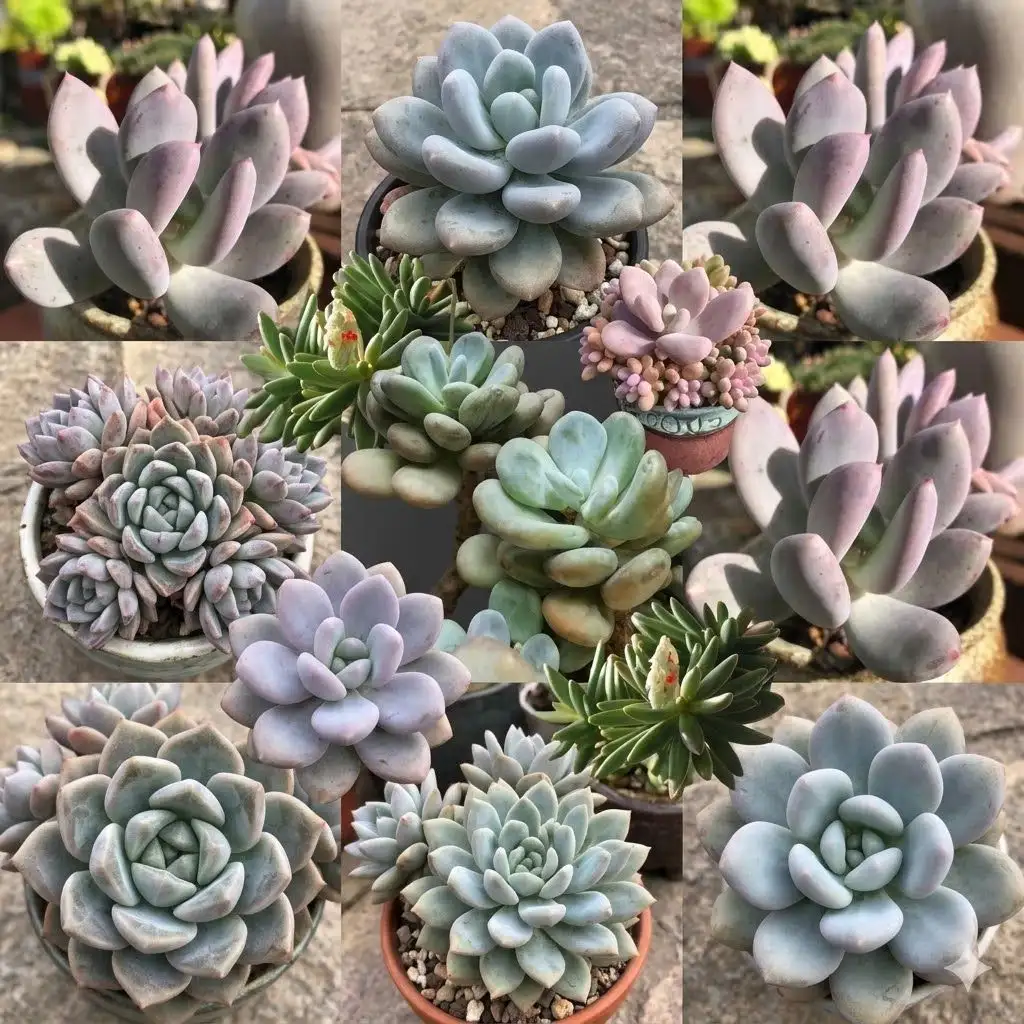
Pachyphytum
Pachyphytum
Pachyphytum is a genus of rosette-forming succulents endemic to Mexico, distinguished by its unusually thick, fleshy leaves that are frequently coated with a waxy pruinose layer giving them soft blue, lavender, or silvery hues. Plants form compact rosettes on short or creeping stems and produce arching inflorescences with bell-shaped red, orange, or white flowers. They inhabit rocky cliffs and xerophytic shrublands typically between 1,000 and 2,800 m elevation, with a notable concentration in San Luis Potosí, Hidalgo, Querétaro, and Tamaulipas. Their striking leaf colouration and compact habit have made many species popular ornamental subjects worldwide.
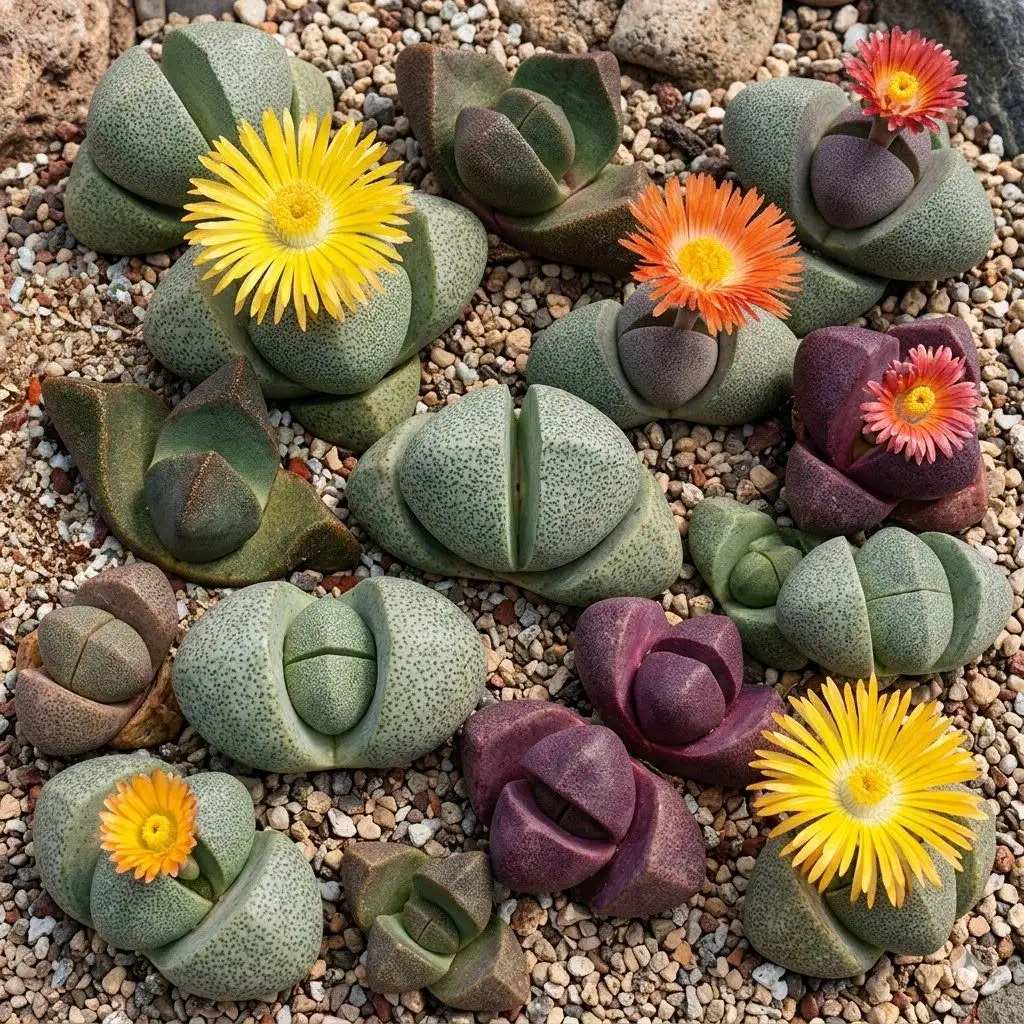
Pleiospilos
Pleiospilos
Pleiospilos is a small genus of perennial succulents in the Aizoaceae family that produces highly succulent leaf-bodies, typically in pairs, with a grey-green or brownish appearance that closely mimics the quartz rocks among which it grows. The genus name derives from the Greek pleios (many) and spilos (spot), referring to the numerous dark dots that mark the leaf surface. They bear conspicuous, daisy-like flowers in yellow-orange or white that open by day from the central fissure between the leaves. They represent a paradigmatic example of lithomorphic mimicry in the arid and semi-arid shrublands of southern Africa.
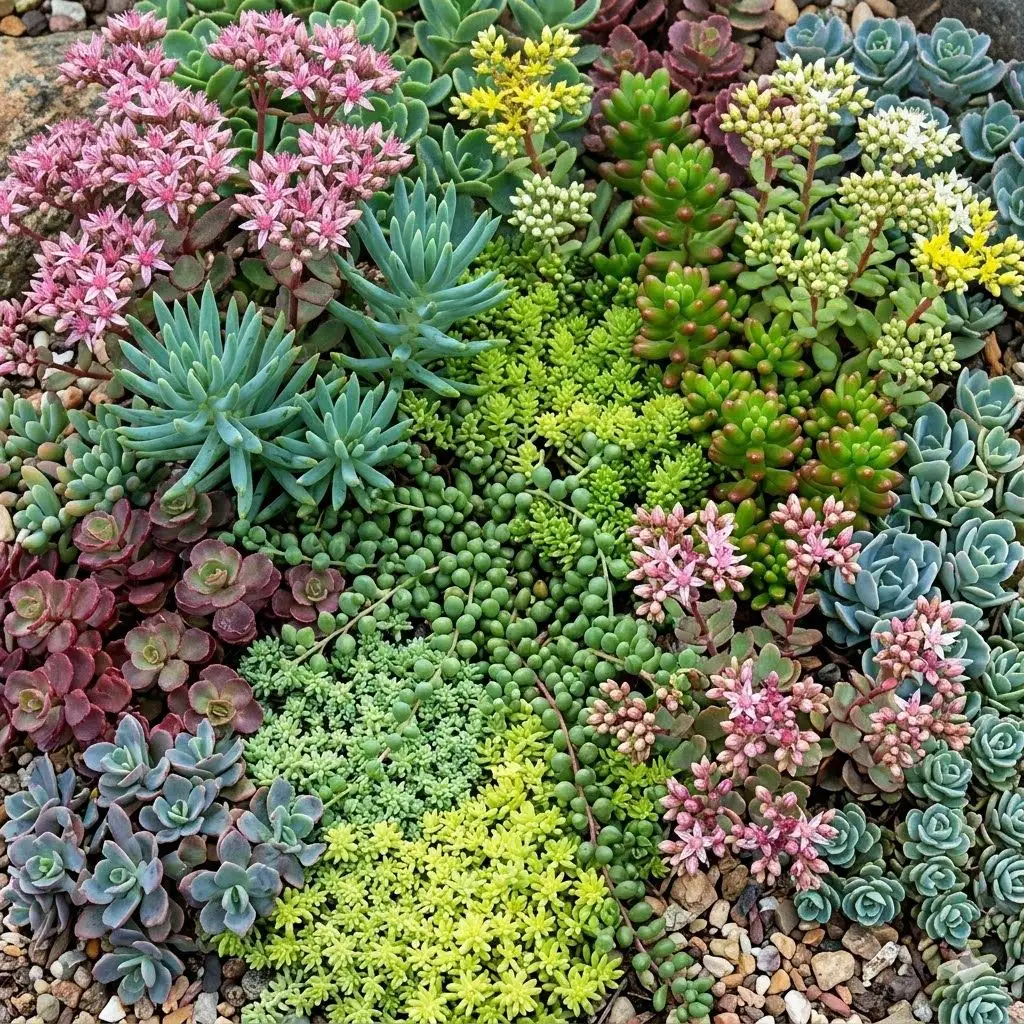
Sedum
Sedum
Large and diverse genus with over 400 accepted species, distributed across temperate and montane regions of the Northern Hemisphere. Includes annual, perennial, and subshrubby plants with alternate succulent leaves. Flowers typically have five petals and are grouped in terminal cymes. Many species are used as ground covers, on green roofs, and in rock gardens.
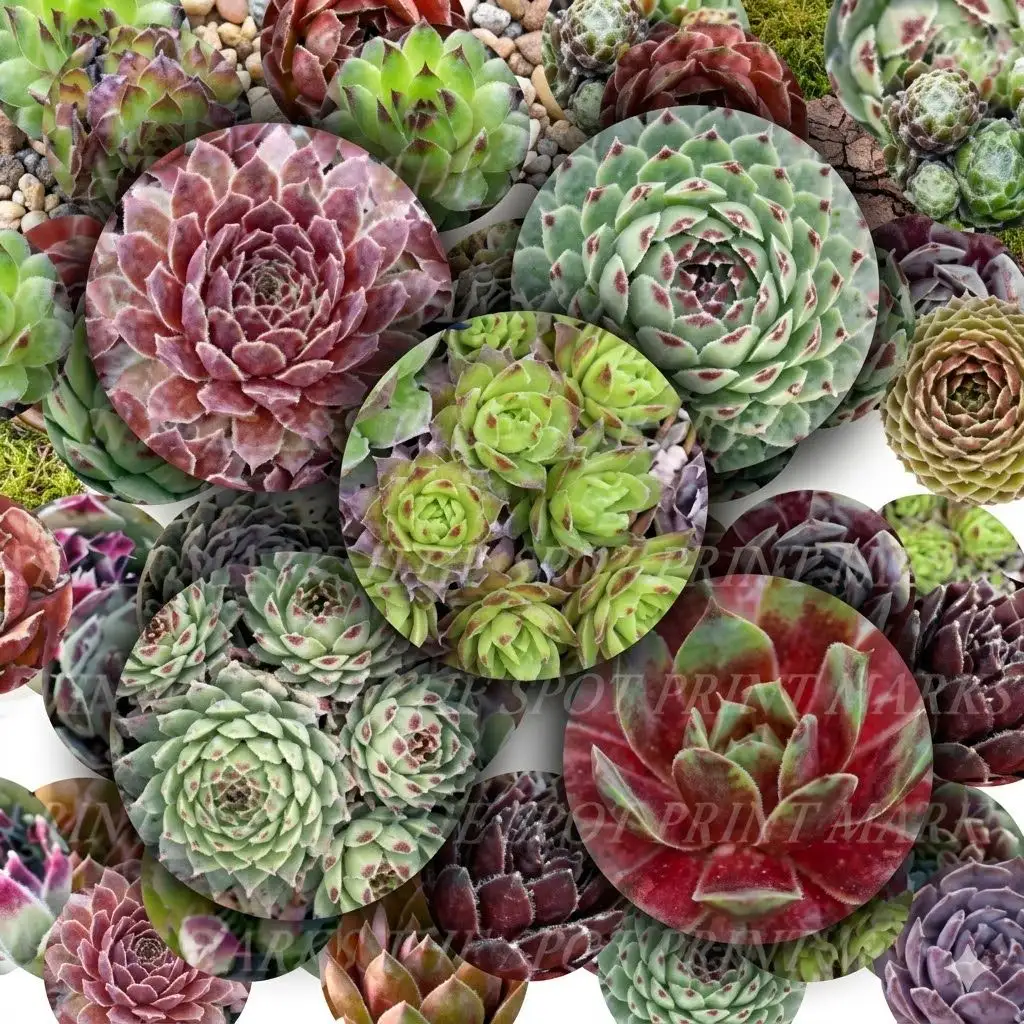
Sempervivum
Sempervivum
Genus of perennial succulents native to the mountains of Europe, the Caucasus, and Asia Minor, with about 40 accepted species. Commonly known as "houseleeks," they form dense rosettes that propagate vigorously through stolons. They are extremely cold-hardy and widely used in rock gardens and green roofs.
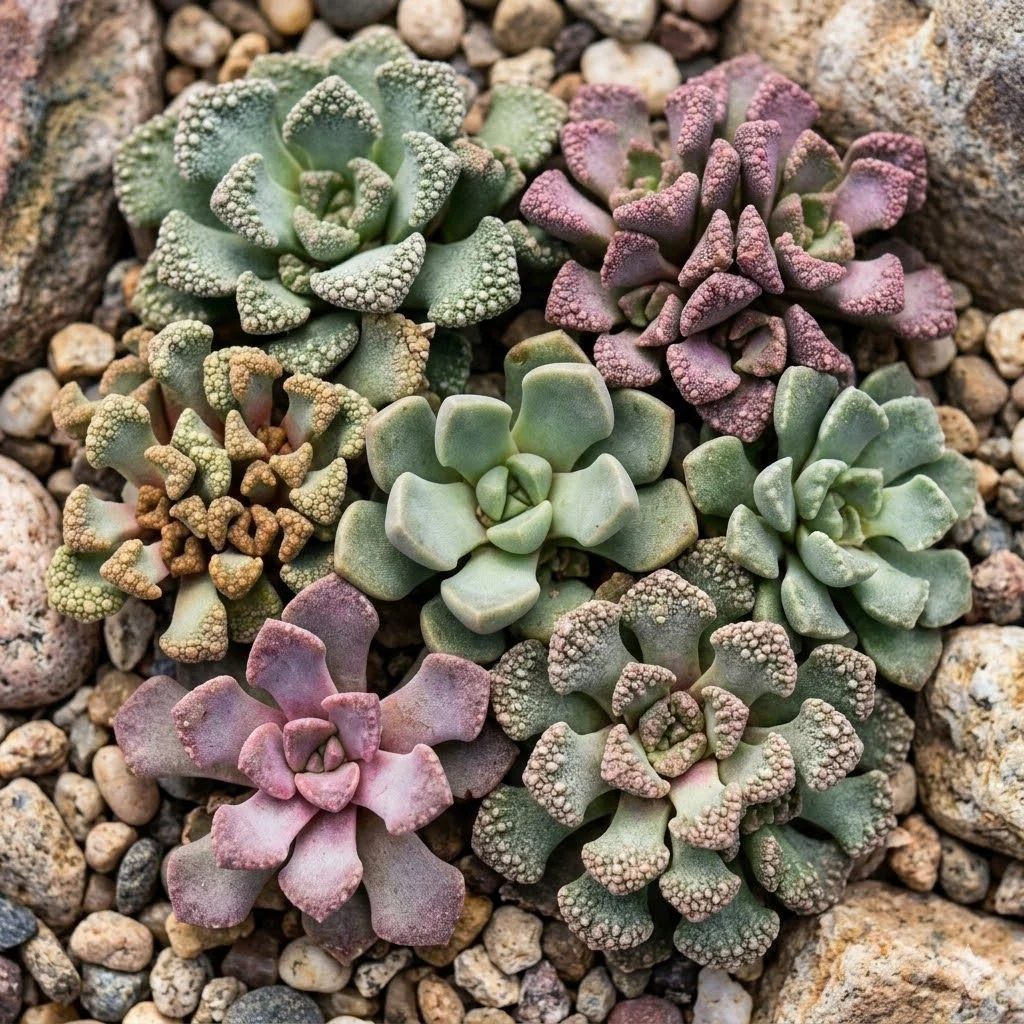
Titanopsis
Titanopsis
Titanopsis is a small genus of highly specialized mesembs in the Aizoaceae family, distinguished by their rosettes of truncated leaves densely covered with whitish, ochre, or bluish tubercles that astonishingly mimic the texture of the limestone or calcrete substrates on which they grow. The generic name derives from the Greek titanos (lime) and opsis (appearance), a direct reference to this lithic camouflage with calcareous substrates. Their vivid yellow flowers emerge in autumn and winter, often the only visible sign of the plant in its habitat. All species follow a winter-growth cycle and enter dormancy during the dry summer.
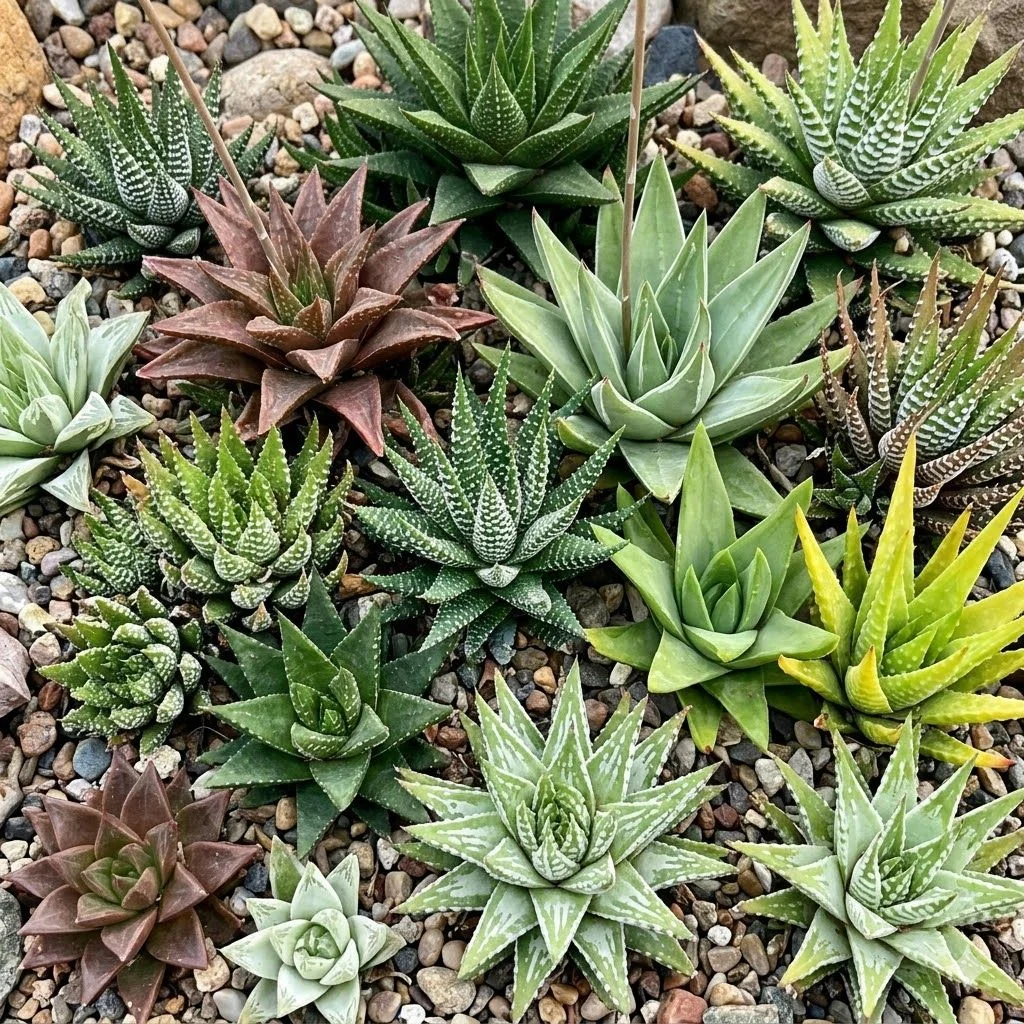
Tulista
Tulista
Tulista is a small genus of stemless succulents endemic to South Africa's Western Cape Province, segregated from Haworthia in the early nineteenth century and revalidated through molecular phylogenetic research. Its members form stemless rosettes of robust, fleshy leaves that are generally larger than those of other haworthioids, lack leaf fibres, and produce a yellowish leaf exudate. Flowers are bilabiate, white with pink or brownish-green central veins, borne on well-branched inflorescences. All species are slow-growing and long-lived, widely prized by collectors worldwide.