
Catevala tessellata (Haw.) Kuntze
Tessellated haworthia
One of the most recognisable haworthias, with dark green leaves covered by a network of pale lines forming a highly ornamental mosaic pattern. Currently classified as Haworthiopsis tessellata, it is native to the arid regions of southern Africa.
chevron_right edit_note Proposed edits auto-approved at +3 net votes
No pending proposals for this section.
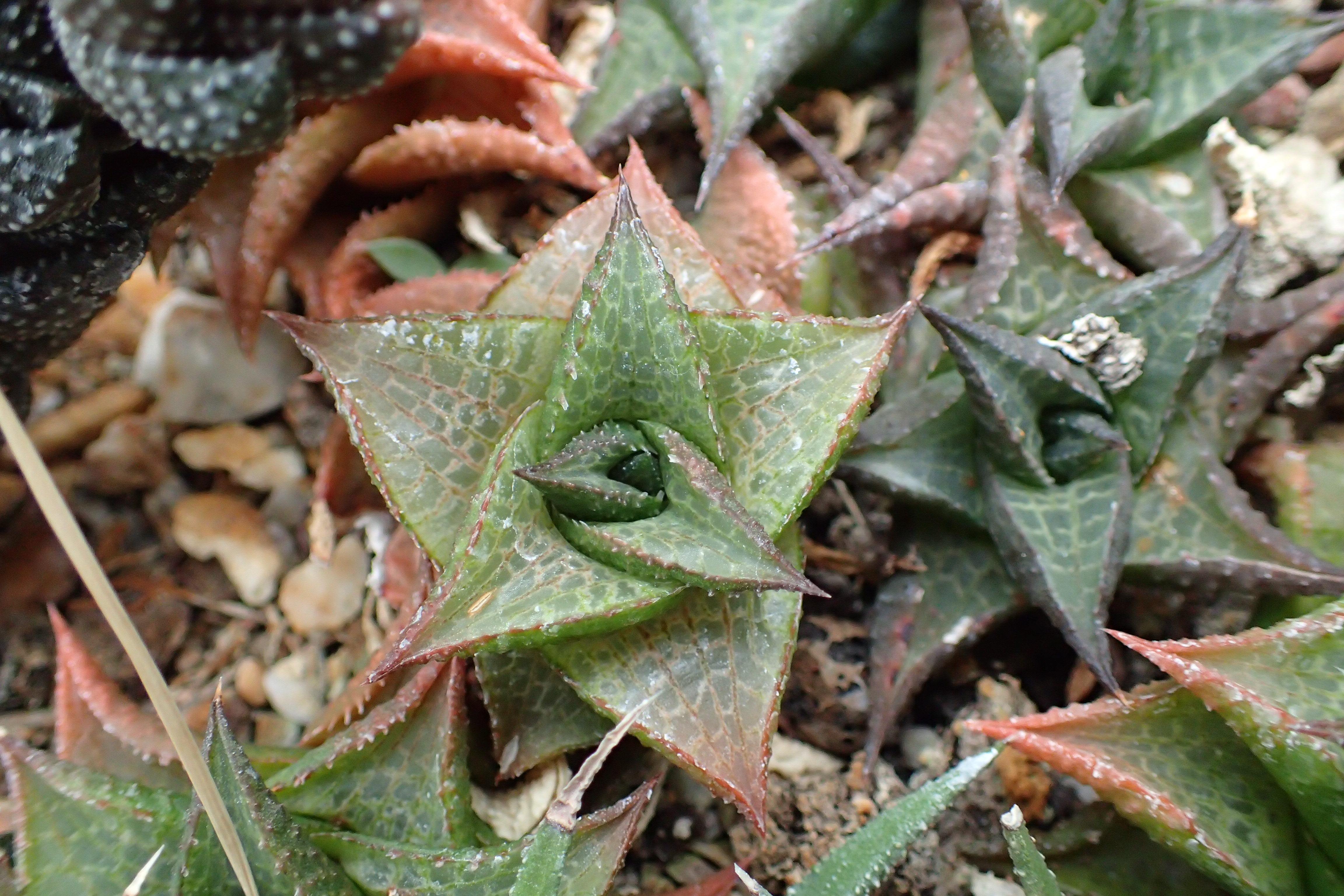
© Krzysztof Ziarnek (Kenraiz) / Hectonichus / stephen boisvert, Wikimedia Commons
CC BY-SA 4.0 / CC BY-SA 3.0 / CC BY 2.0
Overview
| Category | Classification |
|---|---|
| Family | Asphodelaceae |
| Genus | Catevala |
| Growth Habit | Compact stemless rosette, forms colonies via offsets. |
| Conservation Status | Least Concern |
| pH Target | 6.0–7.5 |
| Type | Sandy-gravelly, very well drained |
Origin & Habitat
Morphology
Triangular and fleshy, dark green, with a pale venation network creating a mosaic effect. Margins with small teeth.
ecoSimple raceme on long scape; tubular white to cream flowers with greenish lines.
ecoFleshy semi-tuberous roots that store water.
ecochevron_right edit_note Proposed edits auto-approved at +3 net votes
No pending proposals for this section.
Requirements
Soil & Substrate
Type
Sandy-gravelly, very well drained
chevron_right edit_note Proposed edits auto-approved at +3 net votes
No pending proposals for this section.
Propagation Strategy
- 1 Remove colony from pot
- 2 Separate offsets with intact roots
- 3 Let callus 1–2 days
- 4 Plant in dry substrate
- 5 Water after 7–10 days
Water only when substrate is completely dry
Rot from frequent watering
Every 2–3 years
Once a month in spring with 50% strength cactus fertilizer
Uses & Applications
Precautions / Toxicity
Not toxic to humans or domestic animals.
chevron_right edit_note Proposed edits auto-approved at +3 net votes
No pending proposals for this section.
Plant Health
Root rot from overwatering
Mealybug: treat with isopropyl alcohol
chevron_right edit_note Proposed edits auto-approved at +3 net votes
No pending proposals for this section.
"Synonym of Haworthia tessellata Haw., currently recognised as Haworthiopsis tessellata (Haw.) G.D.Rowley. The epithet 'tessellata' alludes to the mosaic pattern of the leaves, resembling a Roman mosaic (tessella)."
chevron_right edit_note Proposed edits auto-approved at +3 net votes
No pending proposals for this section.
Scientific Integrity
🟢 HighVote to help validate this record
Sources
Loading…
Discussion
Disclaimer
This species record is provided for educational and informational purposes only. Jardín Roca Negra does not guarantee the accuracy or completeness of the data. Content is community-curated and may be subject to revision; it should not replace advice from a qualified botanist. This species may be toxic, invasive, or subject to legal restrictions — verify before handling or cultivating. Jardín Roca Negra accepts no liability for any harm arising from reliance on this information. Images are reproduced under Creative Commons or equivalent free licenses; credits are noted below each image.