Argyroderma fissum (Haw.) L.Bolus
Cleft Silverstone / Split Silverstone
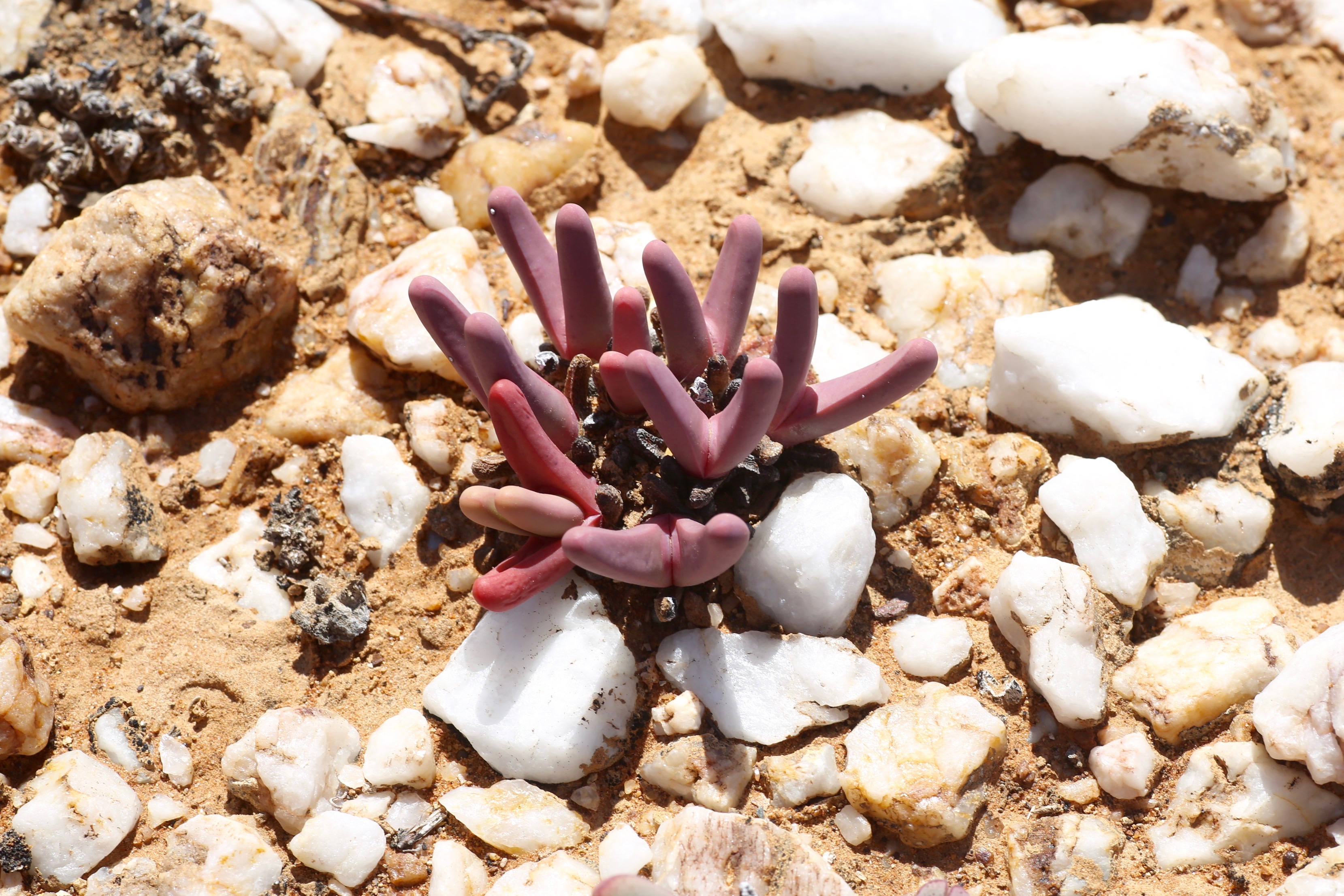
Argyroderma fissum, the "cleft silverstone," is a mesemb in the Aizoaceae family native to the quartz fields of the South African Western Cape. It differs from A. delaetii by its more elongated leaves and more pronounced central fissure (fissus = cleft). Its flowers are bright yellow, chromatically distinguishing it from the magenta of A. delaetii.
chevron_right edit_note Proposed edits auto-approved at +3 net votes
No pending proposals for this section.
© yakovlev.alexey
CC BY-SA 2.0
Overview
| Category | Classification |
|---|---|
| Family | Aizoaceae |
| Genus | Argyroderma |
| Growth Habit | Acaulescent perennial succulent with somewhat more elongated leaves than A. delaetii; can form small clumps over time. Active growth in autumn and winter. |
| Conservation Status | Least Concern (LC); like all Knersvlakte Argyroderma, vulnerable to quartz mining and illegal collection. |
| pH Target | 6.5 – 7.5 |
| Type | Western Cape quartz fields; practically pure quartz, neutral to slightly acidic pH, no organic retention. |
Origin & Habitat
Morphology
Leaves somewhat more elongated and cylindrical than A. delaetii, silvery grey-green in color with a smooth, waxy surface; the central fissure is wider and deeper than in other species of the genus, giving a wedge-like appearance. They measure 3–7 cm in length.
ecoPractically invisible; the plant emerges directly from the quartzitic substrate without an apparent stem.
ecoBright yellow flowers 3–5 cm in diameter; one of the most distinctive traits separating A. fissum from A. delaetii (magenta) in collections. They bloom in autumn–winter during peak sunlight hours.
ecoThick, fleshy vertical roots; architecture similar to A. delaetii but possibly somewhat more robust due to the larger leaves.
ecochevron_right edit_note Proposed edits auto-approved at +3 net votes
No pending proposals for this section.
Requirements
Soil & Substrate
Type
Western Cape quartz fields; practically pure quartz, neutral to slightly acidic pH, no organic retention.
groups Beneficial Associations
chevron_right edit_note Proposed edits auto-approved at +3 net votes
No pending proposals for this section.
Propagation Strategy
- 1 Sow in autumn when temperature drops below 25 °C; A. fissum germinates best with cool nights of 12–15 °C
- 2 Distribute seeds superficially over very fine quartz sand; do not cover, the seeds need light to germinate
- 3 Cover with glass to maintain humidity; moisten only with a fine mister, never with a watering can
- 4 Germination in 1–3 weeks; seedlings are extremely small, gradually ventilate before removing the cover
- 1 Divide only in autumn at the start of the active growing period; the deep cleft between the leaves facilitates separation
- 2 Remove the entire clump and separate leaf pairs with a clean scalpel, preserving the roots of each pair
- 3 Allow divisions to callous for 2–3 days in a dry spot before planting
- 4 Plant in pure mineral sand in a small pot; water only when new growth activity appears
The deep cleft between A. fissum leaves distinguishes it from other species; take care not to accumulate water in it
Watering in summer thinking the plant looks 'dry'; during dormancy it needs no water
Every 3–4 years in autumn; use a small terracotta pot and 100% mineral substrate.
Optional: very diluted mineral fertilizer (10% dose) just once in October. Never in summer or in the first year.
Uses & Applications
Precautions / Toxicity
No known toxicity.
chevron_right edit_note Proposed edits auto-approved at +3 net votes
No pending proposals for this section.
"A. fissum has particular relevance for floral evolution studies in the Argyroderma genus: since yellow flowers are the most common condition in Aizoaceae, the presence of magenta flowers in A. delaetii suggests a relatively recent evolutionary transition. A. fissum possibly represents the most ancestral state of floral coloring in the genus."
chevron_right edit_note Proposed edits auto-approved at +3 net votes
No pending proposals for this section.
Scientific Integrity
🟡 MediumVote to help validate this record
Sources
Loading…
Discussion
Disclaimer
This species record is provided for educational and informational purposes only. Jardín Roca Negra does not guarantee the accuracy or completeness of the data. Content is community-curated and may be subject to revision; it should not replace advice from a qualified botanist. This species may be toxic, invasive, or subject to legal restrictions — verify before handling or cultivating. Jardín Roca Negra accepts no liability for any harm arising from reliance on this information. Images are reproduced under Creative Commons or equivalent free licenses; credits are noted below each image.