
Pleiospilos compactus (Aiton) Schwantes
Living Rock / Compact Split Rock
Pleiospilos compactus is a South African mesemb distributed mainly in the arid Karoo and Great Karoo regions of the Western and Northern Cape. Unlike other species in the genus, it can produce several leaf pairs simultaneously, forming denser clumps. Its granite-like leaves make it virtually invisible among the rocks of its habitat.
chevron_right edit_note Proposed edits auto-approved at +3 net votes
No pending proposals for this section.
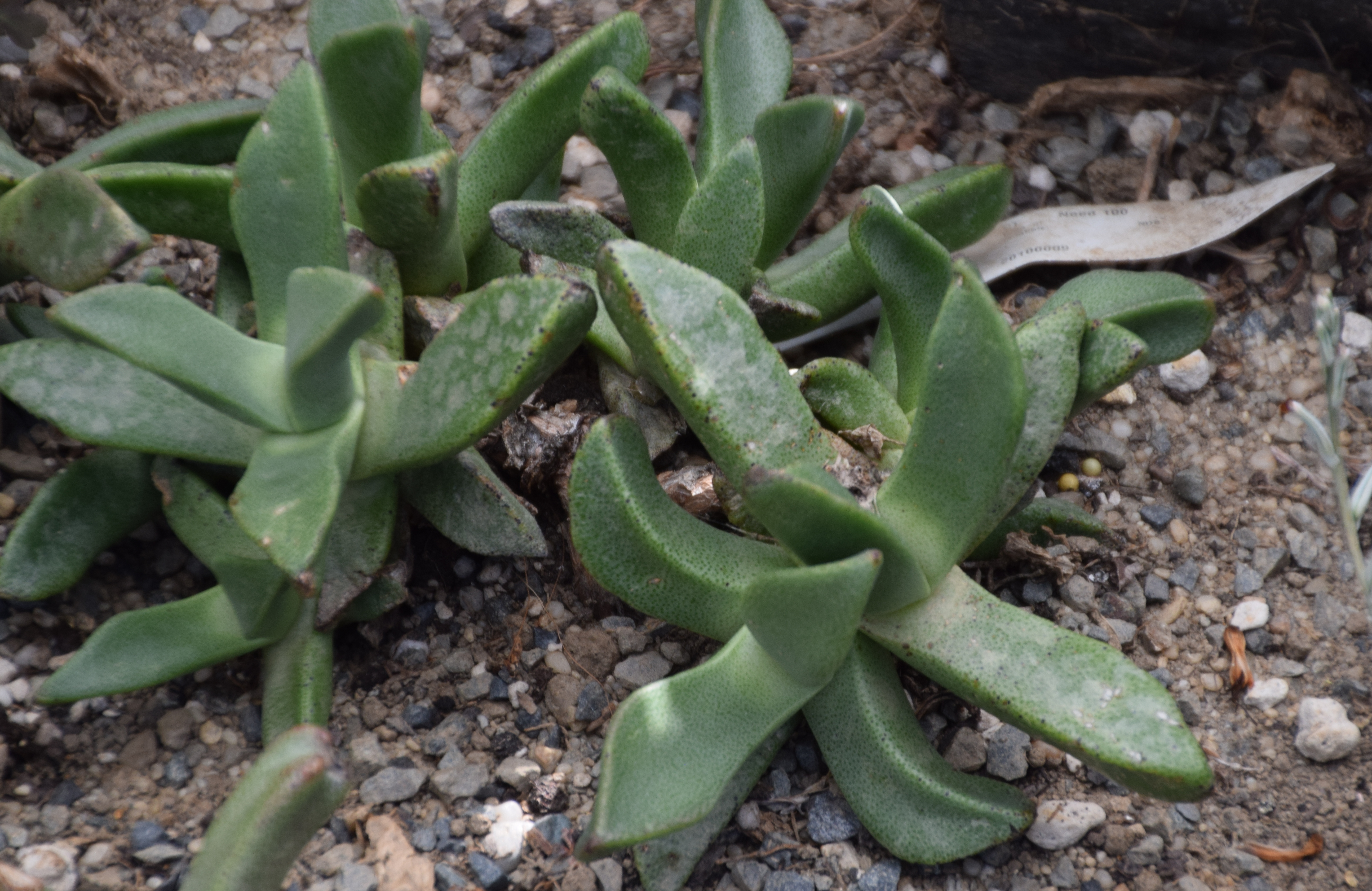
© Krzysztof Golik
CC BY-SA 4.0
Overview
| Category | Classification |
|---|---|
| Family | Aizoaceae |
| Genus | Pleiospilos |
| Growth Habit | Slow-growing perennial succulent that can form clumps with 2–4 active leaf pairs; somewhat more prone to offsetting than its congeners. |
| Conservation Status | Least Concern (LC); habitat is partially degraded by overgrazing in the Karoo, though the species maintains stable populations. |
| pH Target | 6.0 – 7.0 |
| Type | Stony Karoo soil with quartz, shale, and minimal organic matter; excellent and near-instantaneous drainage. |
Origin & Habitat
Morphology
Succulent leaves in grey-green to brown tones, with dark marks and spots simulating granite texture. They are more rounded on top than those of P. nelii and have a well-defined central groove; each pair measures 4–7 cm wide.
ecoShort and subterranean, allowing leaf pairs to appear directly at ground level. In mature specimens the stem may branch slightly and produce several growth centers.
ecoYellow flowers 4–6 cm in diameter, with many linear petals, emerging from the central groove. They bloom in autumn–winter and can last several days if light conditions are optimal.
ecoVertical, fleshy roots that penetrate deeply into rocky substrate; the compact root architecture is efficient for water uptake during brief, sporadic rainfall events.
ecochevron_right edit_note Proposed edits auto-approved at +3 net votes
No pending proposals for this section.
Requirements
Soil & Substrate
Type
Stony Karoo soil with quartz, shale, and minimal organic matter; excellent and near-instantaneous drainage.
groups Beneficial Associations
chevron_right edit_note Proposed edits auto-approved at +3 net votes
No pending proposals for this section.
Propagation Strategy
- 1 Sow on the surface of fine, sandy mineral substrate that is barely moist; do not cover the seeds.
- 2 Maintain temperature of 18–25 °C with day/night fluctuation of 5–8 °C to stimulate germination.
- 3 Cover with clear glass or plastic and ventilate daily.
- 4 Seedlings emerge in 2–4 weeks; gradually remove the cover.
- 5 P. compactus can have 2–4 leaf pairs per plant; transplant when seedlings are manageable.
- 1 P. compactus forms clumps with multiple heads; divide them at the start of autumn.
- 2 Remove the plant, clean the roots, and separate heads with a sterilized knife, keeping roots on each section.
- 3 Callus for 1–2 days in an airy spot.
- 4 Replant in very well-draining mineral substrate in an individual pot; water after one week.
Water only during active growth in autumn-winter; never water while old leaves are being absorbed by new ones.
Watering in summer during semi-dormancy, which quickly rots the plant.
Every 3–4 years at the start of autumn. Shallow terracotta pot with substrate that is almost 100% mineral.
No fertilization, or very occasional (once per active season) with heavily diluted cactus fertilizer.
Uses & Applications
Precautions / Toxicity
No reported toxicity; similar to the rest of the genus, considered low risk for humans and domestic animals.
chevron_right edit_note Proposed edits auto-approved at +3 net votes
No pending proposals for this section.
"P. compactus is considered the most "tolerant" of the genus in cultivation, being somewhat more forgiving than P. nelii and P. bolusii of occasional overwatering. Some authors recognize subspecies with subtle morphological differences in leaf punctation patterns depending on geographic origin."
chevron_right edit_note Proposed edits auto-approved at +3 net votes
No pending proposals for this section.
Scientific Integrity
🟡 MediumVote to help validate this record
Sources
Loading…
Discussion
Disclaimer
This species record is provided for educational and informational purposes only. Jardín Roca Negra does not guarantee the accuracy or completeness of the data. Content is community-curated and may be subject to revision; it should not replace advice from a qualified botanist. This species may be toxic, invasive, or subject to legal restrictions — verify before handling or cultivating. Jardín Roca Negra accepts no liability for any harm arising from reliance on this information. Images are reproduced under Creative Commons or equivalent free licenses; credits are noted below each image.