
Calandrinia cotyledon S.Watson
Rock purslane
Perennial succulent with a loose rosette of spatulate grey-green leaves. Produces tall floral stems with striking 5-petaled magenta flowers. Native to western North America.
chevron_right edit_note Proposed edits auto-approved at +3 net votes
No pending proposals for this section.
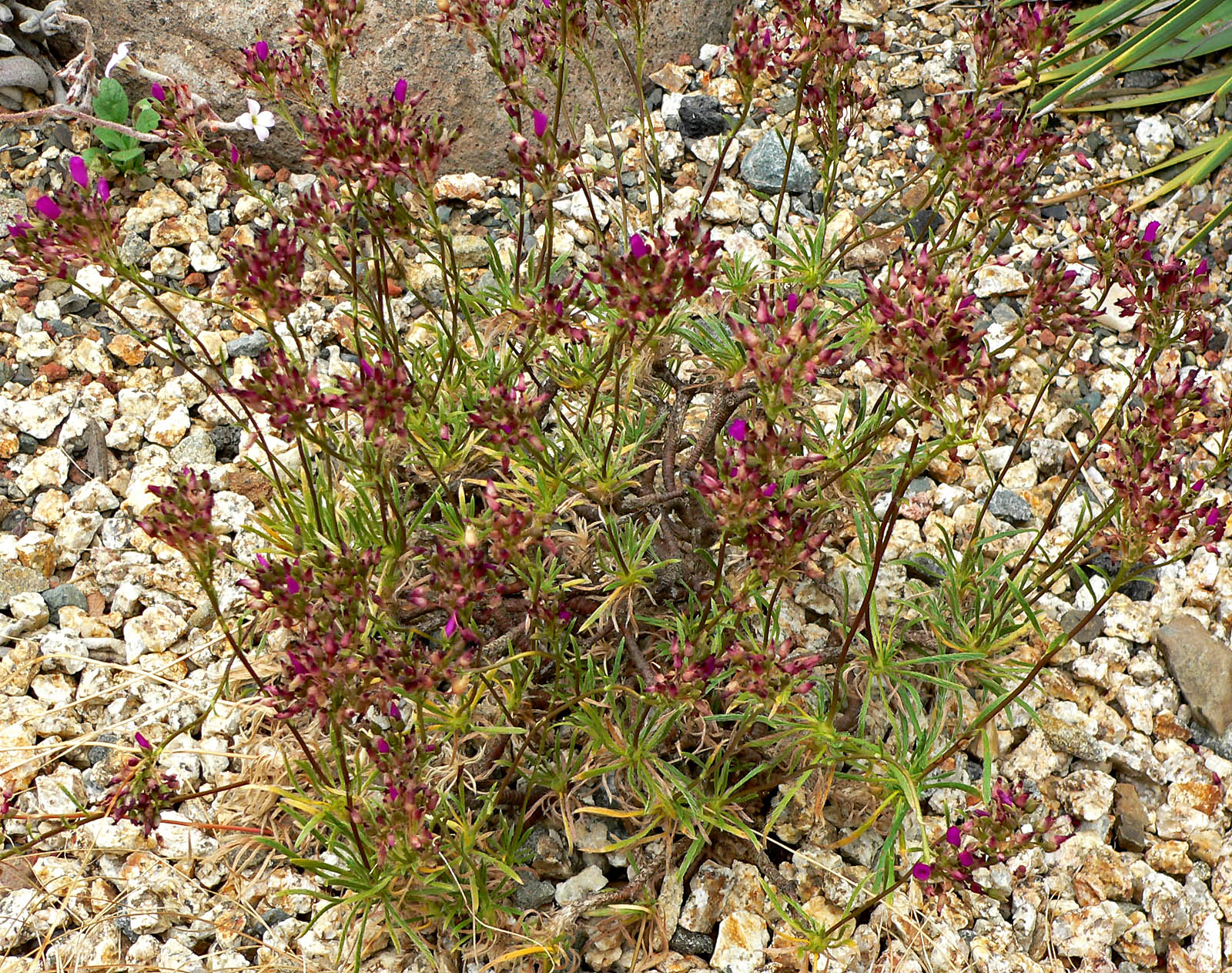
© Meneerke bloem, CC BY-SA 3.0, via Wikimedia Commons
Overview
| Category | Classification |
|---|---|
| Family | Montiaceae |
| Genus | Calandrinia |
| Growth Habit | Rosette-forming perennial succulent |
| Conservation Status | Least Concern |
| pH Target | 6.0–7.0 |
| Type | Sandy-gritty, well-drained |
Origin & Habitat
Requirements
Soil & Substrate
Type
Sandy-gritty, well-drained
groups Beneficial Associations
chevron_right edit_note Proposed edits auto-approved at +3 net votes
No pending proposals for this section.
Propagation Strategy
S
D
Every 2 years in pots; in garden can remain indefinitely.
Diluted balanced fertilizer once at the start of spring.
Uses & Applications
Precautions / Toxicity
Non-toxic; leaves are edible, relative of common purslane (Portulaca oleracea).
chevron_right edit_note Proposed edits auto-approved at +3 net votes
No pending proposals for this section.
"'Calandrinia cotyledon' S.Watson is the most cultivated species of the genus in North America. Frequently sold under the name 'Calandrinia grandiflora' (currently an invalid garden name). Included images correspond to other genus species (C. umbellata and C. grandiflora hort.) with representative floral morphology, as no CC-verified images specifically labeled C. cotyledon were found."
chevron_right edit_note Proposed edits auto-approved at +3 net votes
No pending proposals for this section.
Scientific Integrity
🟢 HighVote to help validate this record
Sources
Loading…
Discussion
Disclaimer
This species record is provided for educational and informational purposes only. Jardín Roca Negra does not guarantee the accuracy or completeness of the data. Content is community-curated and may be subject to revision; it should not replace advice from a qualified botanist. This species may be toxic, invasive, or subject to legal restrictions — verify before handling or cultivating. Jardín Roca Negra accepts no liability for any harm arising from reliance on this information. Images are reproduced under Creative Commons or equivalent free licenses; credits are noted below each image.