
Bryophyllum daigremontianum (Raym.-Hamet & H.Perrier) A.Berger
Mother of Thousands
Succulent native to Madagascar, currently classified as Kalanchoe daigremontiana in modern taxonomy. Its fleshy lanceolate leaves produce small adventitious plantlets on toothed margins that fall to the ground and root easily, hence its popular name 'mother of thousands'. Contains bufadienolide glycosides that are toxic to livestock and other species. It is one of the most common indoor succulents in the world.
chevron_right edit_note Proposed edits auto-approved at +3 net votes
No pending proposals for this section.
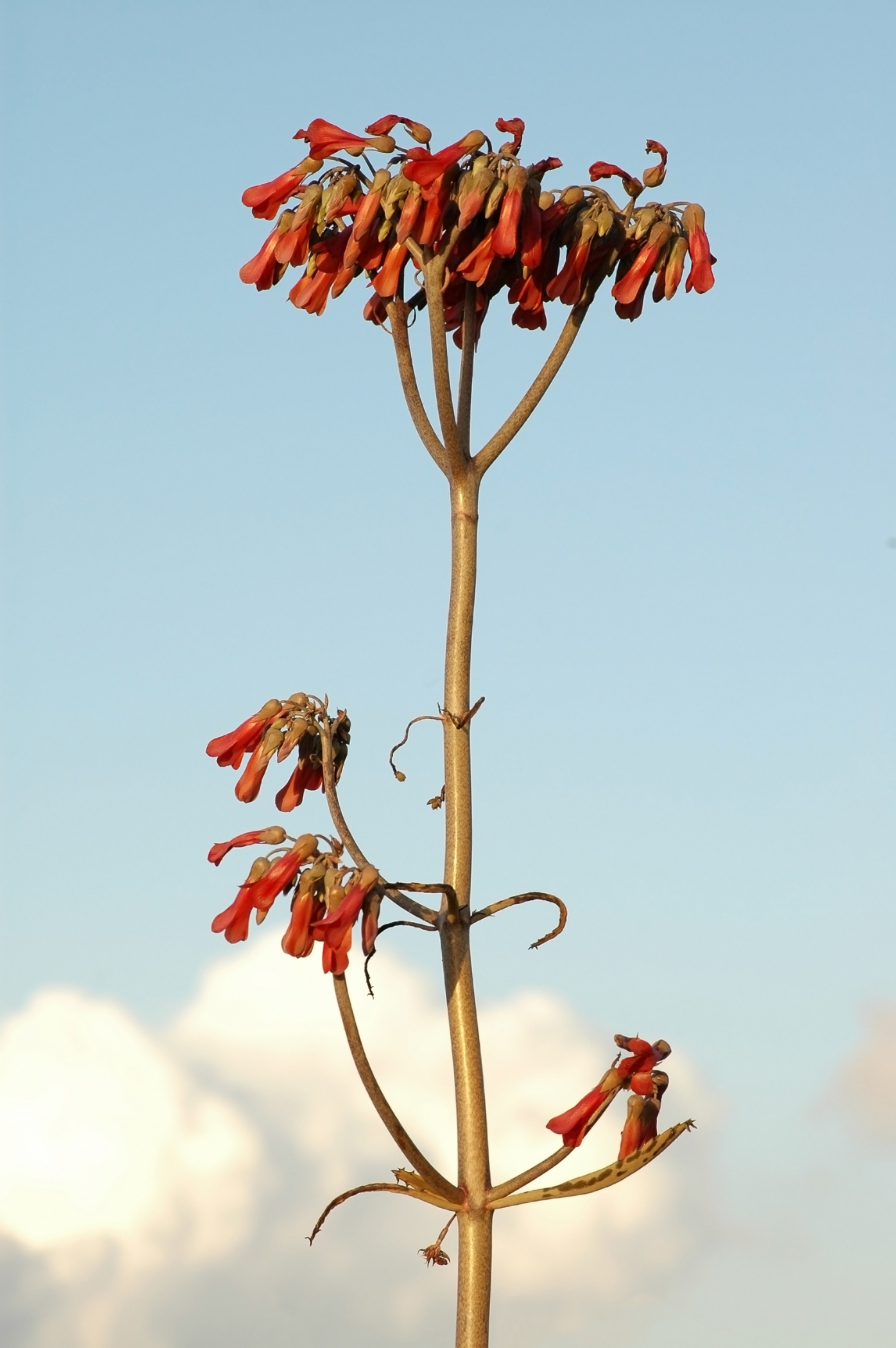
© Ianaré Sévi (Wikimedia Commons)
CC BY-SA 3.0
Overview
| Category | Classification |
|---|---|
| Family | Crassulaceae |
| Genus | Bryophyllum |
| Growth Habit | Erect succulent herb, rarely shrubby in warm climates |
| Conservation Status | Not Evaluated (NE) — widely cultivated and invasive in many regions |
| pH Target | 6.0–7.5 |
| Type | Very well-drained sandy-loamy, low in organic matter |
Origin & Habitat
Requirements
Soil & Substrate
Type
Very well-drained sandy-loamy, low in organic matter
groups Beneficial Associations
chevron_right edit_note Proposed edits auto-approved at +3 net votes
No pending proposals for this section.
Propagation Strategy
A
O
Every 2 years or when roots fill the pot
Cactus fertilizer diluted by half, once a month in spring and summer
Uses & Applications
Precautions / Toxicity
TOXIC. Contains bufadienolide glycosides (daigremontianin, bersalgenin) causing cardiac arrhythmias in animals and humans. Toxic to cats, dogs, livestock, poultry and rabbits.
chevron_right edit_note Proposed edits auto-approved at +3 net votes
No pending proposals for this section.
Plant Health
chevron_right edit_note Proposed edits auto-approved at +3 net votes
No pending proposals for this section.
"Most frequent collection name: Bryophyllum daigremontianum. In current taxonomy it is Kalanchoe daigremontiana (Raym.-Hamet & H.Perrier) Raym.-Hamet & H.Perrier. Adventitious plantlets make it a problematic invasive in subtropical regions."
chevron_right edit_note Proposed edits auto-approved at +3 net votes
No pending proposals for this section.
Scientific Integrity
🟢 HighVote to help validate this record
Sources
Loading…
Discussion
Disclaimer
This species record is provided for educational and informational purposes only. Jardín Roca Negra does not guarantee the accuracy or completeness of the data. Content is community-curated and may be subject to revision; it should not replace advice from a qualified botanist. This species may be toxic, invasive, or subject to legal restrictions — verify before handling or cultivating. Jardín Roca Negra accepts no liability for any harm arising from reliance on this information. Images are reproduced under Creative Commons or equivalent free licenses; credits are noted below each image.