
Haworthiopsis reinwardtii (Salm-Dyck) G.D.Rowley
Reinwardt's Haworthiopsis / Zebra Wart
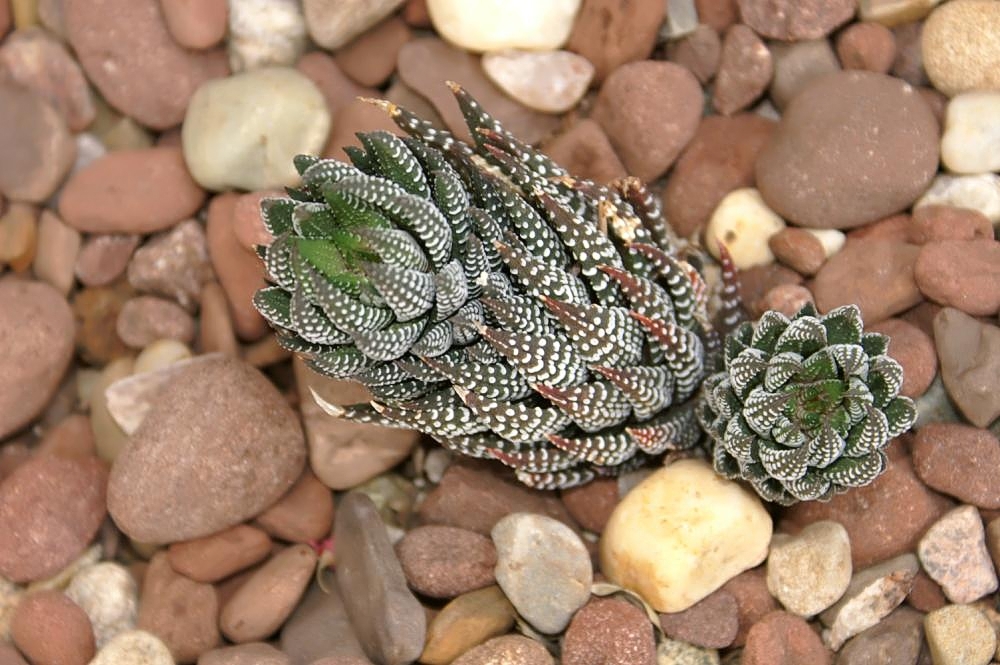
Reinwardt's Haworthiopsis is a columnar succulent from the Eastern Cape of South Africa, with erect stems densely covered in recurved leaves bearing spirally arranged white tubercles. Unlike H. attenuata, its rosettes elongate into visible columns up to 20 cm, giving it an architectural quality prized in succulent collections.
chevron_right edit_note Proposed edits auto-approved at +3 net votes
No pending proposals for this section.
© Agnieszka Kwiecień, Nova
CC BY-SA 4.0
Overview
| Category | Classification |
|---|---|
| Family | Asphodelaceae |
| Genus | Haworthiopsis |
| Growth Habit | Caespitose-columnar; forms colonies of erect stems through basal offsets. |
| Conservation Status | Least Concern (IUCN). Reclassified from Haworthia in 2013. |
| pH Target | 6.0 – 7.0 |
| Type | Porous mineral substrate, low in nutrients, neutral pH. |
Origin & Habitat
Morphology
Triangular leaves 3–7 cm, strongly recurved, dark green with white tubercles aligned in both longitudinal and transverse rows creating a reticulate pattern. Leaves insert densely in a spiral along the columnar stem.
ecoVisible erect stem 10–25 cm tall, densely leafy from base to apex. Unlike most haworthiopsias, the stem is not concealed by the rosette.
ecoSlender inflorescence 20–30 cm; tubular white flowers with green stripes, bilabiate. Spring flowering.
ecoFibrous root system, relatively compact; well-adapted to small containers.
ecochevron_right edit_note Proposed edits auto-approved at +3 net votes
No pending proposals for this section.
Requirements
Soil & Substrate
Type
Porous mineral substrate, low in nutrients, neutral pH.
groups Beneficial Associations
chevron_right edit_note Proposed edits auto-approved at +3 net votes
No pending proposals for this section.
Propagation Strategy
- 1 Remove plant from pot; offsets form at the base of the column.
- 2 Separate offsets ≥ 3 cm in diameter with a sterile blade.
- 3 Callus for 1–2 days in a dry spot.
- 4 Plant in well-draining succulent mix; water after 7 days.
- 1 Remove leaves from the lower part of the column with a lever motion to obtain the base.
- 2 Callus for 3–5 days.
- 3 Place on moist mineral substrate without burying.
- 4 Roots visible in 8–14 weeks; slower development than offsets.
The spiral columnar form can reach 20 cm; use a tall, stable pot to prevent tipping.
Overwatering at the base causing rot of the columnar stem.
Every 2–3 years in spring. The column may need temporary support after repotting.
Low-N fertilizer at 50% once a month from March to September. No fertilization in winter.
Uses & Applications
Precautions / Toxicity
Non-toxic or very low toxicity for humans and domestic pets.
chevron_right edit_note Proposed edits auto-approved at +3 net votes
No pending proposals for this section.
"H. reinwardtii is the type species of genus Haworthiopsis sensu Rowley (2013) and the first in which the columnar growth pattern, previously considered a mere specific character, was recognised as a synapomorphy of the clade. More than 20 varieties and forms have been described, many differing only in tubercle size and arrangement."
chevron_right edit_note Proposed edits auto-approved at +3 net votes
No pending proposals for this section.
Scientific Integrity
🟡 MediumVote to help validate this record
Sources
Loading…
Discussion
Disclaimer
This species record is provided for educational and informational purposes only. Jardín Roca Negra does not guarantee the accuracy or completeness of the data. Content is community-curated and may be subject to revision; it should not replace advice from a qualified botanist. This species may be toxic, invasive, or subject to legal restrictions — verify before handling or cultivating. Jardín Roca Negra accepts no liability for any harm arising from reliance on this information. Images are reproduced under Creative Commons or equivalent free licenses; credits are noted below each image.