
Aloe aculeata Pole-Evans
Prickly Aloe / Red Hot Poker Aloe
Prickly Aloe is a robust arborescent species native to northeastern South Africa, Zimbabwe and Mozambique, unmistakeable for the dense conical yellow-tipped spines that cover both leaf surfaces. It is one of the most heavily armoured succulents in southern Africa and shows extraordinary adaptation to mopane soils and granite.
chevron_right edit_note Proposed edits auto-approved at +3 net votes
No pending proposals for this section.
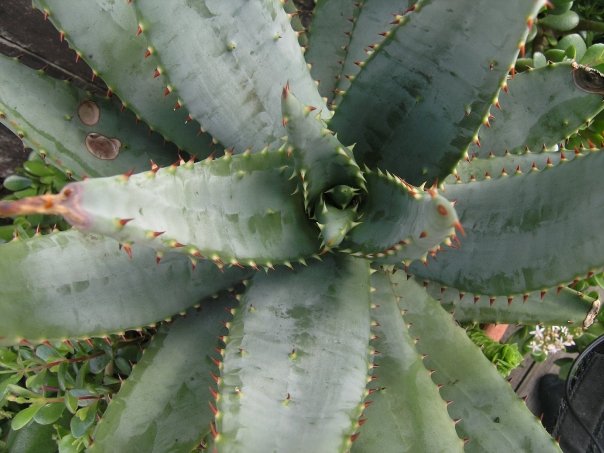
© David J. Stang
CC BY-SA 4.0
Overview
| Category | Classification |
|---|---|
| Family | Asphodelaceae |
| Genus | Aloe |
| Growth Habit | Arborescent; single trunk or few branches from the base; dense terminal rosette. |
| Conservation Status | Least Concern (IUCN). Locally abundant in Limpopo mopaniveld. CITES Appendix II. |
| pH Target | 6.5 – 8.0 |
| Type | Stony to clayey-sandy, well-drained, slightly alkaline. |
Origin & Habitat
Morphology
Broad triangular leaves 50–80 cm, grey-green; completely covered in conical white-to-yellowish spines on both surfaces and margins, with larger marginal spines to 1 cm. Spine density exceeds that of any other arborescent species in the genus.
ecoSingle or basally forked trunk 1–3 m tall, bearing leaf-scar patterns. In mature plants basal diameter can exceed 30 cm.
ecoInflorescence with 6–10 branches; dense racemes of tubular yellow-orange to orange-red, sometimes bicoloured flowers. Blooms in winter (June–August Southern Hemisphere).
ecoFibrous root system of moderate depth, with stout anchor roots suited to rocky or stony soils.
ecochevron_right edit_note Proposed edits auto-approved at +3 net votes
No pending proposals for this section.
Requirements
Soil & Substrate
Type
Stony to clayey-sandy, well-drained, slightly alkaline.
groups Beneficial Associations
chevron_right edit_note Proposed edits auto-approved at +3 net votes
No pending proposals for this section.
Propagation Strategy
- 1 A. aculeata produces basal offsets regularly, though not as prolifically as smaller species; wait until they are 10–12 cm
- 2 Use thick gloves or newspaper to handle the spiny plant; separate the offset with a disinfected knife
- 3 Allow the cut to callous for 3–4 days in a dry, shaded spot
- 4 Plant in very well-drained substrate with a high proportion of grit or coarse sand; water for the first time after 14 days
- 1 Sow on the surface over sand + perlite; A. aculeata seeds are medium-sized, do not cover
- 2 Keep at 22–26 °C under a transparent cover with high indirect brightness
- 3 Germination in 2–4 weeks; seedlings already show small spines, handle carefully
- 4 Transplant to individual pots when they measure 4–5 cm
A. aculeata spines are very sharp; mark the pot with a visible warning if children or pets are present
Handling without protection and sustaining cuts from the toothed spines
Every 2–3 years in spring; use thick leather gloves and rolled newspaper to protect against the spines.
Succulent fertilizer at 50% dose, once in spring; no fertilizer in winter.
Uses & Applications
Precautions / Toxicity
Mild latex toxicity (aloin); spines represent the main physical hazard. CITES Appendix II.
chevron_right edit_note Proposed edits auto-approved at +3 net votes
No pending proposals for this section.
"A. aculeata has the highest leaf-spine density of any arborescent Aloe, making it nearly impossible to handle without protection. The Venda people of northern Limpopo used it to delineate livestock kraals, exploiting its spinose architecture as a living fence that even lions struggled to breach."
chevron_right edit_note Proposed edits auto-approved at +3 net votes
No pending proposals for this section.
Scientific Integrity
🟡 MediumVote to help validate this record
Sources
Loading…
Discussion
Disclaimer
This species record is provided for educational and informational purposes only. Jardín Roca Negra does not guarantee the accuracy or completeness of the data. Content is community-curated and may be subject to revision; it should not replace advice from a qualified botanist. This species may be toxic, invasive, or subject to legal restrictions — verify before handling or cultivating. Jardín Roca Negra accepts no liability for any harm arising from reliance on this information. Images are reproduced under Creative Commons or equivalent free licenses; credits are noted below each image.