
Astridia speciosa L.Bolus
Showy astridia
Astridia speciosa (from Latin 'speciosa': showy, striking) is the species with the largest flowers within the genus, endemic to Namibia. Its deep pink to magenta flowers with numerous brilliant linear petals make it one of the most ornamental bushy Aizoaceae. It grows in arid rocky habitats influenced by marine fog.
chevron_right edit_note Proposed edits auto-approved at +3 net votes
No pending proposals for this section.
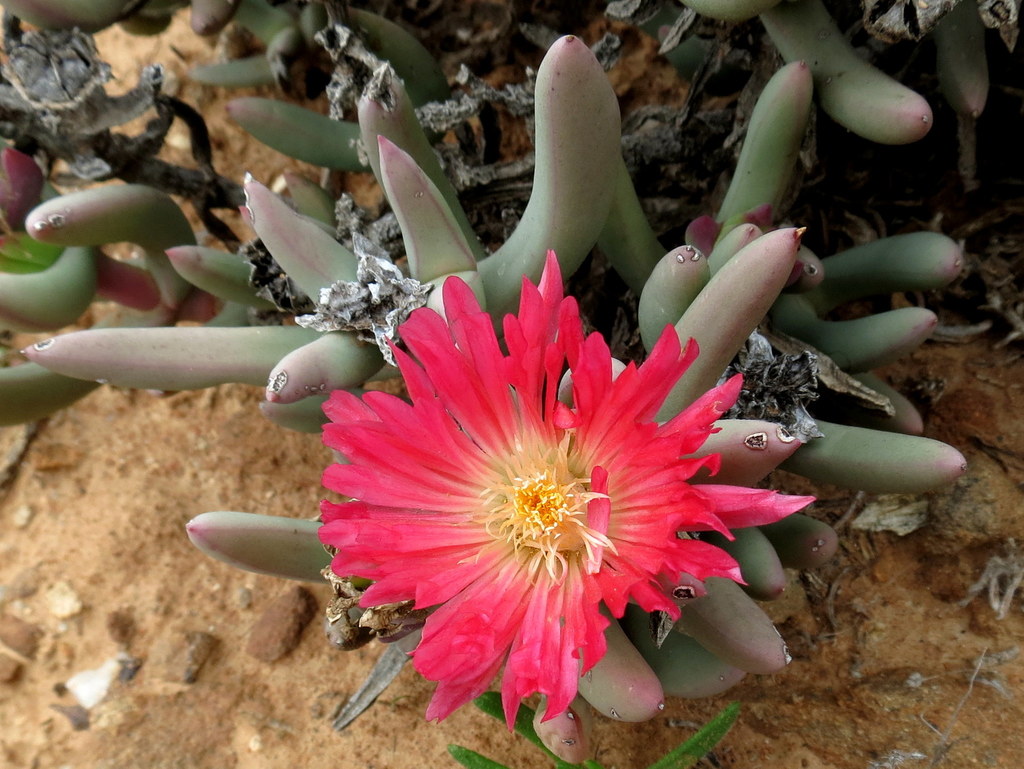
© (c) Gigi Laidler, some rights reserved (CC BY-NC)
CC BY-NC
Overview
| Category | Classification |
|---|---|
| Family | Aizoaceae |
| Genus | Astridia |
| Growth Habit | Compact succulent shrub 20–50 cm tall; branching, with prominent triquetrous leaves and spectacular winter flowering. |
| Conservation Status | Data deficient (DD); Namibian endemic with few modern records. |
| pH Target | 6.5–7.5 |
| Type | Well-drained mineral: coarse sand and perlite or grit |
Origin & Habitat
Morphology
Triquetrous, fleshy, 3–5 cm long, greyish-green to bluish; conspicuous lower keel.
ecoThe largest in the genus: 4–6 cm in diameter, with abundant linear petals in vivid pink to magenta. Winter flowering.
ecoWoody at the base, grey; dense branching forming a rounded canopy.
ecoDehiscent capsule with 5–8 locules; small seeds dispersed by rain.
ecochevron_right edit_note Proposed edits auto-approved at +3 net votes
No pending proposals for this section.
Requirements
Soil & Substrate
Type
Well-drained mineral: coarse sand and perlite or grit
groups Beneficial Associations
chevron_right edit_note Proposed edits auto-approved at +3 net votes
No pending proposals for this section.
Propagation Strategy
- 1 Cut 6–10 cm stems; allow to callous 2–3 days
- 2 Insert in 50% moist mineral substrate
- 3 Bright indirect light until rooted; then full sun
L
Overwatering in summer
Every 2–3 years in spring
Diluted low-nitrogen mineral fertilizer, twice in winter.
Uses & Applications
Precautions / Toxicity
Non-toxic.
chevron_right edit_note Proposed edits auto-approved at +3 net votes
No pending proposals for this section.
Plant Health
chevron_right edit_note Proposed edits auto-approved at +3 net votes
No pending proposals for this section.
"A. speciosa and Lampranthus spectabilis represent the ornamental peak of shrubby Ruschioideae; both produce floral coverage of remarkable chromatic intensity in mid-winter, making them ideal for Mediterranean and Mediterranean-arid gardens."
chevron_right edit_note Proposed edits auto-approved at +3 net votes
No pending proposals for this section.
Scientific Integrity
🟢 HighVote to help validate this record
Sources
Loading…
Discussion
Disclaimer
This species record is provided for educational and informational purposes only. Jardín Roca Negra does not guarantee the accuracy or completeness of the data. Content is community-curated and may be subject to revision; it should not replace advice from a qualified botanist. This species may be toxic, invasive, or subject to legal restrictions — verify before handling or cultivating. Jardín Roca Negra accepts no liability for any harm arising from reliance on this information. Images are reproduced under Creative Commons or equivalent free licenses; credits are noted below each image.