
Astridia blanda L.Bolus
Mild astridia / Sickle-fig
Astridia blanda is one of the best-known succulent shrubs of the genus Astridia, native to the Namibian coast and the Lüderitz area. The epithet 'blanda' (Latin: mild, pleasant) reflects the harmless appearance of its triquetrous leaves. It is the most common species in cultivation within the genus, valued for its showy pink to magenta flowers with numerous linear petals.
chevron_right edit_note Proposed edits auto-approved at +3 net votes
No pending proposals for this section.
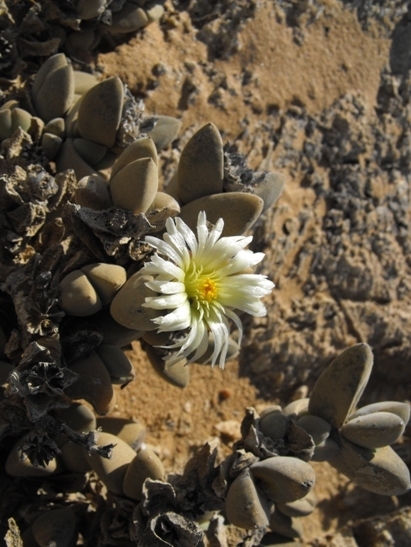
© (c) pietermier, some rights reserved (CC BY-NC)
CC BY-NC
Overview
| Category | Classification |
|---|---|
| Family | Aizoaceae |
| Genus | Astridia |
| Growth Habit | Semi-erect succulent shrub, 15–40 cm tall; woody branches with opposite triquetrous fleshy leaves. Spectacular winter flowering. |
| Conservation Status | Least concern (LC); widespread distribution on the Namibian coast and in cultivation. |
| pH Target | 6.5–7.5 |
| Type | Well-drained mineral mix: coarse sand and perlite |
Origin & Habitat
Morphology
Triquetrous, fleshy, 2–4 cm long, greyish-green to bluish, with prominent lower keel and acute apex.
ecoFlowers 3–5 cm in diameter, with numerous linear petals in vivid pink to magenta; blooms in winter and spring.
ecoSemi-woody, branching stems with light grey bark. The base may lignify with age.
ecoDehiscent capsules with 5–8 locules, characteristic of the family Aizoaceae.
ecochevron_right edit_note Proposed edits auto-approved at +3 net votes
No pending proposals for this section.
Requirements
Soil & Substrate
Type
Well-drained mineral mix: coarse sand and perlite
groups Beneficial Associations
chevron_right edit_note Proposed edits auto-approved at +3 net votes
No pending proposals for this section.
Propagation Strategy
- 1 Cut 5–8 cm segments in spring; allow to callous 2–3 days
- 2 Insert in 50% moist mineral sand
- 3 Keep at 18–24 °C with bright light without direct sun
- 4 Water lightly when substrate is dry
- 1 Sow in fine mineral mix without covering
- 2 Moisten and cover with glass; 16–22 °C
- 3 Gradually uncover after germination
T
Overwatering in summer
Every 2–3 years in spring
Diluted mineral fertilizer (low-N NPK) once in winter and once in spring.
Uses & Applications
Precautions / Toxicity
Non-toxic; safe for pets and people.
chevron_right edit_note Proposed edits auto-approved at +3 net votes
No pending proposals for this section.
Plant Health
chevron_right edit_note Proposed edits auto-approved at +3 net votes
No pending proposals for this section.
"A. blanda is the most cultivated species in the genus and a good entry point for those starting with Astridia. Its relative adaptability makes it tolerant of slightly richer substrates than its more demanding Namibian congeners."
chevron_right edit_note Proposed edits auto-approved at +3 net votes
No pending proposals for this section.
Scientific Integrity
🟢 HighVote to help validate this record
Sources
Loading…
Discussion
Disclaimer
This species record is provided for educational and informational purposes only. Jardín Roca Negra does not guarantee the accuracy or completeness of the data. Content is community-curated and may be subject to revision; it should not replace advice from a qualified botanist. This species may be toxic, invasive, or subject to legal restrictions — verify before handling or cultivating. Jardín Roca Negra accepts no liability for any harm arising from reliance on this information. Images are reproduced under Creative Commons or equivalent free licenses; credits are noted below each image.