
Aridaria longituba L.Bolus
Long-tubed aridaria
Aridaria longituba is a succulent mesemb of the family Aizoaceae, endemic to Namaqualand, South Africa. Its most distinctive trait is the exceptionally long floral tube that extends between the opposite fleshy leaves, an adaptation likely favoring specific pollinators such as nocturnal moths. It grows in pure quartz soils, very well drained, with low seasonal rainfall.
chevron_right edit_note Proposed edits auto-approved at +3 net votes
No pending proposals for this section.
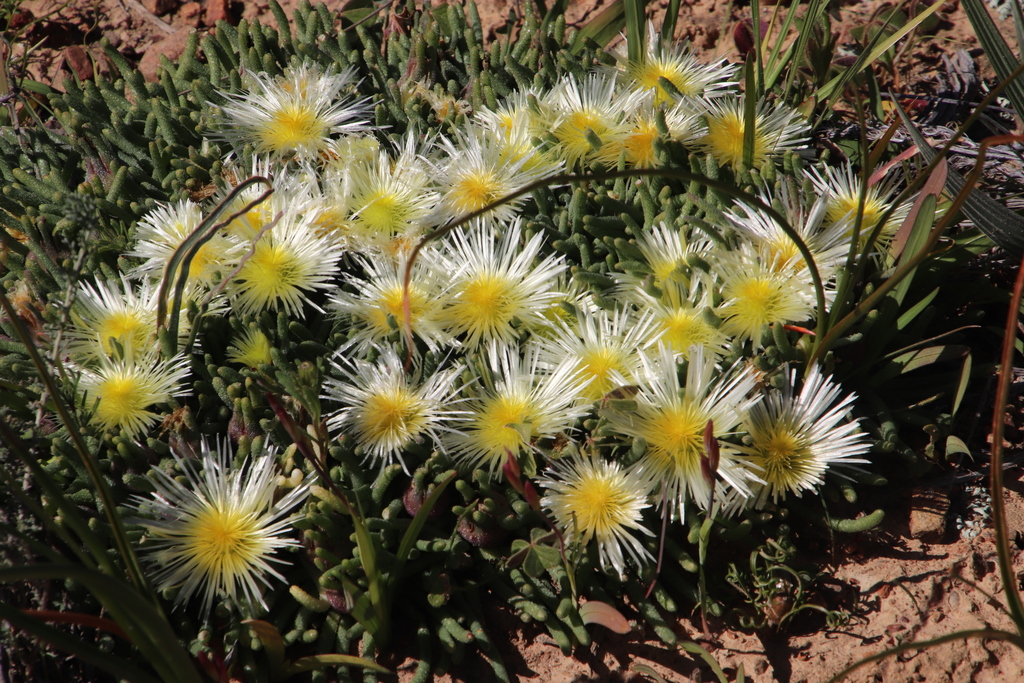
© (c) Tony Rebelo, some rights reserved (CC BY-SA), uploaded by Tony Rebelo
CC BY-SA
Overview
| Category | Classification |
|---|---|
| Family | Aizoaceae |
| Genus | Aridaria |
| Growth Habit | Acaulescent or subcaulescent perennial succulent; forms low rosettes of opposite fleshy leaves. Active growth in austral winter and spring. |
| Conservation Status | Data deficient (DD); endemic to a geographically restricted area of South African Namaqualand. |
| pH Target | 6.5–7.5 |
| Type | Pure quartzitic sand, mineral, without organic components |
Origin & Habitat
Morphology
Opposite, fleshy, triquetrous to semi-cylindrical leaves, greyish-green. The surface may be rough or slightly papillose.
ecoSolitary flowers with a markedly long tube (diagnostic trait of the genus), white or pale pink petals, numerous stamens. Mainly nocturnal or vespertine flowering.
ecoHygroscopic dehiscent capsules typical of Aizoaceae; seed dispersal activated by rain.
ecoRobust, deep root system adapted to penetrate compact quartzite substrates and store reserves during the dry season.
ecochevron_right edit_note Proposed edits auto-approved at +3 net votes
No pending proposals for this section.
Requirements
Soil & Substrate
Type
Pure quartzitic sand, mineral, without organic components
groups Beneficial Associations
chevron_right edit_note Proposed edits auto-approved at +3 net votes
No pending proposals for this section.
Propagation Strategy
- 1 Sow in fine quartzite sand without covering
- 2 Moisten with mister and cover with glass
- 3 Keep at 15–20 °C; bright indirect light
- 4 Ventilate daily; transplant after 2 true leaves
S
Watering in summer
Every 3–4 years in autumn
No fertilizer for the first 2 years; very diluted mineral once in autumn. Never in summer.
Uses & Applications
Precautions / Toxicity
Not toxic to humans or pets; limited data available.
chevron_right edit_note Proposed edits auto-approved at +3 net votes
No pending proposals for this section.
Plant Health
chevron_right edit_note Proposed edits auto-approved at +3 net votes
No pending proposals for this section.
"The long floral tube of A. longituba suggests pollination by long-proboscis moths (Sphingidae); the vespertine flowering and pale corolla point to a rare specialized mutualistic relationship among Namaqualand mesembs."
chevron_right edit_note Proposed edits auto-approved at +3 net votes
No pending proposals for this section.
Scientific Integrity
🟢 HighVote to help validate this record
Sources
Loading…
Discussion
Disclaimer
This species record is provided for educational and informational purposes only. Jardín Roca Negra does not guarantee the accuracy or completeness of the data. Content is community-curated and may be subject to revision; it should not replace advice from a qualified botanist. This species may be toxic, invasive, or subject to legal restrictions — verify before handling or cultivating. Jardín Roca Negra accepts no liability for any harm arising from reliance on this information. Images are reproduced under Creative Commons or equivalent free licenses; credits are noted below each image.