
Antimima ventricosa (L.Bolus) H.E.K.Hartmann
Swollen antimima
Antimima ventricosa (formerly Ruschia ventricosa) is one of the best-documented species in the genus, known for its characteristic ventricose (swollen) leaf base. Native to Namaqua National Park and surrounding areas of Namaqualand in the Northern Cape of South Africa. Forms medium-sized clumping shrubs with fleshy leaves with a clearly swollen base, producing abundant pink to magenta flowers in spring, contributing to the spectacular flower fields of Namaqualand. Classified in Antimima after phylogenetic revisions of Ruschioideae.
chevron_right edit_note Proposed edits auto-approved at +3 net votes
No pending proposals for this section.
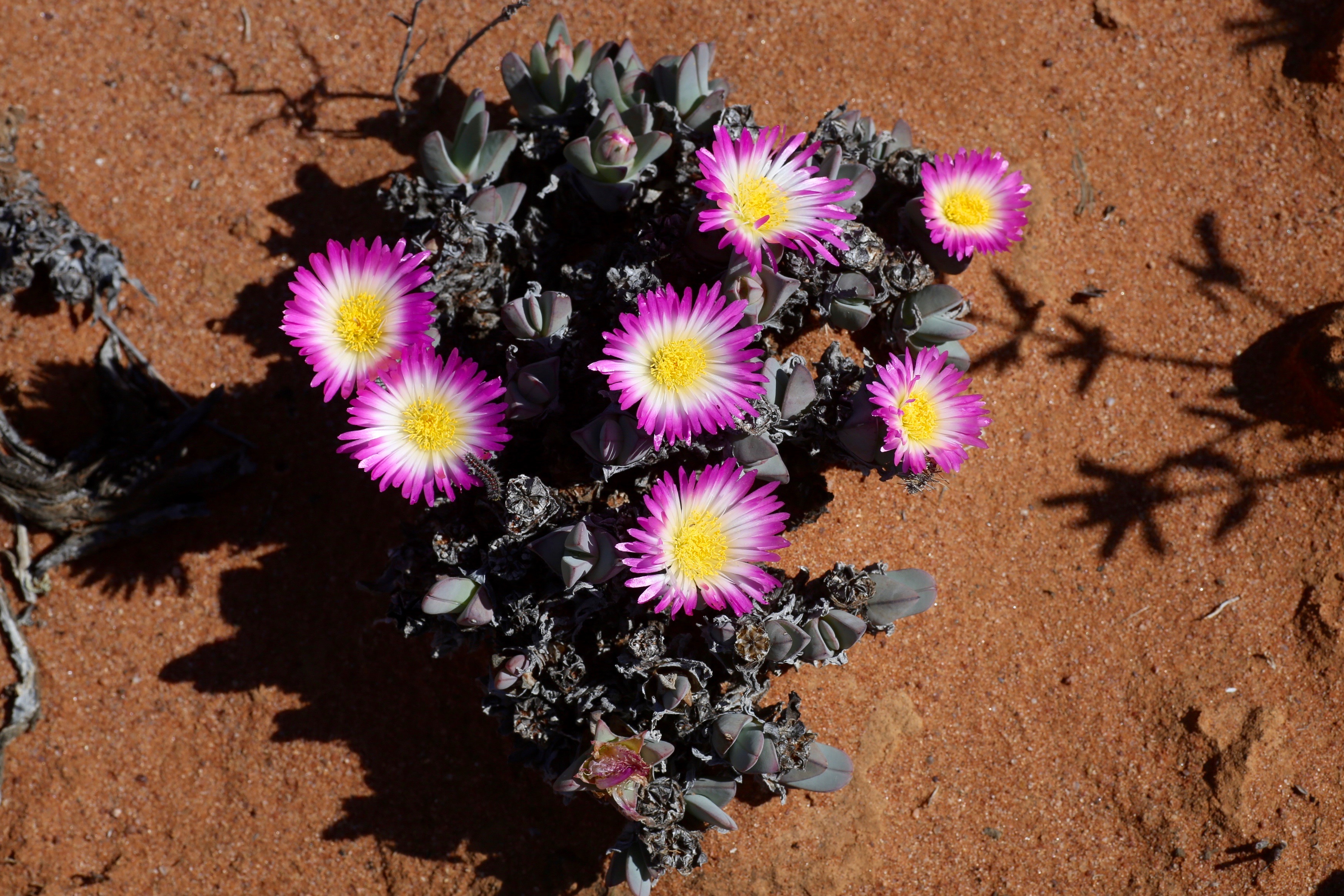
© Alexey Yakovlev / Wikimedia Commons
CC BY-SA 2.0
Overview
| Category | Classification |
|---|---|
| Family | Aizoaceae |
| Genus | Antimima |
| Growth Habit | Medium-sized clump-forming shrub, woody stems, leaves with ventricose base |
| Conservation Status | Least Concern (LC) — present in Namaqua National Park |
| pH Target | 6.5–7.5 |
| Type | Sandy, very well-drained |
Origin & Habitat
Morphology
Semi-cylindrical to triquetrous, 1.5–3 cm, with a clearly swollen (ventricose) base, glaucous green to grey-green. The basal swelling is the most visible diagnostic trait.
ecoPink to bright magenta, 2–3 cm diameter, with numerous narrow petals in a spiral. Diurnal. Abundant flowering in austral spring (August–October), contributing to the flower fields of Namaqualand.
ecoWoody, branched, up to 20 cm tall. Light grey to brown bark on mature branches.
ecoFibrous, moderately deep to anchor the shrub in rocky soils. The ventricose leaf base acts as an additional water reserve.
ecochevron_right edit_note Proposed edits auto-approved at +3 net votes
No pending proposals for this section.
Requirements
Soil & Substrate
Type
Sandy, very well-drained
groups Beneficial Associations
chevron_right edit_note Proposed edits auto-approved at +3 net votes
No pending proposals for this section.
Propagation Strategy
- 1 Cut shoots of 4–6 cm with at least 2 pairs of leaves.
- 2 Allow to callous for 2–3 days in the air.
- 3 Plant in mineral substrate (60% sand, 40% perlite).
- 4 First irrigation 5–7 days after planting.
- 1 Sow in fine sandy substrate, slightly moist.
- 2 Germination temperature: 16–20 °C.
- 3 Keep under glass to retain moisture.
- 4 Transplant to permanent substrate after 2 months.
The easiest Antimima to cultivate and the most recommended for beginners.
Watering the ventricose leaves in summer, causing accelerated rot.
Every 2–3 years
Once in autumn and once in winter, at 25% of the recommended dose for succulents
Uses & Applications
Precautions / Toxicity
No toxicity reported
chevron_right edit_note Proposed edits auto-approved at +3 net votes
No pending proposals for this section.
Plant Health
chevron_right edit_note Proposed edits auto-approved at +3 net votes
No pending proposals for this section.
"Antimima ventricosa is notable for its ventricose leaf base — a water storage adaptation that allows the plant to survive the arid summers of Namaqualand. Alexey Yakovlev photographs from Namaqua National Park (2015) show the plant in its natural habitat with characteristic pink flowering. Formerly known as Ruschia ventricosa, it was transferred to Antimima by Hartmann."
chevron_right edit_note Proposed edits auto-approved at +3 net votes
No pending proposals for this section.
Scientific Integrity
🟢 HighVote to help validate this record
Sources
Loading…
Discussion
Disclaimer
This species record is provided for educational and informational purposes only. Jardín Roca Negra does not guarantee the accuracy or completeness of the data. Content is community-curated and may be subject to revision; it should not replace advice from a qualified botanist. This species may be toxic, invasive, or subject to legal restrictions — verify before handling or cultivating. Jardín Roca Negra accepts no liability for any harm arising from reliance on this information. Images are reproduced under Creative Commons or equivalent free licenses; credits are noted below each image.