
Anacampseros baeseckei Dinter ex Poelln.
Baesecke's anacampseros
Anacampseros baeseckei is a small Namibian succulent collected on the Baesecke farm and described by Dinter ex Poellnitz. It is one of the Anacampseros species with the greatest presence in collections, thanks to its willingness to flower and propagate by seed in cultivation. It forms compact rosettes of fleshy green to blue-green leaves with silky white axillary hairs, producing ephemeral pink flowers in the afternoon.
chevron_right edit_note Proposed edits auto-approved at +3 net votes
No pending proposals for this section.
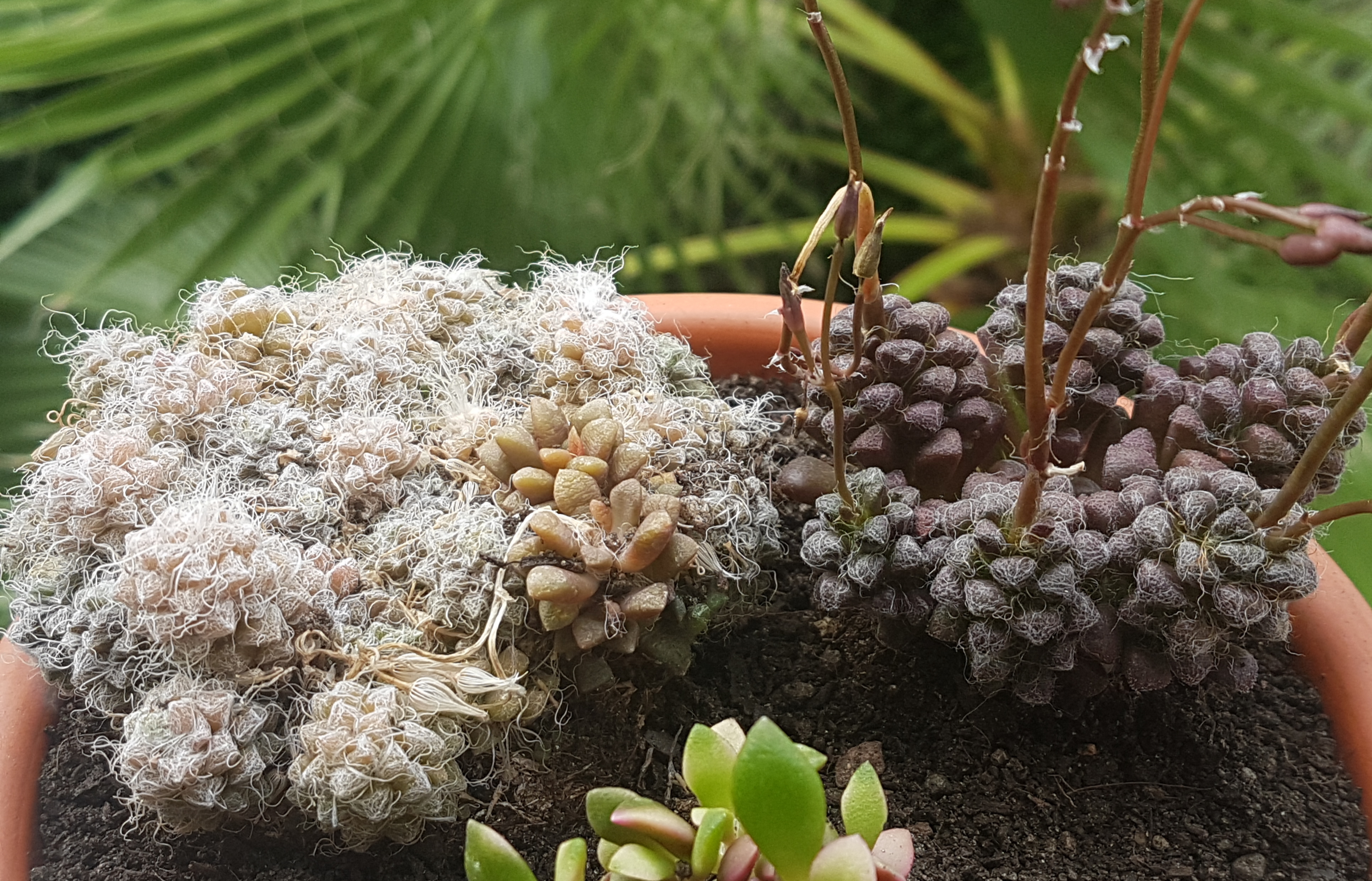
© Joan Andrés de Barcelona
CC BY-SA 4.0
Overview
| Category | Classification |
|---|---|
| Family | Anacampserotaceae |
| Genus | Anacampseros |
| Growth Habit | Dwarf compact-rosette succulent, 2–5 cm in diameter, clump-forming over time |
| Conservation Status | Least Concern (LC) — species well represented in ex-situ collections |
| pH Target | 6.0–7.0 |
| Type | Sandy or gravelly, very well-drained |
Origin & Habitat
Morphology
Ovate to suborbicular, fleshy, green to blue-green, 5–12 mm, with medium-length silky white axillary hairs partially covering the rosette.
ecoEphemeral, medium pink to pink-lilac, 5 petals, 10–16 mm in diameter, opening 2–4 h in the afternoon on sunny days; peduncles 4–8 cm.
ecoShort stem; mature specimens in cultivation develop a small thickened caudex at the base.
ecoFibrous and shallow, typical of the stony and well-drained soils of southern Namibia.
ecochevron_right edit_note Proposed edits auto-approved at +3 net votes
No pending proposals for this section.
Requirements
Soil & Substrate
Type
Sandy or gravelly, very well-drained
groups Beneficial Associations
chevron_right edit_note Proposed edits auto-approved at +3 net votes
No pending proposals for this section.
Propagation Strategy
- 1 Sow on moist mineral substrate shallowly, without covering the seed.
- 2 Keep at 20–25 °C with humid cover; germinates easily.
- 3 Gradually remove cover; transplant at 2–3 months.
One of the easiest species in the genus for beginners.
Watering in winter or on consecutive rainy days.
Every 3–4 years or when the pot is overflowing
Once in spring with cactus fertilizer diluted to 25%
Uses & Applications
Precautions / Toxicity
Generally non-toxic to humans; limited data for pets
chevron_right edit_note Proposed edits auto-approved at +3 net votes
No pending proposals for this section.
Plant Health
chevron_right edit_note Proposed edits auto-approved at +3 net votes
No pending proposals for this section.
"A. baeseckei is relatively easy to obtain seeds from in cultivation: the flowers self-fertilise readily and produce capsules with multiple seeds. It is an excellent starter species for Anacampseros collectors."
chevron_right edit_note Proposed edits auto-approved at +3 net votes
No pending proposals for this section.
Scientific Integrity
🟢 HighVote to help validate this record
Sources
Loading…
Discussion
Disclaimer
This species record is provided for educational and informational purposes only. Jardín Roca Negra does not guarantee the accuracy or completeness of the data. Content is community-curated and may be subject to revision; it should not replace advice from a qualified botanist. This species may be toxic, invasive, or subject to legal restrictions — verify before handling or cultivating. Jardín Roca Negra accepts no liability for any harm arising from reliance on this information. Images are reproduced under Creative Commons or equivalent free licenses; credits are noted below each image.