
Aloiampelos ciliaris (Haw.) Klopper & Gideon F.Sm.
Climbing aloe
Aloiampelos ciliaris, the famous climbing aloe, is the best-known species of the genus Aloiampelos, segregated from Aloe by Klopper and Gideon F. Smith in 2013. Native to the Eastern Cape of South Africa, it is globally recognized as the world's fastest-growing aloe, capable of elongating its scrambling stems by 2–4 meters per year under favorable conditions. Its name 'ciliaris' refers to the white, soft cilia adorning the margins of the leaf sheath and stem, a key diagnostic feature of the species. It is a uniquely habited plant among aloes: instead of growing upright, it scrambles through shrubs and surrounding vegetation using its flexible stems.
chevron_right edit_note Proposed edits auto-approved at +3 net votes
No pending proposals for this section.
© Krzysztof Ziarnek (Kenraiz), Wikimedia Commons
CC BY-SA 4.0
Overview
| Category | Classification |
|---|---|
| Family | Asphodelaceae |
| Genus | Aloiampelos |
| Growth Habit | Scrambling or procumbent with flexible stems that can reach 3–5 m in length; leans on surrounding shrubs and structures. Forms extensive colonies under optimal conditions. |
| Conservation Status | Least Concern (LC) – IUCN |
| pH Target | 5,5 – 7,5 |
| Type | Accepts a wide range of soils: from sandy-loam to clay, always with good drainage. Very adaptable. |
Origin & Habitat
Morphology
Lanceolate leaves 10–15 cm, bright green, with white-toothed margins and leaf sheath adorned with white, soft cilia that are the main diagnostic feature of the genus. Leaves are spirally arranged along the scrambling stem.
ecoCylindrical, flexible and elongated stem up to 5 m long, green to greyish with ringed leaf scars. May branch at the base. Grows at an extraordinarily fast rate for an aloe.
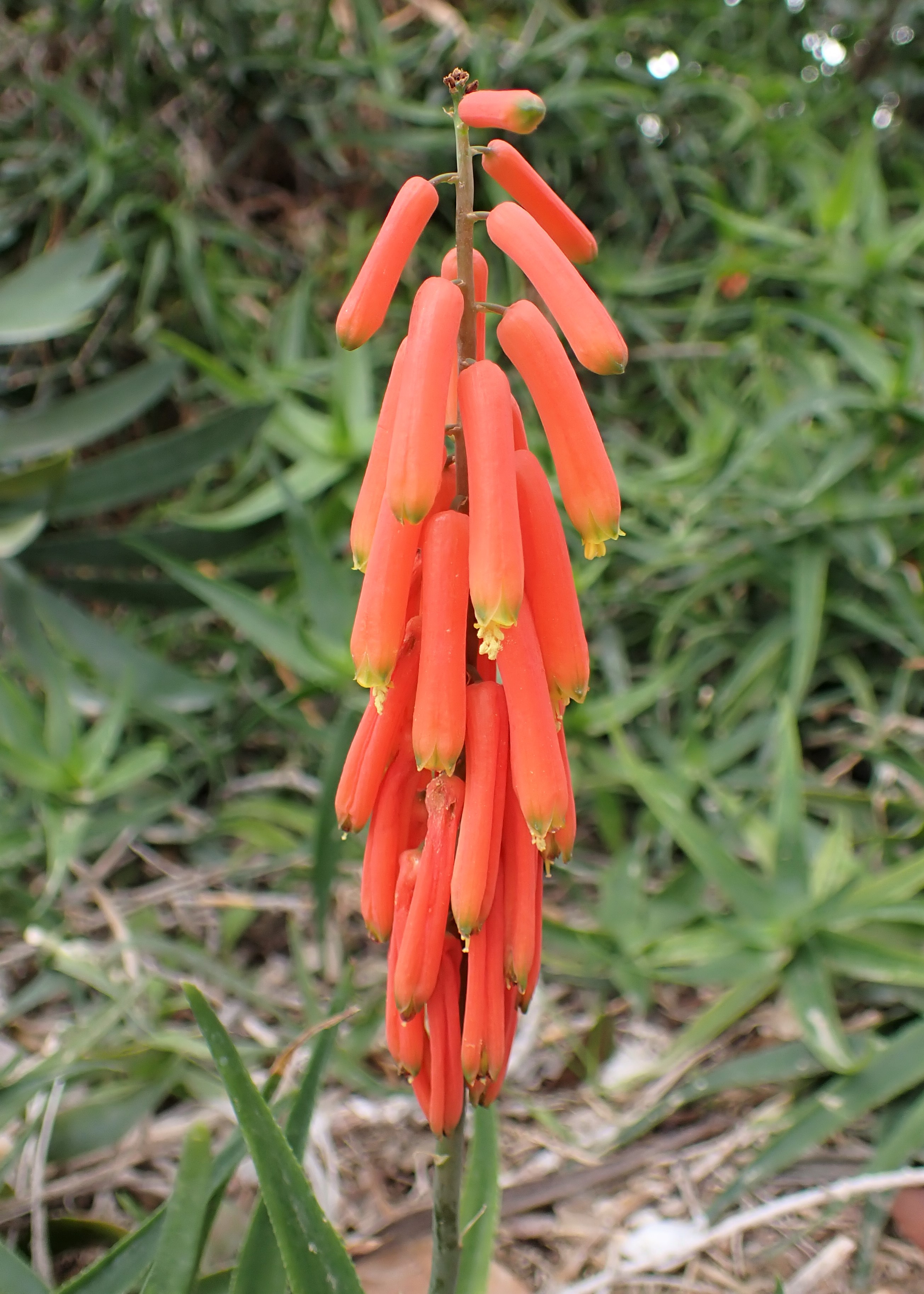
ecoTubular flowers 3–3.5 cm, scarlet-red to vivid orange, in dense cylindrical simple racemes on short scapes. Flowering mainly in the austral winter (May–August), with sporadic periods year-round in cultivation.
ecoFibrous and extensive root system anchoring the stems in coastal scrubland soil and enabling rapid regeneration after fire.
ecochevron_right edit_note Proposed edits auto-approved at +3 net votes
No pending proposals for this section.
Requirements
Soil & Substrate
Type
Accepts a wide range of soils: from sandy-loam to clay, always with good drainage. Very adaptable.
groups Beneficial Associations
chevron_right edit_note Proposed edits auto-approved at +3 net votes
No pending proposals for this section.
Propagation Strategy
- 1 Cut stem sections 15–25 cm with at least 3–4 leaf nodes.
- 2 Allow ends to dry 1–2 days in a shaded spot.
- 3 Plant in moist and well-drained substrate, burying 5–8 cm.
- 4 Keep at warm temperature (20–28 °C) with indirect light until rooted.
- 1 Sow fresh seeds in sand and perlite mix.
- 2 Keep substrate moist at 24–28 °C with diffuse light.
- 3 Transplant when seedlings reach 4–5 cm.
T
Not providing support, causing stems to collapse to the ground.
Primarily a garden species. In large pots: every 2–3 years.
Balanced liquid fertilizer every 4–6 weeks during spring and summer. Suspend in winter.
Uses & Applications
Precautions / Toxicity
Probably toxic to pets and humans if ingested in quantity, like all aloes. Topical gel is generally harmless.
chevron_right edit_note Proposed edits auto-approved at +3 net votes
No pending proposals for this section.
Plant Health
chevron_right edit_note Proposed edits auto-approved at +3 net votes
No pending proposals for this section.
"Aloiampelos ciliaris is the type species of the genus Aloiampelos, segregated from Aloe in the 2013 molecular reclassification (Klopper & Gideon F. Smith). The genus includes species previously in the subgenus Aloe sect. Macrifoliae. The white, soft cilia on the leaf sheath are the diagnostic character distinguishing this genus from all others. This species holds the record for the fastest growth rate among aloes: under ideal conditions it can elongate more than 1 cm per day."
chevron_right edit_note Proposed edits auto-approved at +3 net votes
No pending proposals for this section.
Scientific Integrity
🟡 MediumVote to help validate this record
Sources
Loading…
Discussion
Disclaimer
This species record is provided for educational and informational purposes only. Jardín Roca Negra does not guarantee the accuracy or completeness of the data. Content is community-curated and may be subject to revision; it should not replace advice from a qualified botanist. This species may be toxic, invasive, or subject to legal restrictions — verify before handling or cultivating. Jardín Roca Negra accepts no liability for any harm arising from reliance on this information. Images are reproduced under Creative Commons or equivalent free licenses; credits are noted below each image.