
Cotyledon papillaris L.f.
Papillose Cotyledon
Cotyledon papillaris is a small shrubby succulent restricted mainly to the Central and Western Karoo of South Africa, growing on quartzite and shale rocky slopes. Its leaves display small surface papillae giving a characteristic rough texture, from which the species name derives, clearly differentiating it from smooth-surfaced Cotyledon species.
chevron_right edit_note Proposed edits auto-approved at +3 net votes
No pending proposals for this section.
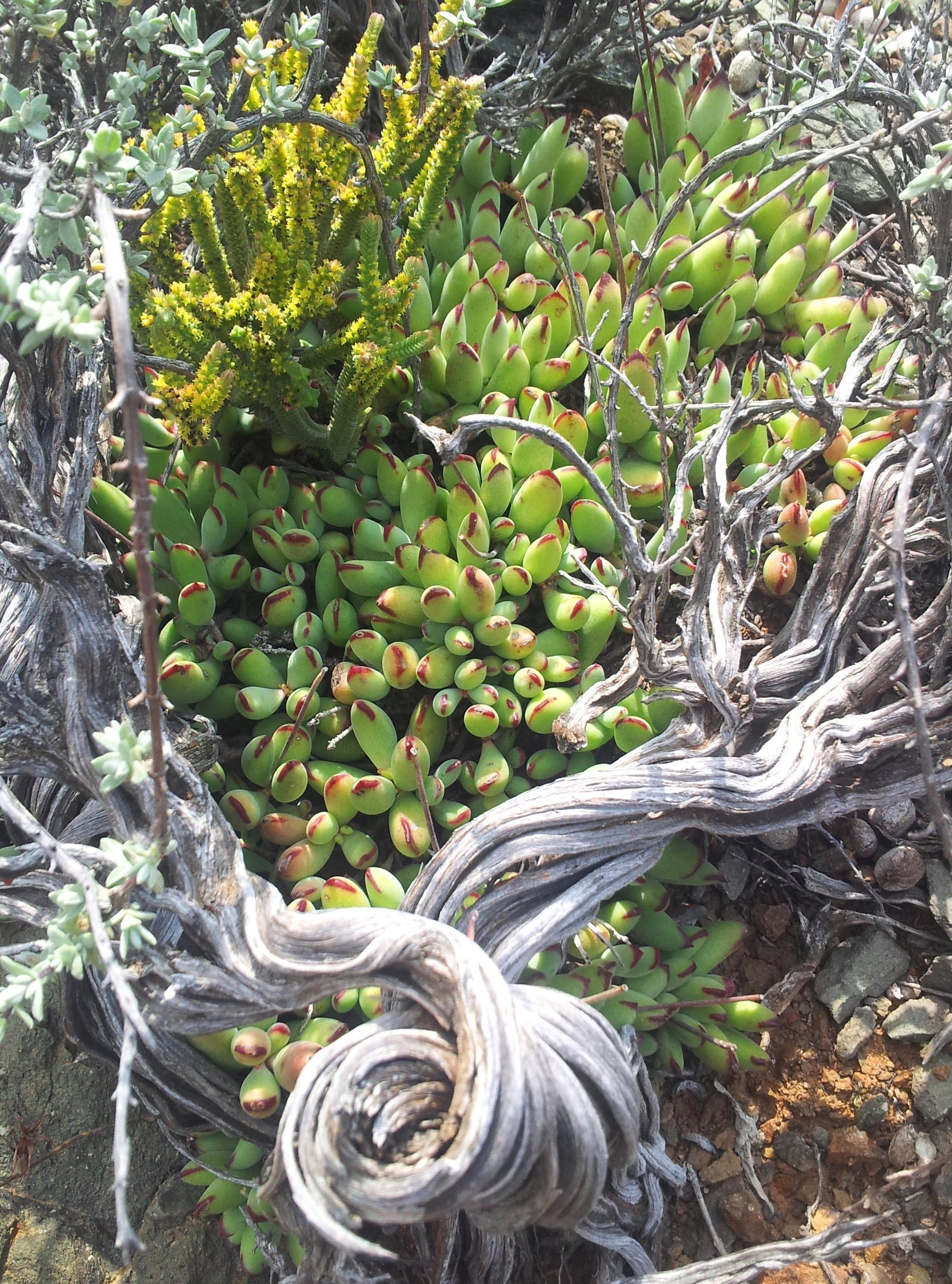
© S Molteno
CC0
Overview
| Category | Classification |
|---|---|
| Family | Crassulaceae |
| Genus | Cotyledon |
| Growth Habit | Compact shrub 15–35 cm; heavily branched from the base; dense and compact appearance. |
| Conservation Status | Not formally assessed by IUCN; relatively restricted distribution in the Karoo; habitat threatened by agricultural expansion. |
| pH Target | 5.5 – 6.5 |
| Type | Quartzite-shale, extremely poor, very acidic to neutral, no water retention. |
Origin & Habitat
Morphology
Obovate-cuneate leaves 2.5–6 cm long, surface covered in minute papillae giving rough tactile feel; grey-green to blue-green color; thin farina; entire margin; obtuse to truncate apex.
ecoSucculent stem 0.3–0.8 cm diameter, heavily branched; semi-woody base; grey epidermis.
ecoPendant tubular flowers orange-yellow to orange, 1.5–2 cm long; inflorescences shorter than in other Cotyledon (15–25 cm); austral summer flowering.
ecoCompact and shallow root system, adapted to very thin quartzite soils with negligible organic matter.
ecochevron_right edit_note Proposed edits auto-approved at +3 net votes
No pending proposals for this section.
Requirements
Soil & Substrate
Type
Quartzite-shale, extremely poor, very acidic to neutral, no water retention.
groups Beneficial Associations
chevron_right edit_note Proposed edits auto-approved at +3 net votes
No pending proposals for this section.
Propagation Strategy
- 1 Wearing gloves, cut a stem with several finger-like papillate leaves 5–8 cm long with sterilised scissors.
- 2 Remove leaves from the lower third of the cutting.
- 3 Allow the cut to cure on a dry, shaded surface for 3–4 days.
- 4 Plant vertically in well-draining cactus mix with perlite; the finger-like structure makes the cutting more stable than in other species.
- 5 Water very sparingly; keep in very bright light.
- 1 Wearing gloves, carefully detach a healthy finger-like leaf by twisting.
- 2 Allow to dry for 4–5 days on a dry tray.
- 3 Lay horizontally on cactus mix; the cylindrical leaves can be rested lengthwise.
- 4 Mist with water once a week until roots and small basal plantlets appear.
⚠️ TOXICITY: All parts of Cotyledon papillaris contain bufadienolides and are toxic to humans and animals. Always wear gloves and keep away from pets and children.
Using substrate rich in organic matter that retains excessive moisture, rotting the roots of this sensitive species.
Repot every 2–3 years in spring. Being a small, slow-growing shrub, it does not require large pots; go up one size (2–3 cm extra).
Fertilise once a month from spring to summer with liquid cactus fertiliser at half dose. No fertilisation in autumn and winter.
Uses & Applications
Precautions / Toxicity
TOXIC — bufadienolides present throughout the plant; toxic to domestic animals and livestock. Do not ingest.
chevron_right edit_note Proposed edits auto-approved at +3 net votes
No pending proposals for this section.
"The papillae of C. papillaris have been studied via scanning electron microscopy, revealing a microarchitecture that increases leaf surface area by ~20% compared to smooth leaves of equal size, possibly optimizing absorption of the scarce Karoo night mist."
chevron_right edit_note Proposed edits auto-approved at +3 net votes
No pending proposals for this section.
Scientific Integrity
🟡 MediumVote to help validate this record
Sources
Loading…
Discussion
Disclaimer
This species record is provided for educational and informational purposes only. Jardín Roca Negra does not guarantee the accuracy or completeness of the data. Content is community-curated and may be subject to revision; it should not replace advice from a qualified botanist. This species may be toxic, invasive, or subject to legal restrictions — verify before handling or cultivating. Jardín Roca Negra accepts no liability for any harm arising from reliance on this information. Images are reproduced under Creative Commons or equivalent free licenses; credits are noted below each image.