
Cotyledon orbiculata L.
Pig's Ear / Round-Leafed Navelwort
Cotyledon orbiculata, known as Pig's Ear or Round-Leafed Navel-Wort, is a widely distributed shrubby succulent across South Africa and Namibia, colonizing rocky slopes, degraded fynbos, and roadsides from sea level to over 2,000 m elevation. It is the most variable and widespread species in the genus, with remarkable morphological plasticity that has generated dozens of recognized varieties.
chevron_right edit_note Proposed edits auto-approved at +3 net votes
No pending proposals for this section.
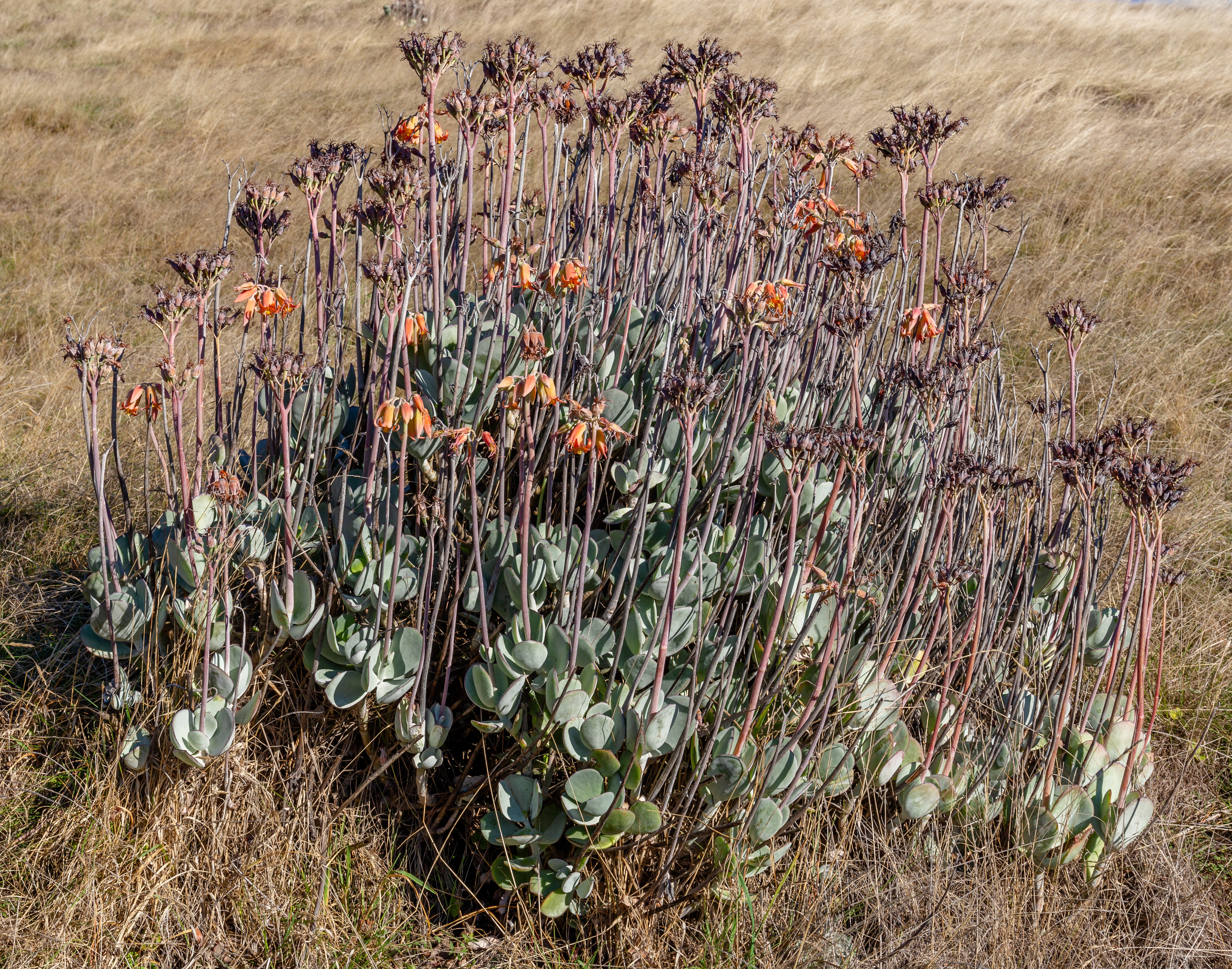
© JJ Harrison
CC BY-SA 2.5
Overview
| Category | Classification |
|---|---|
| Family | Crassulaceae |
| Genus | Cotyledon |
| Growth Habit | Erect to prostrate shrubby succulent 0.3–1.3 m tall; heavily branched from the base; stem lignified in mature plants. |
| Conservation Status | Least Concern (LC) per IUCN; abundant across its native range although some local varieties may be more restricted. |
| pH Target | 6.0 – 7.5 |
| Type | Sandy loam, calcareous or siliceous; well-drained; tolerates impoverished and degraded soils. |
Origin & Habitat
Morphology
Highly variable leaves: obovate to orbicular, 4–14 cm long, flat to subcylindrical; grey-green to near-white, sometimes with a red or yellow margin; coated in waxy farina. Varieties may have finely mottled leaves or be completely white-powdered.
ecoMain stem robust and lignified at the base, up to 2 cm diameter in mature plants; branches succulent and greyish; bark grey-brown in old specimens.
ecoInflorescences in umbel-like cymes 30–60 cm; tubular-campanulate pendant flowers orange to orange-red, 2–3 cm long; appearing November to February (austral summer) or spring in the northern hemisphere.
ecoModerately deep root system for a succulent; main woody roots and secondary fibrous absorbing roots; sensitive to asphyxiation in compact clay soils.
ecochevron_right edit_note Proposed edits auto-approved at +3 net votes
No pending proposals for this section.
Requirements
Soil & Substrate
Type
Sandy loam, calcareous or siliceous; well-drained; tolerates impoverished and degraded soils.
groups Beneficial Associations
chevron_right edit_note Proposed edits auto-approved at +3 net votes
No pending proposals for this section.
Propagation Strategy
- 1 Cut a healthy stem 8–12 cm long with sterilised scissors, wearing gloves due to the plant's toxicity.
- 2 Remove lower leaves, leaving 2–3 cm of bare stem.
- 3 Allow the cut end to callous in a dry, shaded spot for 2–3 days.
- 4 Insert the stem into well-draining cactus mix and water lightly to settle.
- 5 Keep at 18–24 °C in bright indirect light; water sparingly until rooted.
- 1 Wearing gloves, remove a healthy fleshy leaf with a gentle twisting motion to detach it cleanly from the stem.
- 2 Let the leaf rest on kitchen paper in the shade for 3–5 days to form a callous at the base.
- 3 Place the leaf on moist cactus mix with the base lightly touching the surface.
- 4 Keep in a warm spot with indirect light; mist the substrate lightly every 4–5 days.
- 5 Once roots and a small basal rosette appear (6–10 weeks), transplant to an individual pot.
- 1 Sow seeds on the surface of a tray with fine moist cactus mix without covering.
- 2 Cover the tray with cling film or a lid to maintain humidity and a temperature of 20–25 °C.
- 3 Keep under bright indirect light; ventilate daily to prevent fungal issues.
- 4 Once seedlings reach 2–3 cm, transplant individually wearing gloves.
⚠️ TOXICITY: All parts of Cotyledon orbiculata are toxic to humans, pets and livestock (bufadienolides). Always wear gloves when handling and keep away from children and animals.
Overwatering or leaving standing water in the saucer, causing root and crown rot — the most common and fatal mistake.
Repot every 2–3 years in spring, or when roots emerge from drainage holes. Choose a terracotta pot only 2–3 cm larger than the previous one to avoid excess moist substrate.
Fertilise once a month in spring and summer with liquid cactus fertiliser diluted to half the recommended dose. Do not fertilise in autumn or winter.
Uses & Applications
Precautions / Toxicity
TOXIC — contains bufadienolides (cotyledonoside D and others) that are cardiotoxic. Causes «cotyledonosis» in sheep and goats: trembling, paralysis, death. DANGEROUS to dogs, cats, and livestock. Leaves must not be ingested. Keep away from pets and children.
chevron_right edit_note Proposed edits auto-approved at +3 net votes
No pending proposals for this section.
"The bufadienolides of C. orbiculata have been studied for possible antitumor activity in vitro, though no derivative has advanced to clinical trials. The species is a model organism in veterinary toxicology due to the frequency of ovine poisonings in South Africa."
chevron_right edit_note Proposed edits auto-approved at +3 net votes
No pending proposals for this section.
Scientific Integrity
🟡 MediumVote to help validate this record
Sources
Loading…
Discussion
Disclaimer
This species record is provided for educational and informational purposes only. Jardín Roca Negra does not guarantee the accuracy or completeness of the data. Content is community-curated and may be subject to revision; it should not replace advice from a qualified botanist. This species may be toxic, invasive, or subject to legal restrictions — verify before handling or cultivating. Jardín Roca Negra accepts no liability for any harm arising from reliance on this information. Images are reproduced under Creative Commons or equivalent free licenses; credits are noted below each image.