
Pachyphytum longifolium Rose
Long-Leaved Pachyphytum
Pachyphytum longifolium, or Long-Leaved Pachyphytum, stands out within the genus for bearing the longest leaves of all its congeners, with a subterete and lanceolate form that contrasts with the ovoid and globose leaves of other species. It is endemic to Mexico (Hidalgo, Puebla), colonizing vertical cliff faces and limestone ledges between 1,500 and 2,200 m elevation.
chevron_right edit_note Proposed edits auto-approved at +3 net votes
No pending proposals for this section.
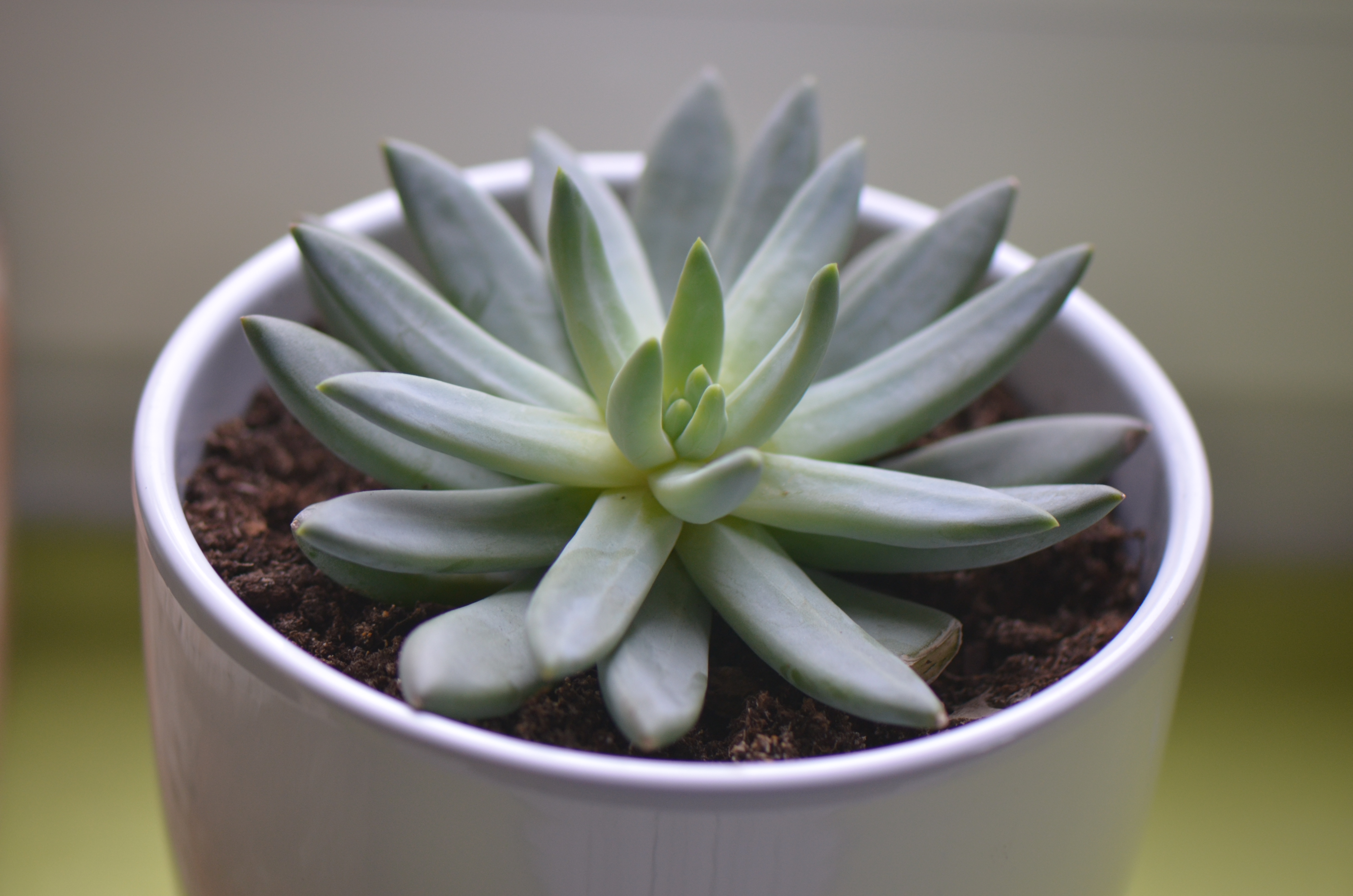
© Jean.claude
CC BY-SA 3.0
Overview
| Category | Classification |
|---|---|
| Family | Crassulaceae |
| Genus | Pachyphytum |
| Growth Habit | Open, lax rosette on erect stem; produces basal offsets less frequently than other genus species; tendency to grow pendantly from cliff faces. |
| Conservation Status | Not assessed; Sierra Madre Oriental endemic; potentially threatened by habitat degradation in calcareous semiarid zones of Hidalgo and Puebla. |
| pH Target | 6.0 – 7.0 |
| Type | Calcareous-rocky, extremely poor and dry; analogous to vertical wall ledge substrate. |
Origin & Habitat
Morphology
Lanceolate-subterete leaves 6–12 cm long, notably longer and narrower than in the rest of the genus; blue-green with fine farina; acute apex. Arranged in a lax rosette that can open considerably.
ecoErect stem 15–30 cm, relatively elongated; in natural habitat grows from vertical fissures with leaves hanging freely.
ecoErect raceme 30–50 cm; tubular orange-red to coral flowers, with petals of greater relative length than in other species; spring flowering.
ecoThin, deep fibrous roots adapted to deep vertical fissures; high efficiency of water extraction from very dry substrates.
ecochevron_right edit_note Proposed edits auto-approved at +3 net votes
No pending proposals for this section.
Requirements
Soil & Substrate
Type
Calcareous-rocky, extremely poor and dry; analogous to vertical wall ledge substrate.
groups Beneficial Associations
chevron_right edit_note Proposed edits auto-approved at +3 net votes
No pending proposals for this section.
Propagation Strategy
- 1 Select a fully mature, long narrow leaf; gently twist it until it detaches cleanly at the base without breaking.
- 2 Hold the leaf only at its base and allow it to callus for 2–4 days in a ventilated spot with indirect light.
- 3 Lay the leaf horizontally on dry mineral substrate; the leaf's length requires enough surface to support it well.
- 4 Lightly mist the substrate every 6–8 days; roots and plantlets will appear in 4–7 weeks.
- 5 Transplant individually with tweezers when plantlets reach 1–2 cm.
- 1 Cut a 6–10 cm stem with rosette of elongated leaves using sterilized scissors.
- 2 Remove lower leaves by holding only their base for additional leaf propagation.
- 3 Callus the cut for 3–5 days in an airy spot without intense direct sun.
- 4 Plant in dry mineral substrate and begin gentle watering 7–10 days after planting.
Never touch the pruina/farina; handle leaves and stems at their base only. Fingerprints permanently damage the coating.
Touching the leaves with fingers and permanently removing the characteristic pruina.
Every 2–3 years in spring. Use shallow terracotta pots with predominantly inorganic substrate.
Once a month in spring and summer with cactus fertilizer at half dose. No fertilization in autumn-winter.
Uses & Applications
Precautions / Toxicity
No documented toxicity; safe for humans and domestic pets.
chevron_right edit_note Proposed edits auto-approved at +3 net votes
No pending proposals for this section.
"The leaf length of P. longifolium is a case of adaptive morphology: on vertical walls, longer leaves capture reflected light from low angles throughout much of the day. This species produces natural hybrids with Echeveria when populations coexist on the same ledge."
chevron_right edit_note Proposed edits auto-approved at +3 net votes
No pending proposals for this section.
Scientific Integrity
🟡 MediumVote to help validate this record
Sources
Loading…
Discussion
Disclaimer
This species record is provided for educational and informational purposes only. Jardín Roca Negra does not guarantee the accuracy or completeness of the data. Content is community-curated and may be subject to revision; it should not replace advice from a qualified botanist. This species may be toxic, invasive, or subject to legal restrictions — verify before handling or cultivating. Jardín Roca Negra accepts no liability for any harm arising from reliance on this information. Images are reproduced under Creative Commons or equivalent free licenses; credits are noted below each image.