
Aloe marlothii A.Berger
Mountain aloe
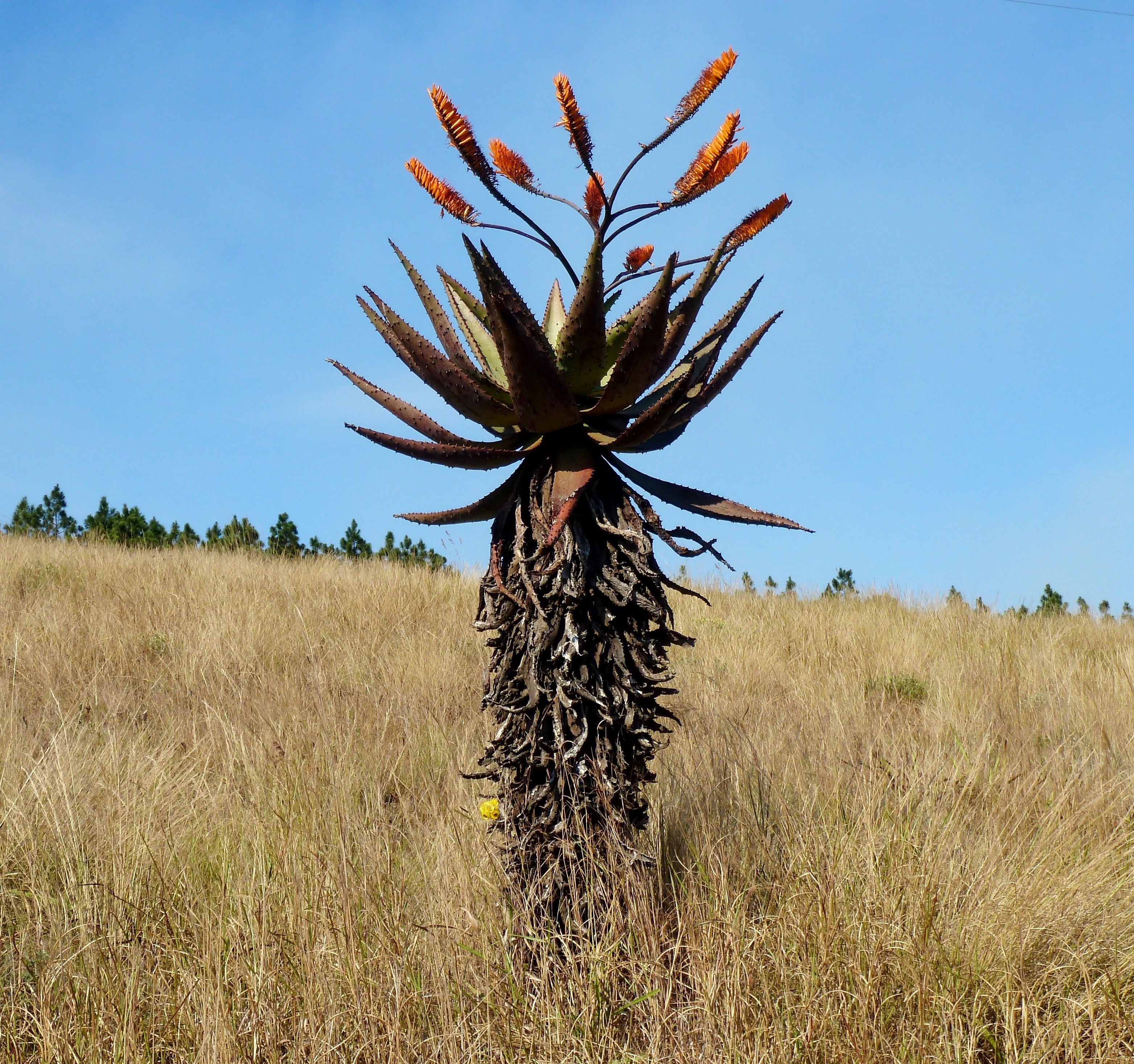
Iconic mountain aloe reaching up to 6 metres in height, forming a robust trunk covered by a skirt of dead leaves. Its orange flowers appear in horizontal clusters that attract nectar-feeding birds during the South African winter. It is one of the most recognisable aloe species in South Africa.
chevron_right edit_note Proposed edits auto-approved at +3 net votes
No pending proposals for this section.
Overview
| Category | Classification |
|---|---|
| Family | Asphodelaceae |
| Genus | Aloe |
| Growth Habit | Solitary arborescent |
| Conservation Status | Least Concern (LC) — IUCN |
| pH Target | 6.0–7.5 |
| Type | Rocky, sandy, well-drained |
Origin & Habitat
Morphology
Long, lanceolate leaves, greyish-green with faint spots on juvenile plants, margins with robust reddish-brown spines. Can reach 1.5 m in length in adult specimens.
ecoSolitary, erect trunk that can exceed 6 m in height, with a considerable base diameter. Covered by a characteristic skirt of persistent dry leaves.
ecoPaniculate inflorescences with numerous horizontal branches bearing tubular orange to orange-red flowers. Flowering during the austral winter (June–August).
ecoDeep and spreading root system that anchors the trunk in rocky hillside soils. Thick and fibrous roots.
ecochevron_right edit_note Proposed edits auto-approved at +3 net votes
No pending proposals for this section.
Requirements
Soil & Substrate
Type
Rocky, sandy, well-drained
groups Beneficial Associations
chevron_right edit_note Proposed edits auto-approved at +3 net votes
No pending proposals for this section.
Propagation Strategy
- 1 Sow in sandy, well-drained substrate.
- 2 Keep slightly moist at 22–26 °C.
- 3 Germination in 2–4 weeks.
- 4 Transplant seedlings when they reach 5 cm in height.
Plant in rocky or very well-drained soils.
Overwatering causes rot at the base of the trunk.
Only during juvenile stages; once established it does not require repotting.
Minimal fertilisation; apply balanced fertiliser once a year in spring.
Uses & Applications
Precautions / Toxicity
Mildly toxic to pets if ingested in large quantities.
chevron_right edit_note Proposed edits auto-approved at +3 net votes
No pending proposals for this section.
"One of the most spectacular aloe species in South Africa, often used as an anchor species in local wildlife conservation gardens."
chevron_right edit_note Proposed edits auto-approved at +3 net votes
No pending proposals for this section.
Scientific Integrity
🟢 HighVote to help validate this record
Sources
Loading…
Discussion
Disclaimer
This species record is provided for educational and informational purposes only. Jardín Roca Negra does not guarantee the accuracy or completeness of the data. Content is community-curated and may be subject to revision; it should not replace advice from a qualified botanist. This species may be toxic, invasive, or subject to legal restrictions — verify before handling or cultivating. Jardín Roca Negra accepts no liability for any harm arising from reliance on this information. Images are reproduced under Creative Commons or equivalent free licenses; credits are noted below each image.