
Aloe haworthioides Baker
Haworthia-like aloe
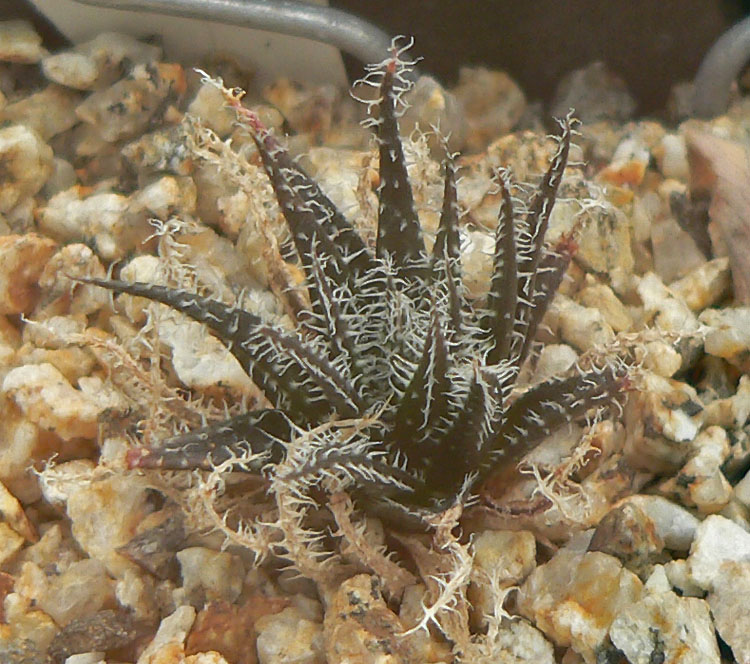
Aloe haworthioides is a miniature aloe endemic to the granite outcrops of the highlands of central Madagascar, whose 2–4 cm rosettes with tuberculate leaves and white bristle tips strongly resemble the genus Haworthia, hence its name. It is one of the smallest aloes in the world and a highly prized collector's gem, with delicate miniature orange flowers that exceed the plant in height several times over.
chevron_right edit_note Proposed edits auto-approved at +3 net votes
No pending proposals for this section.
Overview
| Category | Classification |
|---|---|
| Family | Asphodelaceae |
| Genus | Aloe |
| Growth Habit | Dense miniature rosette, solitary or in small clusters |
| Conservation Status | Vulnerable |
| pH Target | 5.5–6.5 |
| Type | Fine crushed granite, acidic altitude Malagasy lithosol |
Origin & Habitat
Morphology
Triangular-lanceolate leaves 1.5–3 cm long, dark green with white tubercles on both surfaces and apex bearing a white bristle 2–4 mm long.
ecoNo apparent stem; the 2–4 cm diameter rosette grows directly on granite in depressions with sparse soil.
ecoMinute tubular flowers 1–1.5 cm long, orange, on slender peduncles 8–15 cm tall with 5–12 flowers per raceme.
ecoVery fine and branched roots penetrating granite micro-fissures, exploiting accumulated humus.
ecochevron_right edit_note Proposed edits auto-approved at +3 net votes
No pending proposals for this section.
Requirements
Soil & Substrate
Type
Fine crushed granite, acidic altitude Malagasy lithosol
groups Beneficial Associations
chevron_right edit_note Proposed edits auto-approved at +3 net votes
No pending proposals for this section.
Propagation Strategy
- 1 Sow in fine crushed granite with 10 % cactus mix at 20–24 °C.
- 2 Moisten slightly with fine spray; cover with perforated film.
- 3 Irregular germination in 3–8 weeks; do not remove film until 2 leaves are visible.
- 4 Seedlings are extremely small; handle with tweezers under a loupe.
- 1 Separate individual rosettes from mature clusters with a sterile scalpel in spring.
- 2 Allow cuts to callus for 3–4 days in a cool dry environment.
- 3 Plant in crushed granite; water very lightly after 10 days.
- 4 Root in 5–8 weeks under cool altitude conditions.
Use very small terracotta pots (3–5 cm) to replicate the granitic microhabitat.
Watering at the same frequency as normal-sized aloes, causing rapid rot.
Every 4–5 years; almost never needed due to its minimal size
Very diluted acidic fertilizer (pH 5.5–6.0) for succulents, once a year in spring
Uses & Applications
Precautions / Toxicity
Toxic if ingested; minimal size reduces practical risk.
chevron_right edit_note Proposed edits auto-approved at +3 net votes
No pending proposals for this section.
"A. haworthioides is a case of extreme morphological convergence with the genus Haworthia (subfamily Asphodeloideae); the white tubercles with apical bristles are functionally similar to those of Haworthia but arose independently, making it a classic example of convergent evolution in succulents of granitic environments in Africa and Madagascar."
chevron_right edit_note Proposed edits auto-approved at +3 net votes
No pending proposals for this section.
Scientific Integrity
🟡 MediumVote to help validate this record
Sources
Loading…
Discussion
Disclaimer
This species record is provided for educational and informational purposes only. Jardín Roca Negra does not guarantee the accuracy or completeness of the data. Content is community-curated and may be subject to revision; it should not replace advice from a qualified botanist. This species may be toxic, invasive, or subject to legal restrictions — verify before handling or cultivating. Jardín Roca Negra accepts no liability for any harm arising from reliance on this information. Images are reproduced under Creative Commons or equivalent free licenses; credits are noted below each image.