
Pachyphytum oviferum J.A.Purpus
Moonstones / Sugar Almond Plant
Pachyphytum oviferum, commonly called Moonstones, is a cliff-dwelling succulent endemic to limestone escarpments in San Luis Potosí, Mexico. Its plump, opalescent leaves coated in a dense chalky-blue farina give the plant an almost mineral appearance, making it one of the most sought-after ornamental succulents globally.
chevron_right edit_note Proposed edits auto-approved at +3 net votes
No pending proposals for this section.
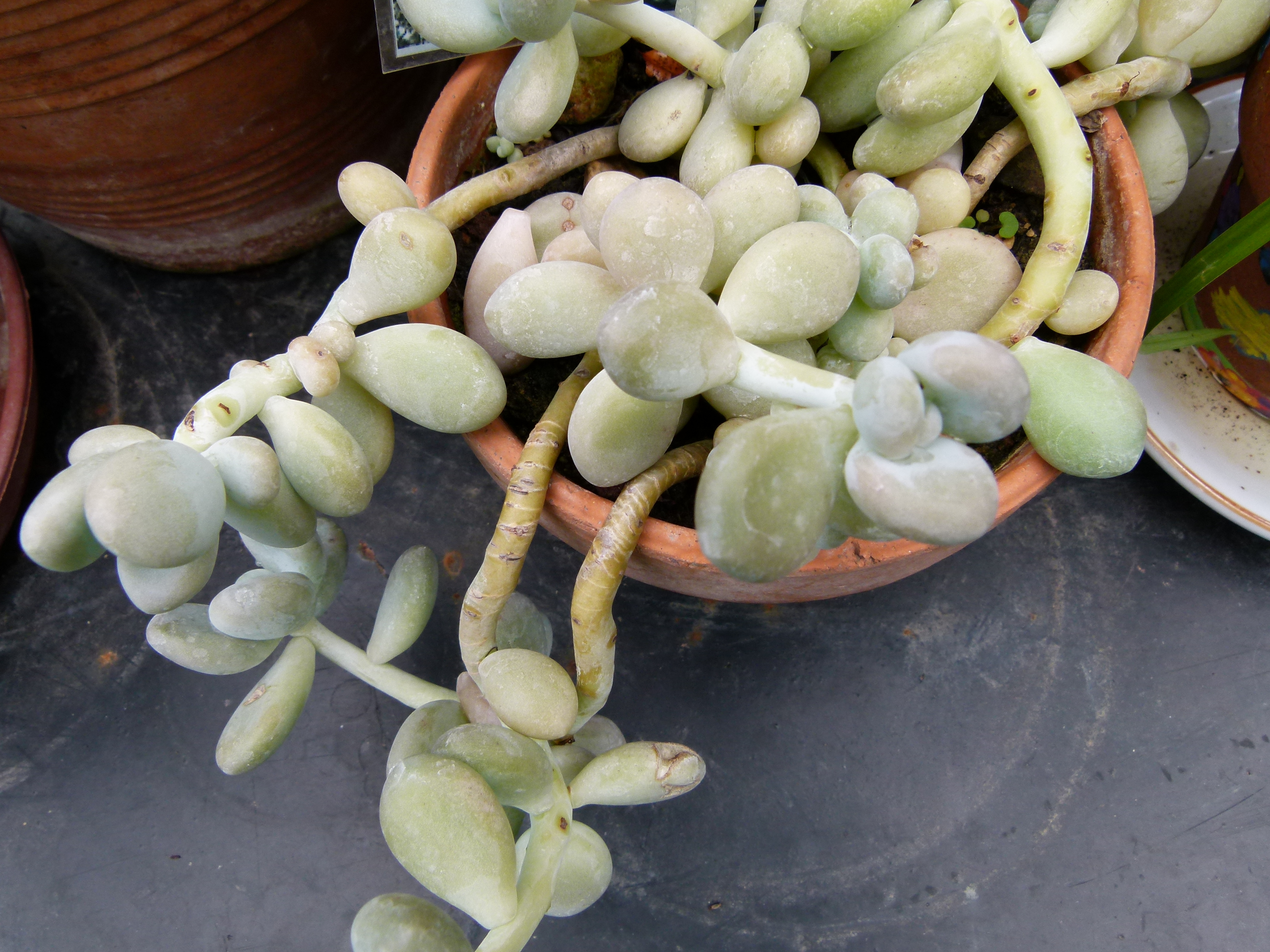
© Didier Descouens
CC BY-SA 4.0
Overview
| Category | Classification |
|---|---|
| Family | Crassulaceae |
| Genus | Pachyphytum |
| Growth Habit | Compact, acaulescent to subcaulescent rosette; slowly branching from the base; stems become prostrate with age. |
| Conservation Status | Not globally assessed by IUCN; Mexican endemic subject to illegal wild collection in San Luis Potosí state. |
| pH Target | 6.0 – 7.0 |
| Type | Calcareous-sandy, highly permeable, low in organic matter; mimics natural cliff substrate. |
Origin & Habitat
Morphology
Ovoid to globose leaves 2–4 cm long arranged in a loose rosette; surface completely covered in a powdery blue-silver farina that rubs off easily. Underlying color white-green to pale lavender; flesh very succulent and brittle.
ecoStem short and erect in young plants, becoming prostrate and branched with age; marked by leaf scars arranged in a distinct helical pattern.
ecoInflorescences are pendant racemes 20–30 cm long; tubular 5-petaled flowers, red to orange-coral, appearing January through April; sepals also pruinose.
ecoShallow fibrous root system, adapted to growing in limestone rock fissures with minimal organic substrate accumulation.
ecochevron_right edit_note Proposed edits auto-approved at +3 net votes
No pending proposals for this section.
Requirements
Soil & Substrate
Type
Calcareous-sandy, highly permeable, low in organic matter; mimics natural cliff substrate.
groups Beneficial Associations
chevron_right edit_note Proposed edits auto-approved at +3 net votes
No pending proposals for this section.
Propagation Strategy
- 1 Select a healthy, mature leaf from the rosette; gently twist it side to side until it detaches cleanly from the base without breaking.
- 2 Hold the leaf only at its base and place it in a warm spot with indirect light for 2–3 days until the wound calluses.
- 3 Lay the leaf on dry cactus mix without burying it; keep away from intense direct light.
- 4 Lightly mist the substrate around the leaf base every 5–7 days; roots and small plantlets will appear in 3–5 weeks.
- 5 Once plantlets reach 1–2 cm, transplant them to their own pot with well-draining substrate.
- 1 With sterilized scissors, cut a stem of 5–8 cm that has at least one healthy rosette.
- 2 Remove the 2–3 lowest leaves by holding only their base to avoid smudging the pruina of the upper leaves.
- 3 Allow the cut end to callus in an airy spot out of direct sun for 3–5 days.
- 4 Plant the cutting in dry cactus mix, burying only the leafless segment; water for the first time after 7 days.
- 5 In 3–6 weeks it will be rooted; resume normal watering and place in bright indirect light.
- 1 Sow on the surface of fine, well-draining substrate that is lightly moist; do not cover the seeds.
- 2 Place a transparent cover to retain humidity at 20–25 °C.
- 3 Seedlings emerge in 2–4 weeks; gradually remove the cover to acclimate them to open air.
- 4 Transplant individually once seedlings reach 1 cm and begin to show the species' characteristic texture.
Never touch the pruina/farina; handle leaves and stems at their base only. Fingerprints permanently damage the silvery-lavender coating.
Touching the leaves with bare fingers during propagation, irreversibly removing the species' characteristic pruina.
Every 2–3 years in spring, or when roots protrude from drainage holes. Prefers small, shallow terracotta pots.
Fertilize once a month during spring and summer with a cactus fertilizer diluted to half the recommended dose. No fertilization in autumn and winter.
Uses & Applications
Precautions / Toxicity
No known toxins reported for humans or pets; however, the farina may irritate mucous membranes if ingested in large quantities. Considered low toxicity.
chevron_right edit_note Proposed edits auto-approved at +3 net votes
No pending proposals for this section.
"The farina is an epicuticular wax layer that acts as a UV shield and reduces water loss — it must not be touched as it does not regenerate on the same leaf. The epithet «oviferum» means «egg-bearing» in Latin, referencing the shape of the leaves."
chevron_right edit_note Proposed edits auto-approved at +3 net votes
No pending proposals for this section.
Scientific Integrity
🟡 MediumVote to help validate this record
Sources
Loading…
Discussion
Disclaimer
This species record is provided for educational and informational purposes only. Jardín Roca Negra does not guarantee the accuracy or completeness of the data. Content is community-curated and may be subject to revision; it should not replace advice from a qualified botanist. This species may be toxic, invasive, or subject to legal restrictions — verify before handling or cultivating. Jardín Roca Negra accepts no liability for any harm arising from reliance on this information. Images are reproduced under Creative Commons or equivalent free licenses; credits are noted below each image.