
Aloe bolusii Baker
Bolus' aloe
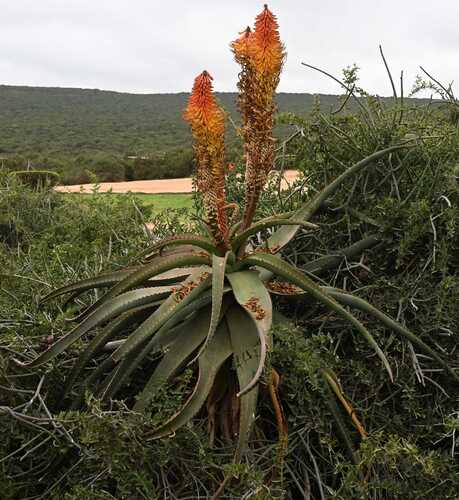
Aloe bolusii is a compact montane grassland aloe from the Eastern Cape and the Lesotho Highlands, where it grows at 1000–2000 m elevation. Its rosettes of grey-green leaves with red marginal teeth settle on wind-exposed rocky slopes. It produces showy orange flowers in winter that contrast with the burnt grasslands of the dry season.
chevron_right edit_note Proposed edits auto-approved at +3 net votes
No pending proposals for this section.
Overview
| Category | Classification |
|---|---|
| Family | Asphodelaceae |
| Genus | Aloe |
| Growth Habit | Compact stemless to short-stemmed rosette |
| Conservation Status | Least Concern |
| pH Target | 6.0–7.0 |
| Type | Basaltic or sandstone very well-draining soil, neutral pH |
Origin & Habitat
Morphology
Leaves 25–40 cm long, grey-green, with red marginal teeth 3–4 mm long and a slightly rough surface.
ecoVery short or absent; in mature plants may reach 10–20 cm, covered with dry leaves.
ecoTubular flowers 3.5 cm long, bright orange-red, in simple racemes on 50–70 cm peduncles. Flowering June–August.
ecoRobust fibrous roots that penetrate deep between the rocks of the Drakensberg and Lesotho Highlands.
ecochevron_right edit_note Proposed edits auto-approved at +3 net votes
No pending proposals for this section.
Requirements
Soil & Substrate
Type
Basaltic or sandstone very well-draining soil, neutral pH
groups Beneficial Associations
chevron_right edit_note Proposed edits auto-approved at +3 net votes
No pending proposals for this section.
Propagation Strategy
- 1 Cold-stratify (5 °C, 3 weeks) before sowing to simulate winter.
- 2 Sow in rocky sandy substrate at 15–18 °C.
- 3 Germinates in 2–5 weeks.
- 4 Transplant individually when 5 cm tall.
- 1 Separate offsets in spring with a clean knife.
- 2 Dry for 2–3 days in an airy place.
- 3 Plant in rocky substrate and keep dry for 2 weeks.
- 4 They root in 6–8 weeks.
One of the most cold-tolerant aloes; suitable for mountain gardens in Europe.
Watering in a wet European winter without water protection, causing rot.
Every 3–4 years in spring
Slow-release mineral granular fertilizer, once in spring
Uses & Applications
Precautions / Toxicity
Toxic if ingested in quantity.
chevron_right edit_note Proposed edits auto-approved at +3 net votes
No pending proposals for this section.
"Named in honour of Harry Bolus, a 19th-century South African botanist and founder of the Bolus Herbarium at the University of Cape Town, which houses the largest South African botanical collection."
chevron_right edit_note Proposed edits auto-approved at +3 net votes
No pending proposals for this section.
Scientific Integrity
🟡 MediumVote to help validate this record
Sources
Loading…
Discussion
Disclaimer
This species record is provided for educational and informational purposes only. Jardín Roca Negra does not guarantee the accuracy or completeness of the data. Content is community-curated and may be subject to revision; it should not replace advice from a qualified botanist. This species may be toxic, invasive, or subject to legal restrictions — verify before handling or cultivating. Jardín Roca Negra accepts no liability for any harm arising from reliance on this information. Images are reproduced under Creative Commons or equivalent free licenses; credits are noted below each image.