
Aloe barbertoniae Pole-Evans
Barberton aloe
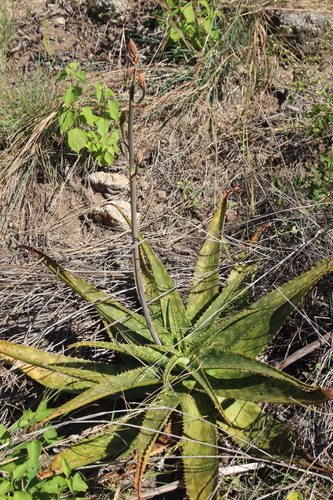
Aloe barbertoniae is a single-stemmed medium-sized aloe native to the low-altitude bushveld around Barberton in Mpumalanga (South Africa) and bordering areas of Eswatini. Its blue-green leaves with reddish marginal teeth are characteristic; it produces orange-red flower clusters in winter that attract sunbirds and other nectar-feeding birds.
chevron_right edit_note Proposed edits auto-approved at +3 net votes
No pending proposals for this section.
Overview
| Category | Classification |
|---|---|
| Family | Asphodelaceae |
| Genus | Aloe |
| Growth Habit | Single-stemmed upright rosette |
| Conservation Status | Least Concern |
| pH Target | 6.0–7.5 |
| Type | Sandy-loam to clay-loam soil with good drainage |
Origin & Habitat
Morphology
Leaves 40–55 cm long, blue-green with reddish tints on the margins, red marginal teeth spaced 3–5 mm.
ecoErect stem 30–60 cm tall, clothed with leaf remnants on the lower portion.
ecoOrange-red tubular flowers 3.5 cm long in simple or forked racemes on 60–80 cm peduncles. Flowering June–August.
ecoModerately deep fibrous root system that exploits rocky cracks in the bushveld habitat.
ecochevron_right edit_note Proposed edits auto-approved at +3 net votes
No pending proposals for this section.
Requirements
Soil & Substrate
Type
Sandy-loam to clay-loam soil with good drainage
groups Beneficial Associations
chevron_right edit_note Proposed edits auto-approved at +3 net votes
No pending proposals for this section.
Propagation Strategy
- 1 Sow in sandy substrate at 22–26 °C.
- 2 Cover with fine sand and keep slightly moist.
- 3 Germinates in 2–4 weeks.
- 4 Transplant individually when reaching 4 cm.
- 1 Remove offsets in spring with a clean knife.
- 2 Dry the wound for 2 days and plant in draining substrate.
- 3 Water moderately from day 7.
- 4 They root in 5–7 weeks.
Position in a spot sheltered from strong summer winds.
Overwatering in winter, rotting the root system.
Every 2–3 years in spring
Balanced fertilizer (NPK 8-8-8), once in spring
Uses & Applications
Precautions / Toxicity
Toxic if ingested; irritating latex.
chevron_right edit_note Proposed edits auto-approved at +3 net votes
No pending proposals for this section.
"The Barberton area is known for the "Barberton Greenstone Belt", one of the world's oldest geological formations (3.5 billion years); A. barbertoniae is named after this historic locality."
chevron_right edit_note Proposed edits auto-approved at +3 net votes
No pending proposals for this section.
Scientific Integrity
🟡 MediumVote to help validate this record
Sources
Loading…
Discussion
Disclaimer
This species record is provided for educational and informational purposes only. Jardín Roca Negra does not guarantee the accuracy or completeness of the data. Content is community-curated and may be subject to revision; it should not replace advice from a qualified botanist. This species may be toxic, invasive, or subject to legal restrictions — verify before handling or cultivating. Jardín Roca Negra accepts no liability for any harm arising from reliance on this information. Images are reproduced under Creative Commons or equivalent free licenses; credits are noted below each image.