
Aloe bamangwatensis Schönland
Bamangwato aloe
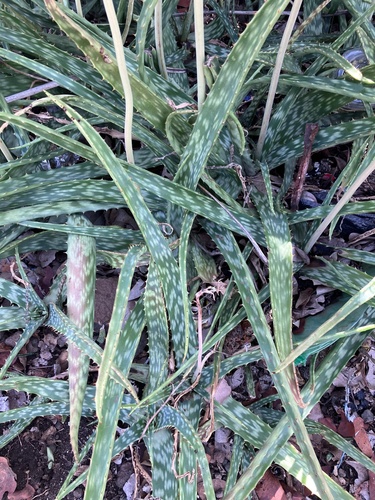
Aloe bamangwatensis is a medium rosette aloe native to the dry savanna of the historical Bamangwato region spanning northern Botswana and western Zimbabwe. Its grey-green leaves, armed with orange marginal teeth, form dense rosettes on sandy rocky soils. It is a species adapted to long periods of seasonal drought.
chevron_right edit_note Proposed edits auto-approved at +3 net votes
No pending proposals for this section.
Overview
| Category | Classification |
|---|---|
| Family | Asphodelaceae |
| Genus | Aloe |
| Growth Habit | Medium rosette, generally solitary |
| Conservation Status | Least Concern |
| pH Target | 6.0–7.0 |
| Type | Sandy to sandy-loam soil, slightly acidic to neutral |
Origin & Habitat
Morphology
Lanceolate leaves 30–45 cm long, grey-green, with orange marginal teeth and a slightly paler central line.
ecoShort to moderate stem (10–20 cm) in adult plants, covered with dry leaf remnants.
ecoYellow-orange tubular flowers in simple racemes on 50–70 cm peduncles. Flowering in the dry winter.
ecoThick succulent roots that store water to survive the prolonged summer drought.
ecochevron_right edit_note Proposed edits auto-approved at +3 net votes
No pending proposals for this section.
Requirements
Soil & Substrate
Type
Sandy to sandy-loam soil, slightly acidic to neutral
groups Beneficial Associations
chevron_right edit_note Proposed edits auto-approved at +3 net votes
No pending proposals for this section.
Propagation Strategy
- 1 Sow in sandy mix at 24–28 °C.
- 2 Cover lightly with fine sand.
- 3 Water with a mister until germination (2–4 weeks).
- 4 Transplant when 5 cm tall.
- 1 Separate rooted offsets from the base in spring.
- 2 Allow to callus for 2 days and plant in dry substrate.
- 3 Water lightly after 10 days.
- 4 They root in 5–7 weeks.
Adapt watering to the Kalahari summer rainfall pattern: abundant in summer, dry in winter.
Watering in winter following patterns of other wet-winter aloes.
Every 3 years in spring
Low-nitrogen fertilizer (NPK 5-10-10), once at the start of summer
Uses & Applications
Precautions / Toxicity
Toxic if ingested in quantity.
chevron_right edit_note Proposed edits auto-approved at +3 net votes
No pending proposals for this section.
"The Bamangwato region was the kingdom of Chief Khama III, who in the late 19th century travelled to London to protect his lands from colonisation; the flora of the area, including this aloe, remained relatively intact thanks to those negotiations."
chevron_right edit_note Proposed edits auto-approved at +3 net votes
No pending proposals for this section.
Scientific Integrity
🟡 MediumVote to help validate this record
Sources
Loading…
Discussion
Disclaimer
This species record is provided for educational and informational purposes only. Jardín Roca Negra does not guarantee the accuracy or completeness of the data. Content is community-curated and may be subject to revision; it should not replace advice from a qualified botanist. This species may be toxic, invasive, or subject to legal restrictions — verify before handling or cultivating. Jardín Roca Negra accepts no liability for any harm arising from reliance on this information. Images are reproduced under Creative Commons or equivalent free licenses; credits are noted below each image.