
Aloe ausana Dinter & Dinter
Aus aloe
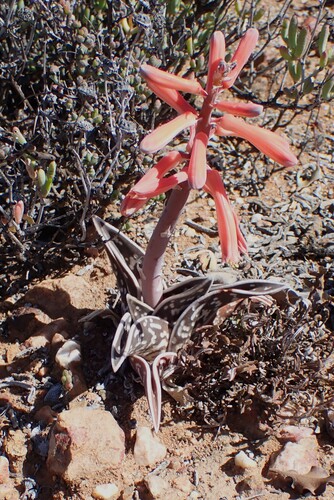
Aloe ausana is a small, compact aloe endemic to the Aus Mountains of southern Namibia within the succulent karoo biome. Its rosettes nestle among quartzite outcrops at elevations of 1200–1600 m, where night temperatures are cool. It is a rare species in botanical collections outside Namibia.
chevron_right edit_note Proposed edits auto-approved at +3 net votes
No pending proposals for this section.
Overview
| Category | Classification |
|---|---|
| Family | Asphodelaceae |
| Genus | Aloe |
| Growth Habit | Compact low-growing rosette |
| Conservation Status | Vulnerable (endemic to restricted area) |
| pH Target | 5.5–6.5 |
| Type | Stony quartzitic soil, very well drained |
Origin & Habitat
Morphology
Short triangular leaves 10–18 cm long, grey-green, with small marginal teeth and a slightly rough surface.
ecoVery short or practically absent; the plant can occasionally produce a small cluster of rosettes.
ecoReddish-orange tubular flowers in simple racemes 25–40 cm tall. Flowering in late winter.
ecoRobust roots that penetrate between quartzite cracks to anchor the plant on exposed slopes.
ecochevron_right edit_note Proposed edits auto-approved at +3 net votes
No pending proposals for this section.
Requirements
Soil & Substrate
Type
Stony quartzitic soil, very well drained
groups Beneficial Associations
chevron_right edit_note Proposed edits auto-approved at +3 net votes
No pending proposals for this section.
Propagation Strategy
- 1 Carefully extract offsets with a sterilised knife.
- 2 Allow to callus in the open air for 2–3 days.
- 3 Plant in mineral mix and water after 7 days.
- 4 Maintain at 15–22 °C for rooting in 6–8 weeks.
- 1 Sow immediately after harvesting in mineral substrate at 18–22 °C.
- 2 Keep slightly moist under bright light.
- 3 Irregular germination in 3–8 weeks.
- 4 Transplant seedlings when they have 3–4 leaves.
Replicate the Namibian seasonal cycle: wet winter, dry summer.
Watering in summer following the calendar of other South African succulents.
Every 3–4 years, when roots protrude from the drainage holes
Very diluted mineral fertilizer (¼ dose), once in spring
Uses & Applications
Precautions / Toxicity
Toxic if ingested; contains anthraquinones.
chevron_right edit_note Proposed edits auto-approved at +3 net votes
No pending proposals for this section.
"Populations of A. ausana have suffered intensive illegal collection; several European botanical gardens now participate in ex-situ programmes to preserve their genetic diversity."
chevron_right edit_note Proposed edits auto-approved at +3 net votes
No pending proposals for this section.
Scientific Integrity
🟡 MediumVote to help validate this record
Sources
Loading…
Discussion
Disclaimer
This species record is provided for educational and informational purposes only. Jardín Roca Negra does not guarantee the accuracy or completeness of the data. Content is community-curated and may be subject to revision; it should not replace advice from a qualified botanist. This species may be toxic, invasive, or subject to legal restrictions — verify before handling or cultivating. Jardín Roca Negra accepts no liability for any harm arising from reliance on this information. Images are reproduced under Creative Commons or equivalent free licenses; credits are noted below each image.