
Echeveria pulidonis E.Walther
Pulidonis Echeveria
Echeveria pulidonis is a rosette-forming succulent described by E. Walther in 1972, endemic to the Sierra de Tehuacán in the state of Puebla, Mexico. It is distinguished by its flat blue-green leaves with pronounced red to coral margins and tips, creating a very decorative bicolor effect. The compact rosette reaches 10–15 cm in diameter and is regarded as one of the most colorful echeverias for ornamental cultivation.
chevron_right edit_note Proposed edits auto-approved at +3 net votes
No pending proposals for this section.
© John Rusk
CC BY 2.0
Overview
| Category | Classification |
|---|---|
| Family | Crassulaceae |
| Genus | Echeveria |
| Growth Habit | Compact, stemless rosette that develops a short stem with age. Produces basal offsets, forming small dense clumps. Moderate growth rate. |
| Conservation Status | Data Deficient (DD) on the IUCN Red List for wild populations; its restricted range in the Sierra de Tehuacán makes it potentially vulnerable to habitat loss. |
| pH Target | 6.5 – 7.5 |
| Type | Calcareous, stony mineral soil with excellent drainage. Low organic matter content; not suitable in peat-based substrates. |
Origin & Habitat
Morphology
Flat, spatulate to oblanceolate leaves, 4–7 cm, blue-green with a soft pruinose coating and very pronounced reddish to coral margins. The apex ends in a fine mucro with intense red coloration, especially in plants exposed to full sun.
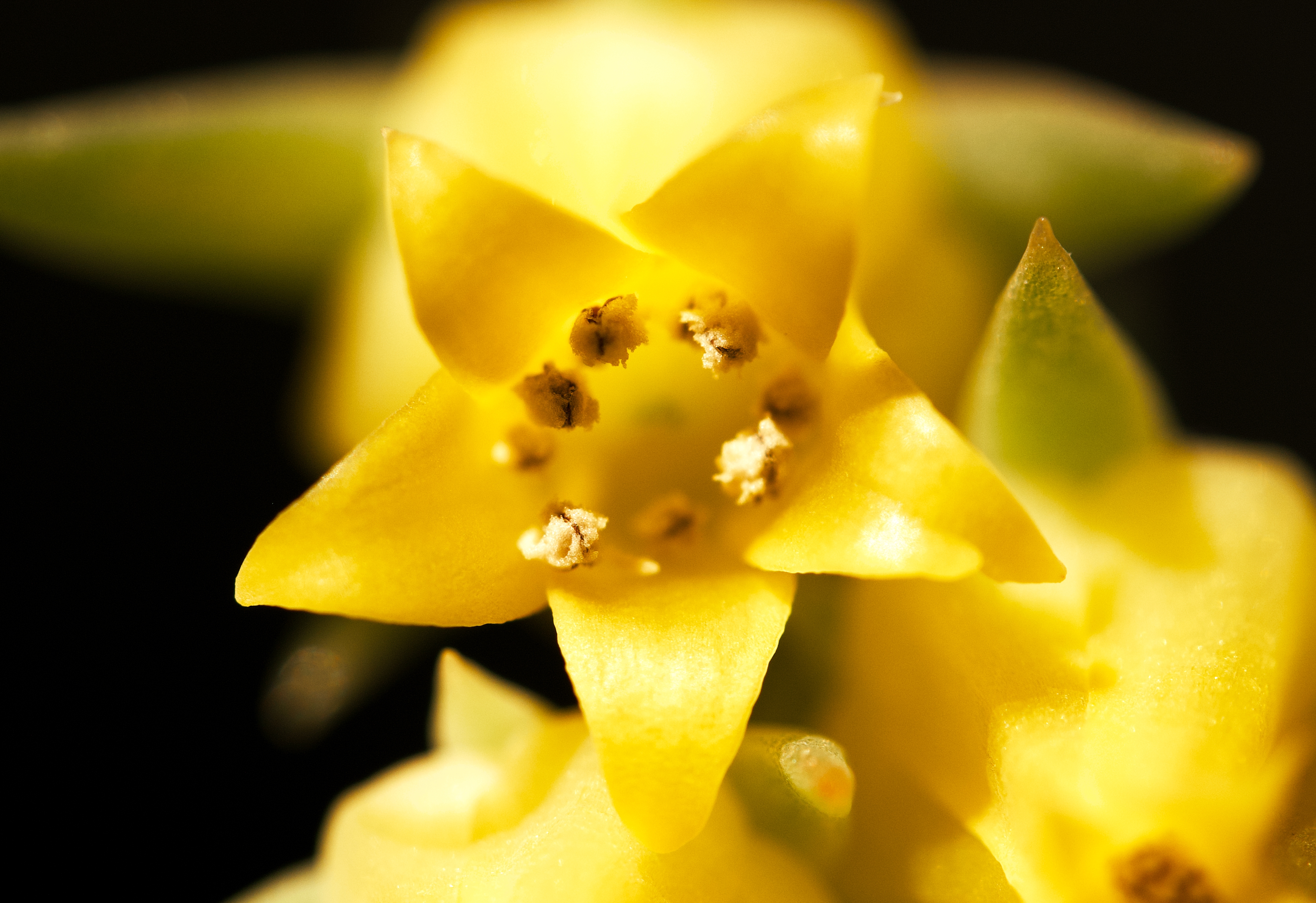
ecoInflorescence a cyme on a stalk 20–30 cm tall. Bell-shaped flowers, red to orange with yellow tips. Blooms in spring–summer. Nectariferous and attractive to hummingbirds.
ecoStem very short or virtually absent in young plants; in old specimens it may develop up to 5 cm. The base of the rosette hardens and lignifies with age.
ecoFibrous and moderately fleshy roots adapted to the calcareous stony soil of its natural habitat in the Sierra de Tehuacán.
ecochevron_right edit_note Proposed edits auto-approved at +3 net votes
No pending proposals for this section.
Requirements
Soil & Substrate
Type
Calcareous, stony mineral soil with excellent drainage. Low organic matter content; not suitable in peat-based substrates.
groups Beneficial Associations
chevron_right edit_note Proposed edits auto-approved at +3 net votes
No pending proposals for this section.
Propagation Strategy
- 1 Remove a mature leaf with a twisting motion to preserve the basal meristem.
- 2 Callous in ventilated shade for 24–48 hours.
- 3 Place on dry mineral substrate at 20–25 °C.
- 4 Mist gently until roots and plantlet appear (4–8 weeks).
- 1 Separate basal offsets with a sterile knife when at least 2 cm in diameter.
- 2 Callous the cut for 12–24 hours and plant in dry substrate.
- 3 Begin light watering after one week.
Expose to morning sun to enhance the red-blue bicolor contrast.
Overwatering during winter, causing basal rot.
Every 2–3 years in spring, preferably in terracotta pots sized just right for the roots.
Liquid cactus fertilizer at half the recommended dose, once in spring and once in summer; none in autumn–winter.
Uses & Applications
Precautions / Toxicity
Non-toxic to humans and pets. Safe species according to major toxicological registries.
chevron_right edit_note Proposed edits auto-approved at +3 net votes
No pending proposals for this section.
Plant Health
Mealybug: inspect leaf axils regularly; treat with 70% isopropyl alcohol.
Root rot from overwatering or poorly drained substrate.
chevron_right edit_note Proposed edits auto-approved at +3 net votes
No pending proposals for this section.
"Echeveria pulidonis is endemic exclusively to the Tehuacán-Cuicatlán Sierra region, one of the world's most succulent-diverse areas and declared a UNESCO World Heritage Site in 2018. Its red pigmentation is induced by anthocyanin accumulation in response to the high UV irradiance of calcareous outcrops above 1,800 m altitude, making it a study model in succulent photobiology."
chevron_right edit_note Proposed edits auto-approved at +3 net votes
No pending proposals for this section.
Scientific Integrity
🟡 MediumVote to help validate this record
Sources
Loading…
Discussion
Disclaimer
This species record is provided for educational and informational purposes only. Jardín Roca Negra does not guarantee the accuracy or completeness of the data. Content is community-curated and may be subject to revision; it should not replace advice from a qualified botanist. This species may be toxic, invasive, or subject to legal restrictions — verify before handling or cultivating. Jardín Roca Negra accepts no liability for any harm arising from reliance on this information. Images are reproduced under Creative Commons or equivalent free licenses; credits are noted below each image.