
Aichryson sedifolium Webb ex Bolle
Sedum-leaved aichryson
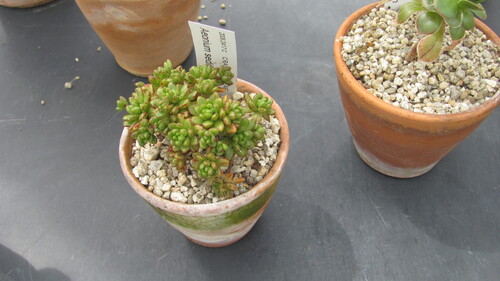
Morphologically singular within the genus for its small, cylindrical, succulent leaves that closely resemble those of the genus Sedum, from which the specific name derives (sedifolium = Sedum-leaved). Adapted to sunny, semi-arid habitats at the low elevations of Gran Canaria and Tenerife, it withstands greater insolation and drought periods than most Aichryson. Its terete leaves accumulate water reserves that allow survival through the Canarian dry season.
chevron_right edit_note Proposed edits auto-approved at +3 net votes
No pending proposals for this section.
Overview
| Category | Classification |
|---|---|
| Family | Crassulaceae |
| Genus | Aichryson |
| Growth Habit | Loose rosette with cylindrical leaves, annual or biennial, low habit |
| Conservation Status | Least Concern; endemic but tolerant of disturbed habitats |
| pH Target | 6.0–7.5 |
| Type | Volcanic sand and pumice, very porous and dry |
Origin & Habitat
Morphology
Cylindrical to subcylindrical (terete), 0.8–2 cm long and 2–4 mm in diameter; pale green to grey, succulent, with reduced glandular hairiness compared to other Aichryson.
ecoErect to semi-erect, 8–20 cm, with branching that produces clusters of small rosettes at the tips.
ecoFlowers with 6–8 pale yellow to golden petals; terminal cymes of moderate size; flowering mainly in winter.
ecoFibrous and somewhat more robust than in other Aichryson; able to explore the dry, gravelly soil of sunny slopes.
ecochevron_right edit_note Proposed edits auto-approved at +3 net votes
No pending proposals for this section.
Requirements
Soil & Substrate
Type
Volcanic sand and pumice, very porous and dry
groups Beneficial Associations
chevron_right edit_note Proposed edits auto-approved at +3 net votes
No pending proposals for this section.
Propagation Strategy
- 1 Sow in autumn in very porous sandy substrate without covering seeds.
- 2 Keep at 18–22 °C with direct morning light and very fine waterings.
- 3 Thin to the most robust seedling per cell at 2–3 weeks.
- 4 Transplant when they have 4–5 well-defined cylindrical leaves.
- 1 Cut twigs of 3–5 cm with cylindrical leaves at the tip.
- 2 Allow the cut to dry for 2–3 days until a callus forms.
- 3 Insert in dry sandy substrate; begin minimal watering after 1 week.
- 4 Expose to gentle sun during establishment to stimulate roots.
Prioritise very well-draining substrate to mimic arid volcanic slopes.
Watering like other shade-loving Aichryson: excess moisture rots the roots.
Every 2 years at the start of autumn, in fresh substrate
Diluted mineral fertilizer (1/4 dose) once in autumn and once in spring
Uses & Applications
Precautions / Toxicity
Not toxic.
chevron_right edit_note Proposed edits auto-approved at +3 net votes
No pending proposals for this section.
"The morphological convergence between A. sedifolium and certain terete-leaved Sedum is an example of parallel evolution in Crassulaceae under similar aridity ecological pressures."
chevron_right edit_note Proposed edits auto-approved at +3 net votes
No pending proposals for this section.
Scientific Integrity
🟡 MediumVote to help validate this record
Sources
Loading…
Discussion
Disclaimer
This species record is provided for educational and informational purposes only. Jardín Roca Negra does not guarantee the accuracy or completeness of the data. Content is community-curated and may be subject to revision; it should not replace advice from a qualified botanist. This species may be toxic, invasive, or subject to legal restrictions — verify before handling or cultivating. Jardín Roca Negra accepts no liability for any harm arising from reliance on this information. Images are reproduced under Creative Commons or equivalent free licenses; credits are noted below each image.