
Aichryson laxum (Haw.) Bramwell
Lax aichryson
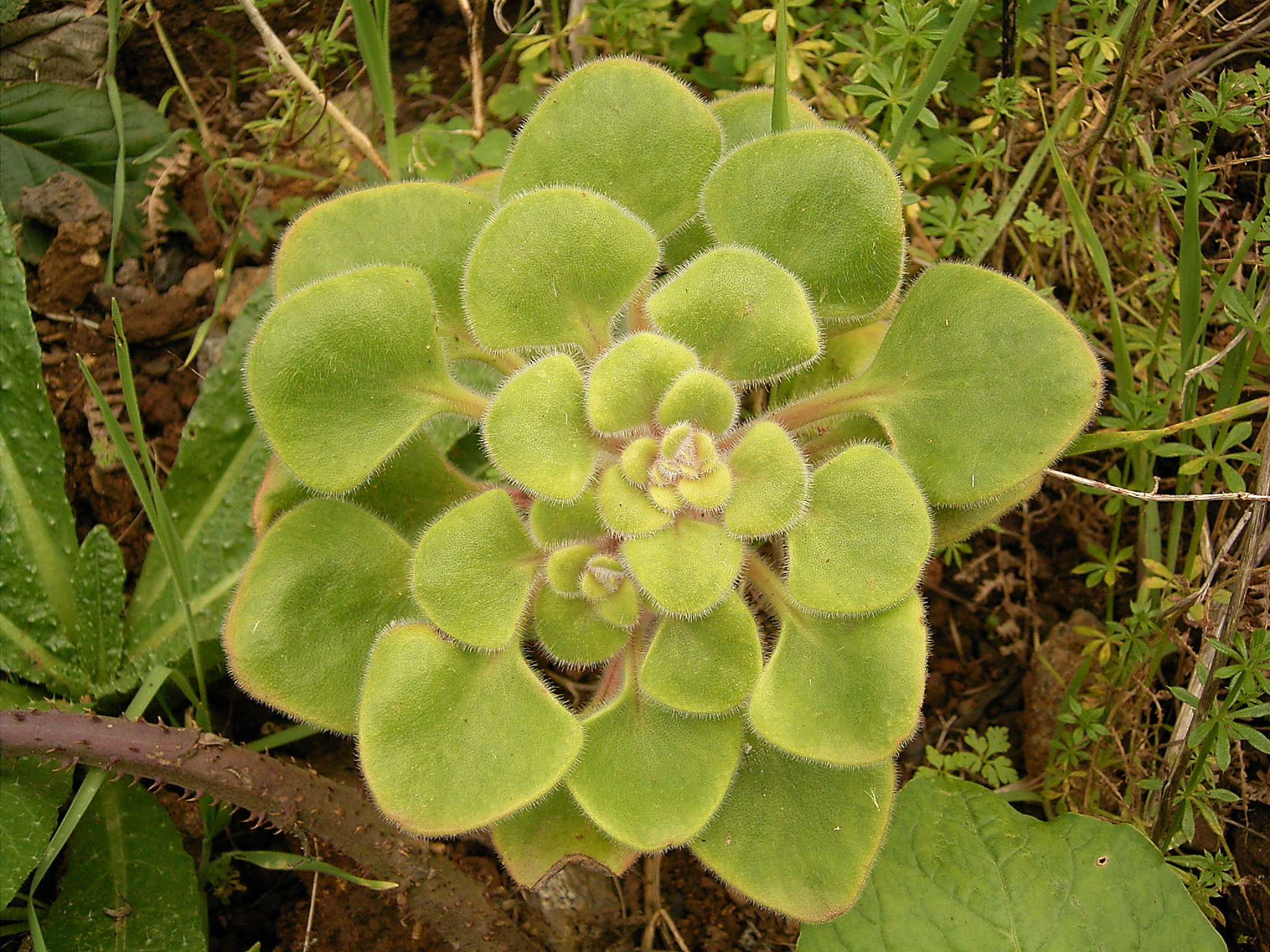
Annual or biennial succulent adapted to drier and warmer habitats at low Canarian elevations — a distinguishing feature compared to most Aichryson, which prefer humid shade. Forms open, lax rosettes of greyish-green fleshy leaves on volcanic rocks and stony slopes. Its ability to colonise rock crevices under sparse rainfall sets it apart from the rest of the genus.
chevron_right edit_note Proposed edits auto-approved at +3 net votes
No pending proposals for this section.
Overview
| Category | Classification |
|---|---|
| Family | Crassulaceae |
| Genus | Aichryson |
| Growth Habit | Open and lax annual or biennial rosette, low to medium habit |
| Conservation Status | Least Concern; tolerates disturbed habitats and arid coastal zones |
| pH Target | 6.0–7.5 |
| Type | Sandy-volcanic with some organic matter |
Origin & Habitat
Morphology
Spatulate, 1.5–3 cm long, thicker and more succulent than other Aichryson; greyish-green with less dense glandular pubescence.
ecoErect to prostrate, 8–25 cm tall, often branched from the base; internodes longer than in other Aichryson, giving the lax appearance.
ecoFlowers with 6–7 narrow yellow petals in loose terminal cymes; flowering from winter to early spring.
ecoFibrous roots with greater drought tolerance than other Aichryson; able to grow in narrow basaltic rock crevices.
ecochevron_right edit_note Proposed edits auto-approved at +3 net votes
No pending proposals for this section.
Requirements
Soil & Substrate
Type
Sandy-volcanic with some organic matter
groups Beneficial Associations
chevron_right edit_note Proposed edits auto-approved at +3 net votes
No pending proposals for this section.
Propagation Strategy
- 1 Sow in autumn in sandy substrate with 20% leaf mould, without covering seeds.
- 2 Keep at 16–22 °C with bright indirect light and fine waterings.
- 3 Thin seedlings to 3–4 cm spacing when the first leaf pair appears.
- 4 Transplant to final position after 6–8 weeks.
- 1 Detach lateral rosettes with a 2–3 cm stem.
- 2 Allow the cut to cure for 1–2 days in a cool, ventilated spot.
- 3 Plant in sandy substrate and withhold watering for the first 5 days.
- 4 Once rooted, move to a sunnier position.
Adapt watering to the season: more frequent in winter (active growth) and reduced in summer.
Overwatering in summer when the plant is semi-dormant.
Annual/biennial plant; generally propagated from seed each season
Diluted mineral fertilizer once a month during active growth period (autumn–spring)
Uses & Applications
Precautions / Toxicity
Not toxic to people or domestic animals.
chevron_right edit_note Proposed edits auto-approved at +3 net votes
No pending proposals for this section.
"A. laxum is the most ecologically plastic Aichryson in the genus, surviving in both arid coastal scrub and semi-arid mid-elevation environments, making it a candidate for degraded habitat restoration."
chevron_right edit_note Proposed edits auto-approved at +3 net votes
No pending proposals for this section.
Scientific Integrity
🟡 MediumVote to help validate this record
Sources
Loading…
Discussion
Disclaimer
This species record is provided for educational and informational purposes only. Jardín Roca Negra does not guarantee the accuracy or completeness of the data. Content is community-curated and may be subject to revision; it should not replace advice from a qualified botanist. This species may be toxic, invasive, or subject to legal restrictions — verify before handling or cultivating. Jardín Roca Negra accepts no liability for any harm arising from reliance on this information. Images are reproduced under Creative Commons or equivalent free licenses; credits are noted below each image.