
Aichryson bethencourtianum Bolle
Bethencourt's aichryson
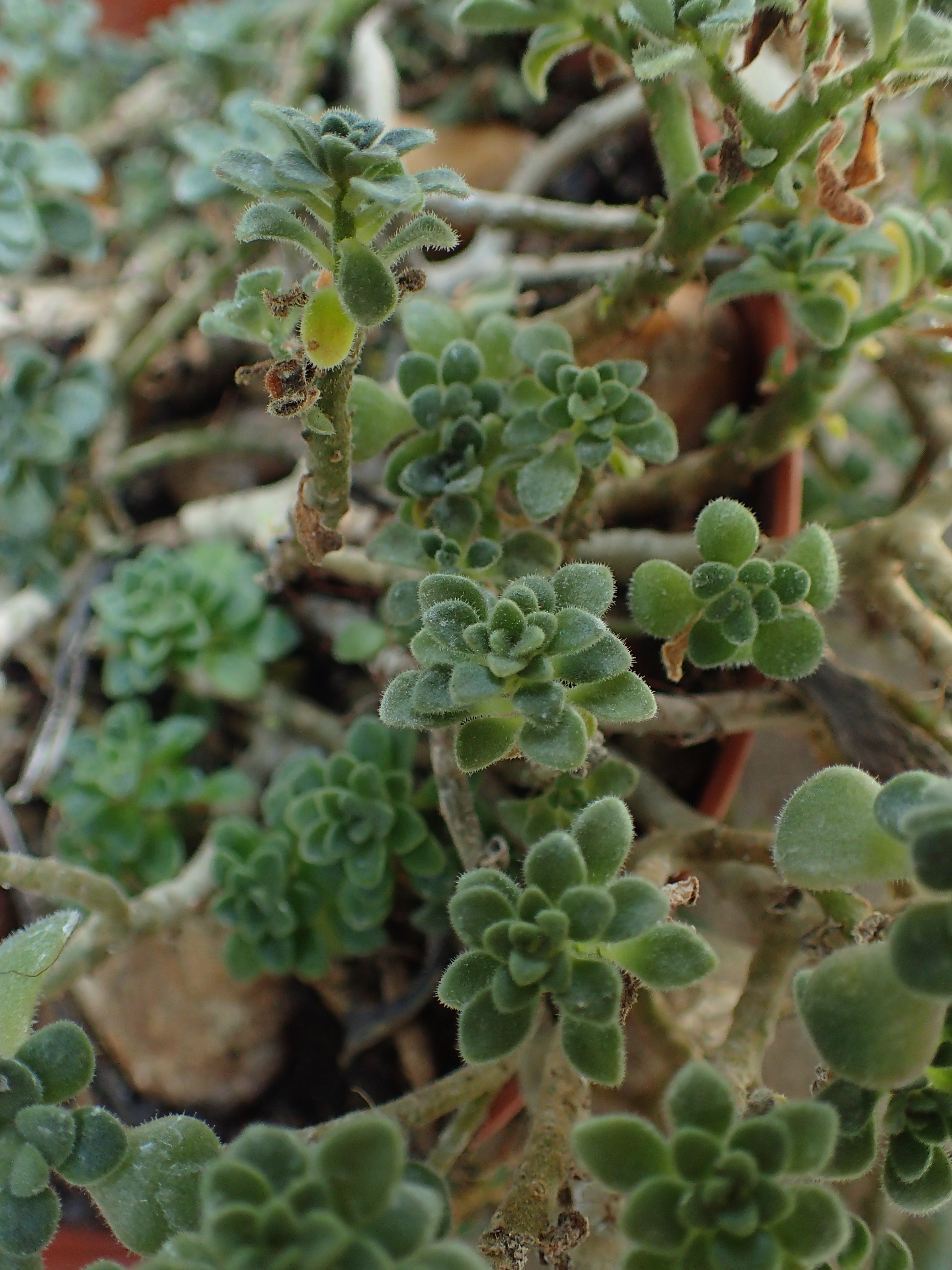
Annual or biennial rosette succulent endemic to the humid laurel forest ravines of northern Gran Canaria. Named in honour of Jean de Béthencourt, the Norman conqueror of the Canary Islands. Forms small rosettes of fleshy, sticky, hairy leaves ranging from green to bronze-tinted, with yellow star-shaped flowers appearing in spring. Its restriction to humid, shaded habitats makes it particularly sensitive to forest fragmentation.
chevron_right edit_note Proposed edits auto-approved at +3 net votes
No pending proposals for this section.
Overview
| Category | Classification |
|---|---|
| Family | Crassulaceae |
| Genus | Aichryson |
| Growth Habit | Small annual or biennial rosette, sticky herbaceous stems |
| Conservation Status | Vulnerable; Gran Canaria endemic with very restricted distribution |
| pH Target | 5.5–7.0 |
| Type | Leaf mould, moist organic substrate with good drainage |
Origin & Habitat
Morphology
Obovate to spatulate, 1–2.5 cm long, fleshy, covered in sticky glandular hairs; colouring green to bronze depending on light exposure.
ecoHerbaceous, erect to semi-erect, 5–20 cm tall, with short internodes at the base forming the rosette.
ecoStar-shaped flowers with 6–8 golden-yellow petals, 8–12 mm in diameter; grouped in branched terminal cymes emerging in spring.
ecoFibrous and shallow root system, well adapted to the moist, organically rich soils of laurel forest ravines.
ecochevron_right edit_note Proposed edits auto-approved at +3 net votes
No pending proposals for this section.
Requirements
Soil & Substrate
Type
Leaf mould, moist organic substrate with good drainage
groups Beneficial Associations
chevron_right edit_note Proposed edits auto-approved at +3 net votes
No pending proposals for this section.
Propagation Strategy
- 1 Collect ripe seeds in summer and store them cool and dry until sowing.
- 2 Sow in leaf mould and perlite substrate (70/30) in late summer or autumn.
- 3 Keep the substrate moist and temperature around 18–20 °C.
- 4 Transplant seedlings when they reach 2–3 cm, avoiding direct sun.
- 1 Cut lateral stems of 4–6 cm with at least two pairs of leaves.
- 2 Allow the cut to dry for 12–24 hours in a cool, shaded place.
- 3 Insert into moist leaf mould and perlite substrate.
- 4 Keep in partial shade with moderate humidity until rooted.
Use a substrate with high organic content to mimic laurel forest soil.
Exposing the plant to intense direct sun, which scorches the sticky leaves.
Annually or every two years, at the start of the growing season
Balanced liquid fertilizer diluted to half strength, once a month in spring and summer
Uses & Applications
Precautions / Toxicity
No known toxicity to humans or domestic animals.
chevron_right edit_note Proposed edits auto-approved at +3 net votes
No pending proposals for this section.
"A. bethencourtianum is one of the few Macaronesian Crassulaceae that thrives exclusively in humid, shaded conditions — an unusual trait within a family dominated by arid-habitat plants."
chevron_right edit_note Proposed edits auto-approved at +3 net votes
No pending proposals for this section.
Scientific Integrity
🟡 MediumVote to help validate this record
Sources
Loading…
Discussion
Disclaimer
This species record is provided for educational and informational purposes only. Jardín Roca Negra does not guarantee the accuracy or completeness of the data. Content is community-curated and may be subject to revision; it should not replace advice from a qualified botanist. This species may be toxic, invasive, or subject to legal restrictions — verify before handling or cultivating. Jardín Roca Negra accepts no liability for any harm arising from reliance on this information. Images are reproduced under Creative Commons or equivalent free licenses; credits are noted below each image.