
Agave shawii Engelm.
Shaw's agave
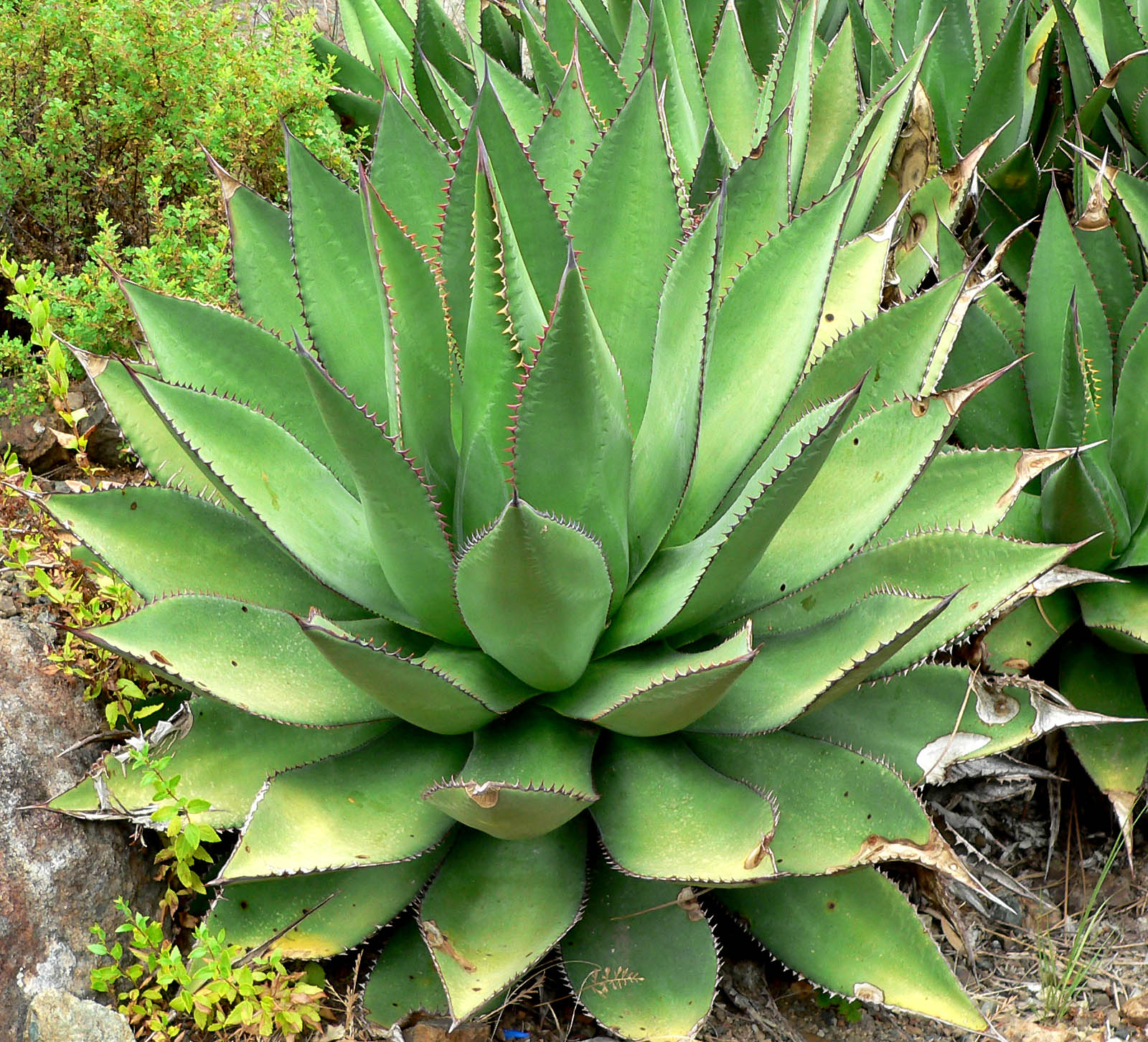
Shaw's agave is a range-restricted coastal agave, endemic to coastal sage scrub at the northern tip of Baja California (Mexico) and southern San Diego County (California, USA). It is one of the few agaves that grows just metres from the Pacific Ocean, tolerating marine fog, salt-laden winds and poor soils on coastal terraces. It is recognised by its compact, dense rosettes of broad, green to blue-green leaves with strongly toothed margins and a stout terminal spine. The nominal subspecies (var. shawii) grows on the coastal strip, while var. goldmaniana is found inland. The species is threatened by urban development on both sides of the border.
chevron_right edit_note Proposed edits auto-approved at +3 net votes
No pending proposals for this section.
Overview
| Category | Classification |
|---|---|
| Family | Asparagaceae |
| Genus | Agave |
| Growth Habit | Compact and dense monocarpic rosette, slow-growing. Can reproduce vegetatively through basal offsets, forming clumps. Flowers after 15–25 years and dies. |
| Conservation Status | Regionally Vulnerable. Protected in California (CNPS List 1B). Threatened by urban expansion in the San Diego area and by fire in Baja California. Populations in Mexico are fragmented. |
| pH Target | 6.5–7.5 |
| Type | Coastal sandy-rocky, sometimes with some caliche; very well drained and nutrient-poor |
Origin & Habitat
Morphology
Broadly ovate to lanceolate, 40–80 cm long and 10–18 cm wide, thick and succulent, dark green to blue-green with slight pruina. Margins with strong corneous teeth, reddish-brown, 0.5–1.5 cm; terminal spine 3–5 cm, dark and very sharp. Leaves imprint denticulate marks on adjacent leaves during growth.
ecoDense spike inflorescence 3–5 m tall. Tubular flowers 6–8 cm, reddish to orange-yellow when open, very showy. Pollinated mainly by the lesser long-nosed bat (Leptonycteris yerbabuenae) and hummingbirds.
ecoNearly stemless. The piña is compact and dense. In coastal plants the stem is frequently slightly inclined due to the effect of dominant marine winds.
ecoFibrous and shallow root system, adapted to rocky, well-drained coastal terrace soils. Roots secrete exudates that modify the local soil pH, favouring nutrient absorption in saline soils.
ecochevron_right edit_note Proposed edits auto-approved at +3 net votes
No pending proposals for this section.
Requirements
Soil & Substrate
Type
Coastal sandy-rocky, sometimes with some caliche; very well drained and nutrient-poor
groups Beneficial Associations
chevron_right edit_note Proposed edits auto-approved at +3 net votes
No pending proposals for this section.
Propagation Strategy
E
F
Every 3–5 years; prefers not to be repotted frequently.
One very moderate application of low-nitrogen fertilizer in spring. Excess fertilizer can weaken the plant.
Uses & Applications
Precautions / Toxicity
Moderately toxic. Sap irritating to sensitive skin. Terminal spines and marginal teeth are physically dangerous. Do not ingest raw parts.
chevron_right edit_note Proposed edits auto-approved at +3 net votes
No pending proposals for this section.
Plant Health
Basal rot by Phytophthora spp. — high risk in compacted soils or with excessive summer watering.
Agave scale (Dactylopius spp.) — colonises leaves and base; treat with isopropyl alcohol and potassium soap.
Agave snout weevil (Scyphophorus acupunctatus) — especially dangerous in young and weakened plants.
chevron_right edit_note Proposed edits auto-approved at +3 net votes
No pending proposals for this section.
"Shaw's agave represents a case of transborder conservation: its healthiest populations remain south of the border, in the mountainous and coastal areas of Baja California with less urban pressure. In cultivation outside its range, it tolerates temperate Mediterranean climates exceptionally well thanks to its adaptation to coastal fog. It is an excellent choice for xeriscaping gardens in warm-dry climates with a winter rainy season."
chevron_right edit_note Proposed edits auto-approved at +3 net votes
No pending proposals for this section.
Scientific Integrity
🟡 MediumVote to help validate this record
Sources
Loading…
Discussion
Disclaimer
This species record is provided for educational and informational purposes only. Jardín Roca Negra does not guarantee the accuracy or completeness of the data. Content is community-curated and may be subject to revision; it should not replace advice from a qualified botanist. This species may be toxic, invasive, or subject to legal restrictions — verify before handling or cultivating. Jardín Roca Negra accepts no liability for any harm arising from reliance on this information. Images are reproduced under Creative Commons or equivalent free licenses; credits are noted below each image.