
Agave rubescens Salm-Dyck
Reddening Agave
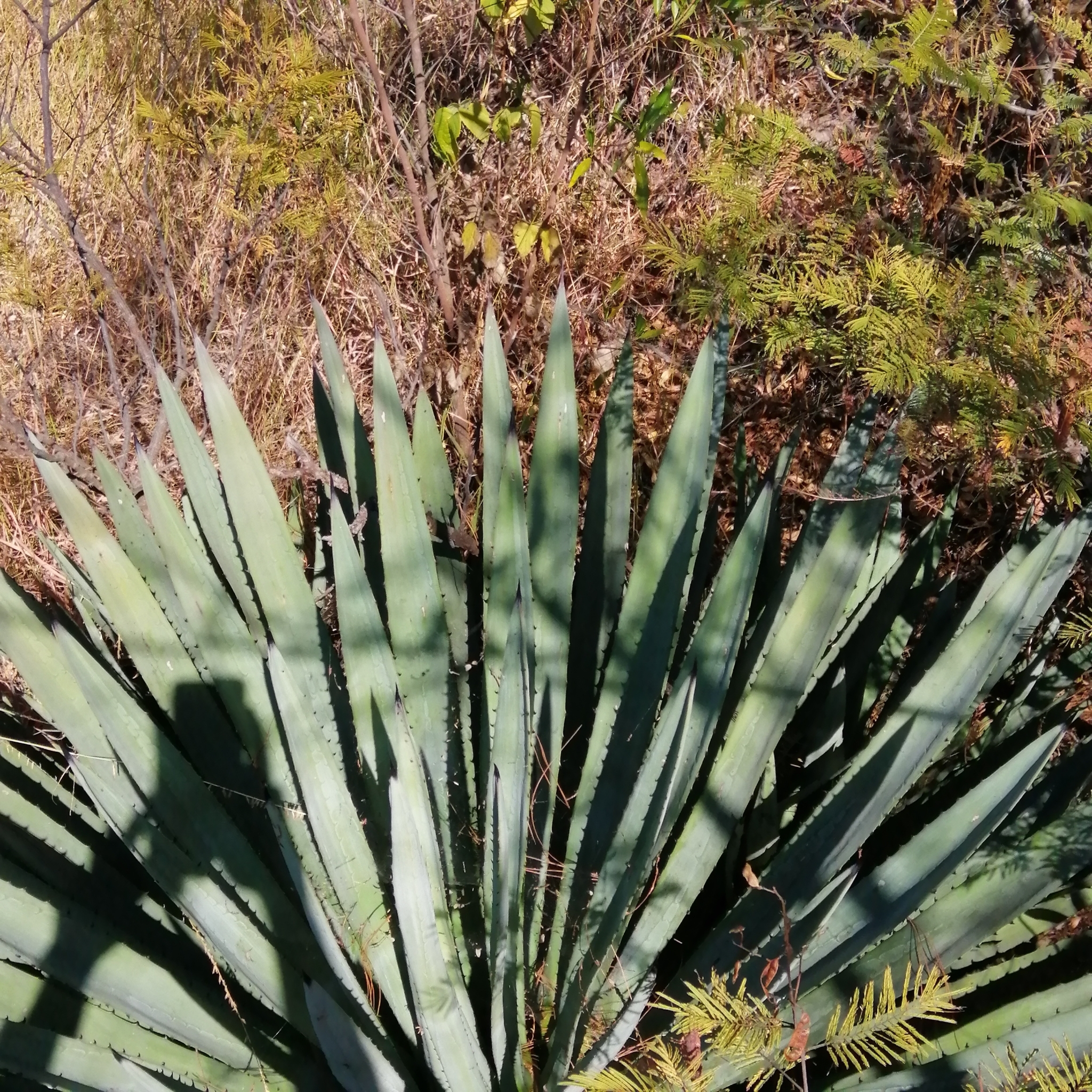
Agave rubescens, described by Salm-Dyck in 1859, is a species closely related to Agave angustifolia and considered by many authors as a variety or subspecies of the latter (Agave angustifolia var. rubescens). It is characterised by leaves that develop a striking reddish or purplish colouration when the plant is subjected to intense water stress, high radiation, or extreme temperatures. Native to the central valleys of Oaxaca, Mexico, where it grows in xerophytic scrublands and abandoned agricultural areas on poor, stony soils. It is a medium to large plant with a long history of use by Zapotec and Mixtec indigenous communities for fibre production and edible inflorescences.
chevron_right edit_note Proposed edits auto-approved at +3 net votes
No pending proposals for this section.
Overview
| Category | Classification |
|---|---|
| Family | Asparagaceae |
| Genus | Agave |
| Growth Habit | Acaulescent to subcaulescent medium-to-large rosette (60–120 cm tall, 80–150 cm diameter), monocarpic. Life cycle 10–20 years. Produces numerous basal and rhizomatous offsets, forming dense colonies under favourable conditions. |
| Conservation Status | Least Concern (LC) as a variety of Agave angustifolia, a widely distributed species. Wild populations in Oaxaca are under pressure from land-use change but are not considered at immediate risk. |
| pH Target | 6.8–8.0 |
| Type | Stony to silty soil, nutrient-poor, derived from calcareous or metamorphic substrates; neutral to slightly alkaline pH. Tolerates compact and degraded soils. |
Origin & Habitat
Morphology
Linear to lanceolate, rigid leaves 50–100 cm long and 4–8 cm wide at base, grayish-green to blue-green, tending to redden (rubescent) under stress. Margins with regular, rigid corneous teeth 3–7 mm long. Terminal spine 2–5 cm, dark brown, very pungent. Thick, pruinose cuticle.
ecoDense panicle 4–7 m tall with numerous lateral branches bearing tubular yellow-green flowers 6–8 cm long. Exserted yellow anthers. Flowers once during the summer of the year of senescence. Mixed pollination: bats, moths, and bees.
ecoShort to moderately developed stem (to 30 cm in mature plants), partially exposed. Accumulates fructan reserves (long-chain sugars) that are mobilised during the intense reproductive effort of terminal flowering.
ecoDense, shallow root system that may extend up to 3 m from the rosette centre. Deeper roots may reach rock fissures for anchorage and water absorption during severe drought. Frequent arbuscular mycorrhizal associations.
ecochevron_right edit_note Proposed edits auto-approved at +3 net votes
No pending proposals for this section.
Requirements
Soil & Substrate
Type
Stony to silty soil, nutrient-poor, derived from calcareous or metamorphic substrates; neutral to slightly alkaline pH. Tolerates compact and degraded soils.
groups Beneficial Associations
chevron_right edit_note Proposed edits auto-approved at +3 net votes
No pending proposals for this section.
Propagation Strategy
P
O
Every 4–6 years or when the rosette completely fills the container.
One annual spring application of slow-release granular fertiliser, low in nitrogen (NPK 5-10-10). In ground gardens, generally not necessary.
Uses & Applications
Precautions / Toxicity
Fresh sap can cause contact dermatitis in sensitive skin. Calcium oxalate crystals in tissues cause mucosal irritation if raw plant parts are ingested without preparation. Marginal teeth cause lacerations.
chevron_right edit_note Proposed edits auto-approved at +3 net votes
No pending proposals for this section.
Plant Health
Basal rot (Fusarium oxysporum / Pythium spp.)
Mealybug (Pseudococcus spp.)
Agave snout weevil (Scyphophorus acupunctatus)
chevron_right edit_note Proposed edits auto-approved at +3 net votes
No pending proposals for this section.
"The taxonomic identity of Agave rubescens is debated: some authors recognise it as an independent species (Salm-Dyck 1859), while others synonymise it with Agave angustifolia var. rubescens or directly with Agave angustifolia s.l. The rubescent colouration is an environmentally influenced phenotypic trait (water stress, UV radiation) and is not always reliable as a stable taxonomic marker. iNaturalist observations in Oaxaca continue to be identified under Agave angustifolia rubescens. Consultation of recent molecular revisions of the A. angustifolia group is recommended for definitive placement."
chevron_right edit_note Proposed edits auto-approved at +3 net votes
No pending proposals for this section.
Scientific Integrity
🟡 MediumVote to help validate this record
Sources
Loading…
Discussion
Disclaimer
This species record is provided for educational and informational purposes only. Jardín Roca Negra does not guarantee the accuracy or completeness of the data. Content is community-curated and may be subject to revision; it should not replace advice from a qualified botanist. This species may be toxic, invasive, or subject to legal restrictions — verify before handling or cultivating. Jardín Roca Negra accepts no liability for any harm arising from reliance on this information. Images are reproduced under Creative Commons or equivalent free licenses; credits are noted below each image.