
Agave roseana Trel.
Rose's Agave
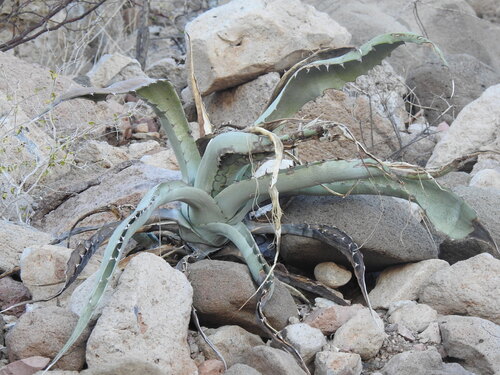
Agave roseana is a small to medium species endemic to the arid Tehuacán Valley in the state of Oaxaca (Mexico), one of the regions with the greatest diversity of agaves on the planet. It was described by William Trelease in 1920 and named in honor of the botanist Joseph Nelson Rose. It inhabits xerophilous scrublands on rocky calcareous or volcanic soils between 1,400 and 2,000 m a.s.l. Its rosettes are compact, with relatively narrow, bluish-glaucous leaves. It is considered ornamentally valuable for its manageable size and extreme drought adaptation. Its habitat overlaps with the Tehuacán-Cuicatlán Biosphere Reserve, declared a UNESCO World Heritage Site in 2018.
chevron_right edit_note Proposed edits auto-approved at +3 net votes
No pending proposals for this section.
Overview
| Category | Classification |
|---|---|
| Family | Asparagaceae |
| Genus | Agave |
| Growth Habit | Compact acaulescent rosette, solitary or with few basal offsets. Leaves 30–60 cm long and 4–8 cm wide. Mature rosette reaches 60–90 cm in diameter. Inflorescence a panicle 3–5 m tall. |
| Conservation Status | Not formally assessed by IUCN. Endemic to the restricted area of the Tehuacán Valley; part of its habitat is protected within the Tehuacán-Cuicatlán Biosphere Reserve (UNESCO, 2018). Potentially vulnerable due to habitat fragmentation and illegal extraction. |
| pH Target | 6.5–8.0 |
| Type | Rocky calcareous to volcanic, very well-drained, nutrient-poor |
Origin & Habitat
Morphology
Lanceolate to linear, 30–60 cm long and 4–8 cm wide, glaucous blue to greyish green. Margins with medium corneous teeth (3–6 mm), brown to black; apical spine 2–4 cm, brownish. The thick, waxy cuticle minimizes water loss in the arid Tehuacán Valley.
ecoPanicle inflorescence 3–5 m tall with second-order branches. Greenish-yellow, tubular flowers 5–7.5 cm long. Pollinated mainly by nectar-feeding bats and nocturnal hawkmoths. Ovoid capsules with flat black seeds.
ecoAcaulescent; very short basal caudex, rich in reserve fructans. The plant accumulates energy for several years before monocarpic flowering. After the parent plant dies, offsets continue the colony.
ecoFibrous and extensive root system in the first 30–40 cm of soil, with contractile roots that keep the rosette anchored in stony substrates. Highly adapted to capturing scarce seasonal rainfall.
ecochevron_right edit_note Proposed edits auto-approved at +3 net votes
No pending proposals for this section.
Requirements
Soil & Substrate
Type
Rocky calcareous to volcanic, very well-drained, nutrient-poor
groups Beneficial Associations
chevron_right edit_note Proposed edits auto-approved at +3 net votes
No pending proposals for this section.
Propagation Strategy
P
W
Every 5–7 years or when roots emerge through drainage holes
Very limited fertilization: low-nitrogen fertilizer (5-10-10) once a year in spring
Uses & Applications
Precautions / Toxicity
Apical spines and marginal teeth pose puncture wound risk. Sap may irritate sensitive skin. No reports of systemic toxicity in humans or animals.
chevron_right edit_note Proposed edits auto-approved at +3 net votes
No pending proposals for this section.
Plant Health
Crown rot by Phytophthora spp. under overwatering or compacted substrate conditions
Mealybugs (Pseudococcidae) at the leaf base; treat with neem oil or isopropyl alcohol
Agave snout weevil (Scyphophorus acupunctatus): regular preventive monitoring of the caudex
chevron_right edit_note Proposed edits auto-approved at +3 net votes
No pending proposals for this section.
"Agave roseana is scarcely available in the ornamental market; when found, it is usually sold under the colloquial name 'dwarf Tehuacán agave.' Its small size makes it ideal for pots and very bright interior gardens. Protecting its habitat is critical: the Tehuacán-Cuicatlán Reserve harbors more than 30 Agave species, several endemic. Trelease (1920) is the original taxonomic reference; verify synonymy with Gentry (1982)."
chevron_right edit_note Proposed edits auto-approved at +3 net votes
No pending proposals for this section.
Scientific Integrity
🟡 MediumVote to help validate this record
Sources
Loading…
Discussion
Disclaimer
This species record is provided for educational and informational purposes only. Jardín Roca Negra does not guarantee the accuracy or completeness of the data. Content is community-curated and may be subject to revision; it should not replace advice from a qualified botanist. This species may be toxic, invasive, or subject to legal restrictions — verify before handling or cultivating. Jardín Roca Negra accepts no liability for any harm arising from reliance on this information. Images are reproduced under Creative Commons or equivalent free licenses; credits are noted below each image.