
Agave sartorii K.Koch
Sartori's Agave
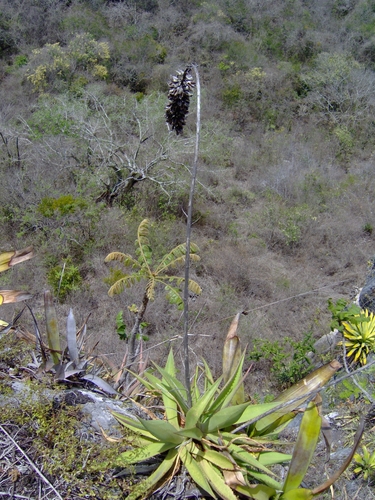
Agave sartorii is an unusual species of the genus Agave native to the humid mountain zones of central-eastern Veracruz and northern Oaxaca (Mexico), where it grows on edges of montane cloud forest, basalt ravines, and lava slopes at altitudes of 1,000–2,000 m a.s.l. Unlike most agaves, this species tolerates higher ambient humidity and partial shade. It was described by Karl Koch in 1860 and named in honor of the German naturalist Moritz Sartori, who collected plants in Veracruz in the 19th century. Some authors synonymized it with A. pendula Schnittsp., but POWO (Kew) recognizes it as a valid species. Its leaves are relatively narrow and its pendulous floral scape is one of its most striking features.
chevron_right edit_note Proposed edits auto-approved at +3 net votes
No pending proposals for this section.
Overview
| Category | Classification |
|---|---|
| Family | Asparagaceae |
| Genus | Agave |
| Growth Habit | Acaulescent to shortly caulescent rosette, solitary or with few basal offsets. Leaves 40–80 cm long and 4–7 cm wide. The inflorescence—a diagnostic feature—is pendulous or arching, 1.5–3 m long, unlike the erect scape of most agaves. |
| Conservation Status | Data Deficient (DD) globally. Populations are restricted to fragmented cloud-forest habitats in Veracruz, heavily threatened by deforestation. Potentially Vulnerable or Endangered if properly assessed. |
| pH Target | 5.5–7.0 |
| Type | Organic loam to sandy loam, well-drained but with moderate moisture retention |
Origin & Habitat
Morphology
Lanceolate to linear, 40–80 cm long and 4–7 cm wide, medium to dark green (less glaucous than most agaves from dry zones). Margins with small to medium corneous teeth (3–5 mm); apical spine 2–4 cm long, dark brown. The surface is not as rough as in A. scabra.
ecoPendulous to arching inflorescence 1.5–3 m long, borne on a flexible scape. Tubular greenish-yellow to green flowers 5–7 cm long. The pendulous inflorescence is exceptional in the genus and facilitates pollination by hummingbirds and hawkmoths.
ecoVery short or absent, with fibrous basal tissue and moderate fructan accumulation. In its cloud-forest habitat, the caudex tends to remain hidden beneath leaf litter and mosses.
ecoShallow and fibrous root system, adapted to volcanic soils with high moisture. Tolerates substrates with higher organic content than typical for the genus. Roots tend to colonize cracks in basalt outcrops.
ecochevron_right edit_note Proposed edits auto-approved at +3 net votes
No pending proposals for this section.
Requirements
Soil & Substrate
Type
Organic loam to sandy loam, well-drained but with moderate moisture retention
groups Beneficial Associations
chevron_right edit_note Proposed edits auto-approved at +3 net votes
No pending proposals for this section.
Propagation Strategy
P
T
Every 3–5 years; it grows more slowly than desert agaves
Balanced (10-10-10) or potassium-rich (5-5-10) fertilizer every 6–8 weeks during the growing season (spring-summer)
Uses & Applications
Precautions / Toxicity
Apical spines and marginal teeth can cause puncture wounds. Sap has potential to irritate sensitive skin. No significant systemic toxicity reported.
chevron_right edit_note Proposed edits auto-approved at +3 net votes
No pending proposals for this section.
Plant Health
Root rot by Pythium spp. or Fusarium in substrate without adequate drainage
Mealybugs and thrips in low-ventilation conditions; treat with neem oil
Agave snout weevil (Scyphophorus acupunctatus): less common in humid habitats but possible in cultivation
chevron_right edit_note Proposed edits auto-approved at +3 net votes
No pending proposals for this section.
"Agave sartorii is notably difficult to obtain outside Mexico. Its cloud-forest habitat makes it an exceptional candidate for collections of agaves from humid environments. The pendulous inflorescence visually distinguishes it from any other species of the genus available commercially. Confirm botanical identity when acquiring specimens, as it is frequently confused with A. pendula or A. celsii. See Koch (1860) and Gentry (1982) for detailed original descriptions."
chevron_right edit_note Proposed edits auto-approved at +3 net votes
No pending proposals for this section.
Scientific Integrity
🟡 MediumVote to help validate this record
Sources
Loading…
Discussion
Disclaimer
This species record is provided for educational and informational purposes only. Jardín Roca Negra does not guarantee the accuracy or completeness of the data. Content is community-curated and may be subject to revision; it should not replace advice from a qualified botanist. This species may be toxic, invasive, or subject to legal restrictions — verify before handling or cultivating. Jardín Roca Negra accepts no liability for any harm arising from reliance on this information. Images are reproduced under Creative Commons or equivalent free licenses; credits are noted below each image.