
Agave poselgeri Salm-Dyck
Huachuca Agave
Agave poselgeri, known as 'Huachuca agave' or 'Chisos lechuguilla', is a small- to medium-sized agave native to the Chihuahuan Desert, distributed in southern Texas (mainly the Big Bend area), and the Mexican states of Chihuahua, Coahuila, and Tamaulipas. Some authors treat it as Agave lophantha var. poselgeri due to its morphological similarities with A. lophantha. It forms open rosettes with linear-lanceolate leaves ranging from glossy dark green to yellowish green, with a characteristic lighter banding pattern on the adaxial surface. It is a keystone species of the Chihuahuan ecosystem for its value as a nurse plant and food source for local fauna.
chevron_right edit_note Proposed edits auto-approved at +3 net votes
No pending proposals for this section.
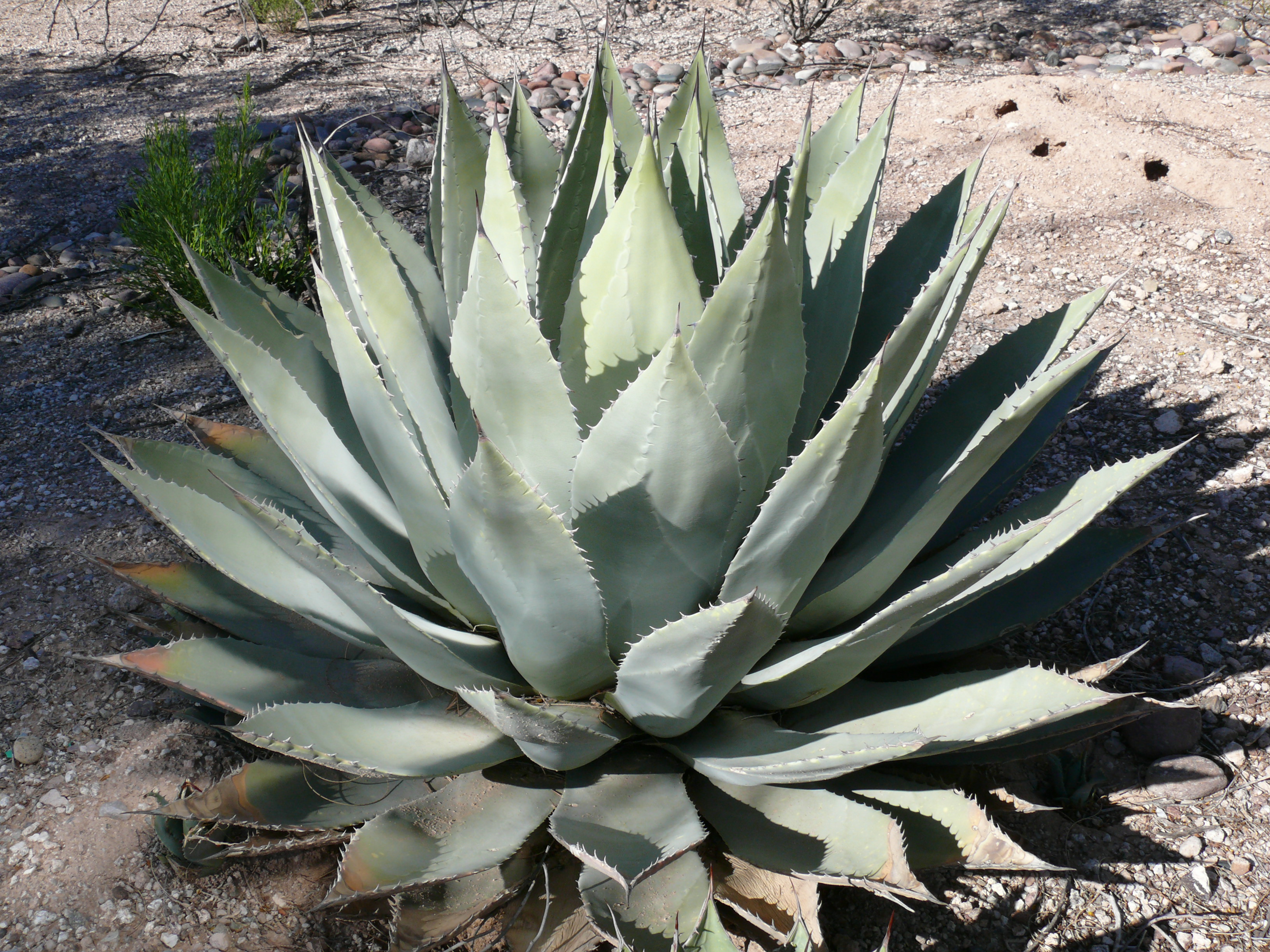
Overview
| Category | Classification |
|---|---|
| Family | Asparagaceae |
| Genus | Agave |
| Growth Habit | Open rosette, acaulescent or with a short stem, 40–70 cm tall and up to 90 cm in diameter. Monocarpic; produces a single elongated flower spike then dies. Generates basal offsets that form colonies. |
| Conservation Status | Least Concern (LC) in general; locally vulnerable in Texas due to habitat fragmentation and illegal collection. The Big Bend National Park population is protected. |
| pH Target | 7.0–8.5 |
| Type | Calcareous rocky soil, highly porous, low in organic matter |
Origin & Habitat
Morphology
Linear-lanceolate leaves, 25–45 cm long and 2.5–5 cm wide, dark green with a lighter longitudinal stripe on the center of the adaxial surface. Margins with concave teeth, brown to grayish, 5–8 mm long. Terminal spine 1.5–2.5 cm long, rigid and pungent.
ecoInflorescence a narrow spike 2.5–4 m tall. Tubular greenish-yellow to greenish-red flowers, 4–6 cm long. Blooms in spring to early summer. Important nectar source for the Mexican long-nosed bat (Leptonycteris yerbabuenae).
ecoStem very short or absent. The fibrous central tissue accumulates fructans and water as energy reserves for the single flowering. The peripheral tissues are rich in saponins that act as chemical defenses.
ecoShallow and extensive fibrous roots with high absorption efficiency in rocky soils. The association with mycorrhizae is important for phosphorus uptake in poor calcareous soils.
ecochevron_right edit_note Proposed edits auto-approved at +3 net votes
No pending proposals for this section.
Requirements
Soil & Substrate
Type
Calcareous rocky soil, highly porous, low in organic matter
groups Beneficial Associations
chevron_right edit_note Proposed edits auto-approved at +3 net votes
No pending proposals for this section.
Propagation Strategy
S
W
Every 4–6 years; repot only when roots protrude from the bottom of the pot
Annual fertilization in spring with low-nitrogen mineral fertilizer (NPK 5-10-10) at 25% of the recommended dose. Excess nutrients promote soft growth susceptible to the weevil.
Uses & Applications
Precautions / Toxicity
Very pungent terminal spines. Saponins in the tissues are irritating upon prolonged contact with mucous membranes. No significant documented systemic toxicity.
chevron_right edit_note Proposed edits auto-approved at +3 net votes
No pending proposals for this section.
Plant Health
Root rot by Phytophthora spp. when grown in heavy substrates or with excessive watering
Root mealybug (Pseudococcus longispinus) difficult to detect until advanced stages
Agave snout weevil (Scyphophorus acupunctatus): larva bores the center; first sign is wilting of central leaves
chevron_right edit_note Proposed edits auto-approved at +3 net votes
No pending proposals for this section.
"One of the few Agave species genuinely resistant to extreme cold (down to −10 °C), making it valuable for collections in cold continental climates of Europe and North America. Its relationship with the bat Leptonycteris yerbabuenae makes it a key piece for conserving chiropteran migrations in the Chihuahuan Desert."
chevron_right edit_note Proposed edits auto-approved at +3 net votes
No pending proposals for this section.
Scientific Integrity
🟡 MediumVote to help validate this record
Sources
Loading…
Discussion
Disclaimer
This species record is provided for educational and informational purposes only. Jardín Roca Negra does not guarantee the accuracy or completeness of the data. Content is community-curated and may be subject to revision; it should not replace advice from a qualified botanist. This species may be toxic, invasive, or subject to legal restrictions — verify before handling or cultivating. Jardín Roca Negra accepts no liability for any harm arising from reliance on this information. Images are reproduced under Creative Commons or equivalent free licenses; credits are noted below each image.