
Agave orcuttiana Trel.
Orcutt's Agave
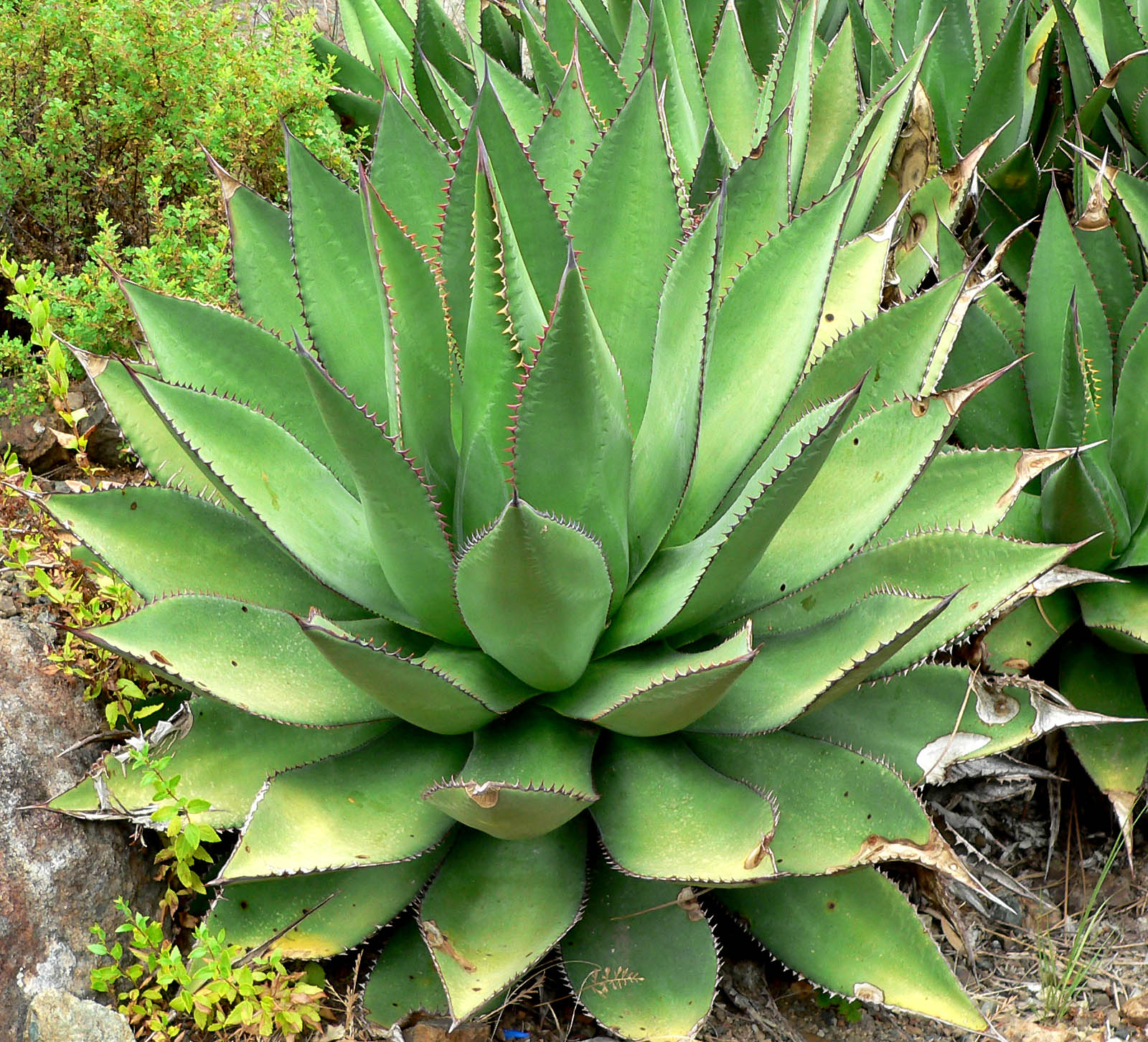
Agave orcuttiana, now recognized by many authors as Agave shawii subsp. orcuttiana, is a coastal agave endemic to the chaparral and coastal sage of northern Baja California and the extreme southwest of San Diego County, California. It develops open, robust rosettes with ovate leaves ranging from bright green to bluish green, with prominent reddish-brown marginal teeth. It inhabits coastal cliffs, rocky slopes, and ravines exposed to marine influence, where coastal fog compensates for scarce rainfall. It is a rare species considered threatened.
chevron_right edit_note Proposed edits auto-approved at +3 net votes
No pending proposals for this section.
Overview
| Category | Classification |
|---|---|
| Family | Asparagaceae |
| Genus | Agave |
| Growth Habit | Open, acaulescent to subcaulescent rosette, 60–90 cm tall and up to 120 cm in diameter. Monocarpic; flowers only once after 10–20 years then dies. Produces basal offsets and occasionally bulbils on the inflorescence. |
| Conservation Status | Vulnerable to threatened. Populations in California (USA) are very small; those in Baja California are better represented but face urban and tourist pressure in the coastal zone. |
| pH Target | 6.0–7.5 |
| Type | Sandy-rocky coastal soil, moderately acidic to neutral |
Origin & Habitat
Morphology
Ovate-lanceolate leaves, 25–50 cm long and 8–14 cm wide, rigid, bright green with slight glaucousness. Margins with robust teeth 5–8 mm long, reddish-brown to grayish. Terminal spine 2–4 cm long, robust and channeled, dark brown.
ecoInflorescence an open panicle 4–6 m tall with numerous lateral branches. Flowers yellow to orange-yellow, 6–8 cm long. Blooms in spring–summer, attracting hummingbirds, orioles, and nectar bats.
ecoShort stem (up to 30 cm in older specimens), fibrous, supporting the rosette. In coastal conditions it may lean toward the light following the prevailing wind. Accumulates starches and sugars that are converted into energy for the single flowering.
ecoFibrous, shallow root system extending radially up to 1.5 m. Highly efficient in absorbing moisture from coastal fog and seasonal winter rains. Very sensitive to root suffocation.
ecochevron_right edit_note Proposed edits auto-approved at +3 net votes
No pending proposals for this section.
Requirements
Soil & Substrate
Type
Sandy-rocky coastal soil, moderately acidic to neutral
groups Beneficial Associations
chevron_right edit_note Proposed edits auto-approved at +3 net votes
No pending proposals for this section.
Propagation Strategy
O
W
Every 3–4 years, in spring
One fertilization in spring with a low-nitrogen fertilizer (NPK 5-10-10) diluted to 25%. Do not fertilize in autumn or winter.
Uses & Applications
Precautions / Toxicity
Apical spines and marginal teeth are highly pungent; physical risk of injury. Sap contains calcium oxalate which can irritate skin and mucous membranes. No documented systemic toxicity.
chevron_right edit_note Proposed edits auto-approved at +3 net votes
No pending proposals for this section.
Plant Health
Crown rot by Pythium spp. favored by overwatering in humid climates
Mealybugs (Dactylopius spp.) at leaf bases and root zone
Agave snout weevil (Scyphophorus acupunctatus): stem borer, lethal to the plant
chevron_right edit_note Proposed edits auto-approved at +3 net votes
No pending proposals for this section.
"The distinction between A. orcuttiana and A. shawii is taxonomically debated. Some authors keep them separate based on tooth size and shape differences; others treat them as subspecies. In cultivation outside their native range, drainage and air circulation are critical to prevent rot."
chevron_right edit_note Proposed edits auto-approved at +3 net votes
No pending proposals for this section.
Scientific Integrity
🟡 MediumVote to help validate this record
Sources
Loading…
Discussion
Disclaimer
This species record is provided for educational and informational purposes only. Jardín Roca Negra does not guarantee the accuracy or completeness of the data. Content is community-curated and may be subject to revision; it should not replace advice from a qualified botanist. This species may be toxic, invasive, or subject to legal restrictions — verify before handling or cultivating. Jardín Roca Negra accepts no liability for any harm arising from reliance on this information. Images are reproduced under Creative Commons or equivalent free licenses; credits are noted below each image.