
Agave pringlei Engelm. ex Baker
Pringle's Agave
Agave pringlei (= Agave deserti subsp. pringlei) is an agave endemic to the Sierra Juárez in northern Baja California, one of the most arid mountain ranges on the peninsula. It forms small to medium, caespitose rosettes with numerous offsets. Its leaves are glaucous-green, triangular-lanceolate, with corneous margins and a long terminal spine decurrent onto the leaf margin. It is distinguished from Agave deserti by its narrower, less glaucous leaves and a terminal spine that visibly continues along the leaf margin. It inhabits rocky slopes and canyons of the sierra at 1,000–2,000 m elevation.
chevron_right edit_note Proposed edits auto-approved at +3 net votes
No pending proposals for this section.
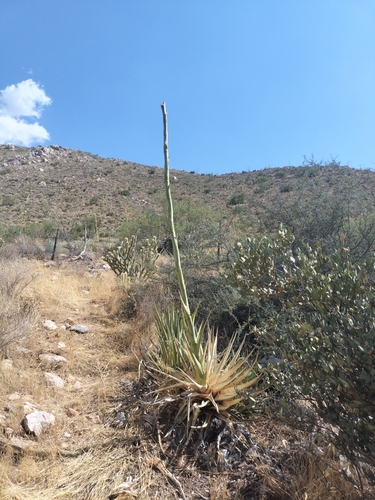
Overview
| Category | Classification |
|---|---|
| Family | Asparagaceae |
| Genus | Agave |
| Growth Habit | Caespitose rosette (produces many basal offsets); small to medium; grows on arid rocky slopes. |
| Conservation Status | Not independently assessed by IUCN (included within A. deserti). Endemic to a very restricted range in Sierra Juárez; vulnerable to fire and collection. |
| pH Target | 6.5 – 7.5 |
| Type | Granitic and schist substrates; arid rocky mountain slopes; rapid and excellent drainage. |
Origin & Habitat
Morphology
Triangular-lanceolate, 40–70 cm long × 5–7 cm wide; glaucous-green, less glaucous than A. deserti; corneous margins with 5–10 mm teeth regularly spaced; terminal spine 3–4 cm, reddish-brown, decurrent along the leaf margin.
ecoYellow; 40–60 mm long; in panicle atop 3–6 m scape (taller at higher elevation); 10–15 lateral branches; pollinated by bats and bees.
ecoAcaulescent; floral scape erect, with deltoid bracts; taller in higher-elevation populations.
ecoFibrous, shallow and very spreading; essential for capturing the scarce rainfall and mist of the sierra.
ecochevron_right edit_note Proposed edits auto-approved at +3 net votes
No pending proposals for this section.
Requirements
Soil & Substrate
Type
Granitic and schist substrates; arid rocky mountain slopes; rapid and excellent drainage.
groups Beneficial Associations
chevron_right edit_note Proposed edits auto-approved at +3 net votes
No pending proposals for this section.
Propagation Strategy
S
W
Every 4–5 years in spring; prefer terracotta pots for better transpiration.
Minimal annual fertilization: one application of very diluted, low-nitrogen fertilizer in spring.
Uses & Applications
Precautions / Toxicity
Sap with oxalates and saponins; long decurrent terminal spine poses risk of deep injury. No serious systemic toxicity.
chevron_right edit_note Proposed edits auto-approved at +3 net votes
No pending proposals for this section.
Plant Health
Root rot – main risk in cultivation; poorly drained substrate or winter watering are the usual cause.
Mealybugs (Pseudococcus spp.) – inspect the base of offsets and basal leaves.
Agave snout weevil (Scyphophorus acupunctatus) – lethal borer; immediately remove infected plants.
chevron_right edit_note Proposed edits auto-approved at +3 net votes
No pending proposals for this section.
"Described by George Engelmann and published by John Gilbert Baker. The terminal spine decurrent along the corneous margin is the key diagnostic character distinguishing it from A. deserti subsp. deserti. Endemic to Sierra Juárez, one of Baja California's biodiversity hotspots."
chevron_right edit_note Proposed edits auto-approved at +3 net votes
No pending proposals for this section.
Scientific Integrity
🟡 MediumVote to help validate this record
Sources
Loading…
Discussion
Disclaimer
This species record is provided for educational and informational purposes only. Jardín Roca Negra does not guarantee the accuracy or completeness of the data. Content is community-curated and may be subject to revision; it should not replace advice from a qualified botanist. This species may be toxic, invasive, or subject to legal restrictions — verify before handling or cultivating. Jardín Roca Negra accepts no liability for any harm arising from reliance on this information. Images are reproduced under Creative Commons or equivalent free licenses; credits are noted below each image.