
Agave patonii Trel.
Paton's Agave
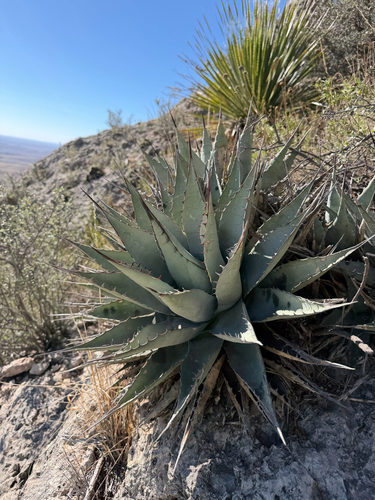
Agave patonii is a compact, globose, very slow-growing agave taxonomically related to Agave parryi. It forms a dense, rounded rosette of grey-glaucous leaves with toothed margins, a prominent terminal spine, and a diameter under 70 cm. It is remarkably frost-tolerant if the substrate remains dry, making it one of the coldest-hardy agaves of northern Mexico. It inhabits semi-arid scrublands and mountain grasslands in Sonora and Chihuahua.
chevron_right edit_note Proposed edits auto-approved at +3 net votes
No pending proposals for this section.
Overview
| Category | Classification |
|---|---|
| Family | Asparagaceae |
| Genus | Agave |
| Growth Habit | Acaulescent, globose, very compact rosette; extremely slow-growing; may produce sparse offsets over time. |
| Conservation Status | Not independently assessed by IUCN (often treated as a variety of A. parryi). Locally stable; illegal collection may be a threat. |
| pH Target | 6.5 – 8.0 |
| Type | Stony to clay-sandy soils; mountain grasslands and semi-arid scrublands; well-drained. |
Origin & Habitat
Morphology
Ovate-lanceolate, short and wide, 20–35 cm long × 7–12 cm wide; grey-glaucous; margins with corneous teeth 3–6 mm; strong terminal spine 2–4 cm, grey to brown.
ecoYellow to orange-yellow; in dense panicle atop 3–5 m scape; pollinated by bats, butterflies and hummingbirds.
ecoAcaulescent; floral scape robust, with triangular bracts; branched in upper portion with 15–25 lateral branches.
ecoExtensive and fibrous; penetrate stony and clay-sandy soils; high drought resistance.
ecochevron_right edit_note Proposed edits auto-approved at +3 net votes
No pending proposals for this section.
Requirements
Soil & Substrate
Type
Stony to clay-sandy soils; mountain grasslands and semi-arid scrublands; well-drained.
groups Beneficial Associations
chevron_right edit_note Proposed edits auto-approved at +3 net votes
No pending proposals for this section.
Propagation Strategy
S
W
Every 4–6 years; the species prefers confined roots and does not tolerate frequent repotting.
One minimal annual application of low-nitrogen fertilizer in spring; avoid fertilizing in autumn and winter.
Uses & Applications
Precautions / Toxicity
Sap with oxalates and saponins; teeth and terminal spine represent wound risk. No serious systemic toxicity.
chevron_right edit_note Proposed edits auto-approved at +3 net votes
No pending proposals for this section.
Plant Health
Root rot – main threat in cultivation due to excess winter moisture.
Mealybugs (Pseudococcus spp.) – treat with systemic insecticide or neem oil.
Agave snout weevil (Scyphophorus acupunctatus) – destroys the piña; remove and eliminate infected plants.
chevron_right edit_note Proposed edits auto-approved at +3 net votes
No pending proposals for this section.
"Described by William Trelease; often treated as Agave parryi var. patonii or Agave parryi var. couesii. Its extraordinary cold hardiness makes it the preferred agave for continental cold-climate gardens."
chevron_right edit_note Proposed edits auto-approved at +3 net votes
No pending proposals for this section.
Scientific Integrity
🟡 MediumVote to help validate this record
Sources
Loading…
Discussion
Disclaimer
This species record is provided for educational and informational purposes only. Jardín Roca Negra does not guarantee the accuracy or completeness of the data. Content is community-curated and may be subject to revision; it should not replace advice from a qualified botanist. This species may be toxic, invasive, or subject to legal restrictions — verify before handling or cultivating. Jardín Roca Negra accepts no liability for any harm arising from reliance on this information. Images are reproduced under Creative Commons or equivalent free licenses; credits are noted below each image.