
Agave ornithobroma Gentry
Hummingbird Agave
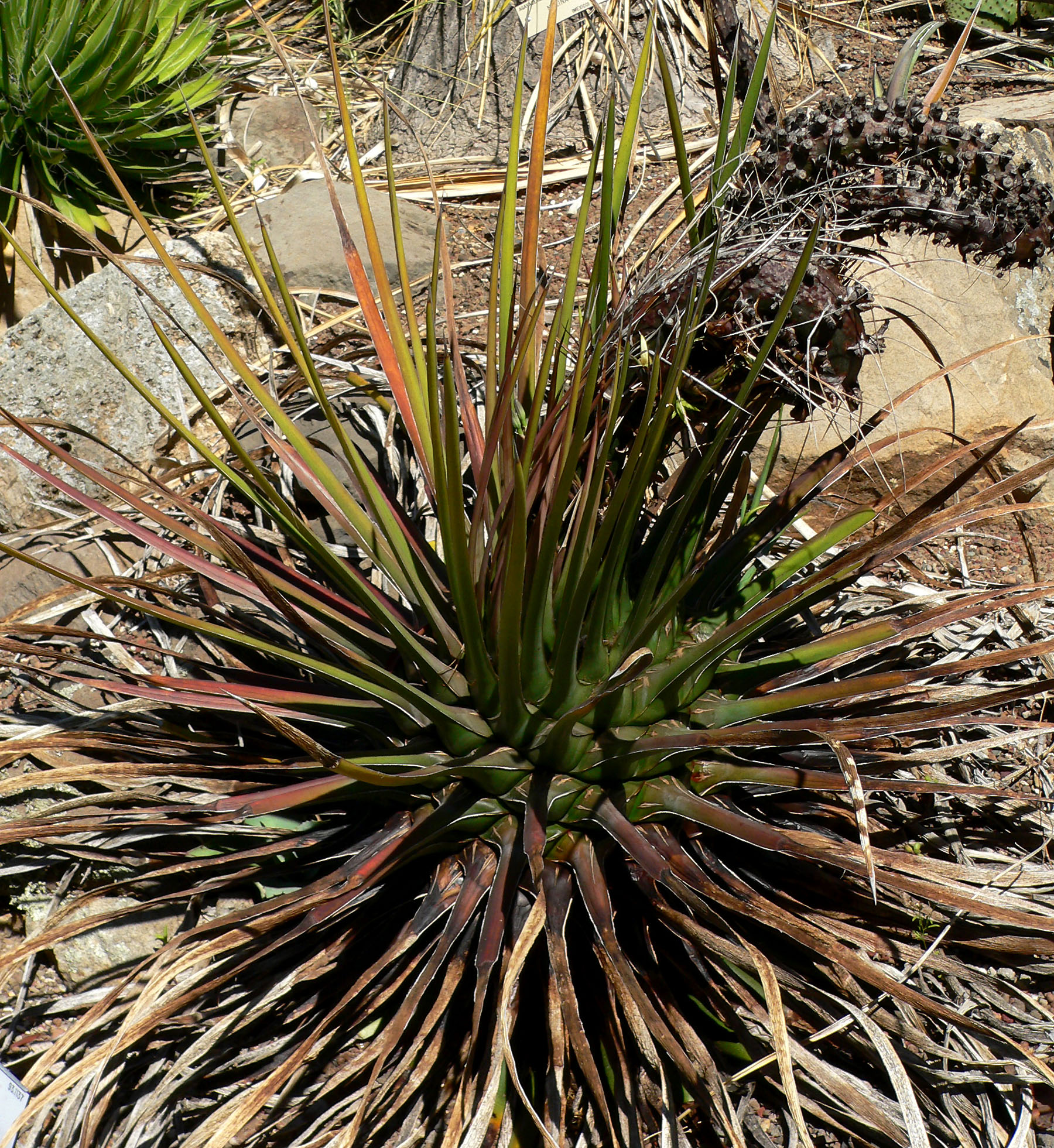
Agave ornithobroma is a small to medium species with narrowly linear, greyish-green leaves and finely toothed margins. Its scientific name refers to hummingbird pollination (ornithobroma = 'bird food'), which is remarkable within Agave, where bat pollination is most common. It forms rosettes up to 60 cm in diameter with numerous slender arching leaves. It grows in semi-arid scrublands of Chihuahua and Sinaloa at mid elevations.
chevron_right edit_note Proposed edits auto-approved at +3 net votes
No pending proposals for this section.
Overview
| Category | Classification |
|---|---|
| Family | Asparagaceae |
| Genus | Agave |
| Growth Habit | Acaulescent rosette, small to medium; may produce sparse basal offsets. Leaves narrowly linear and arching. |
| Conservation Status | Not globally assessed by IUCN; locally scarce within its range. Not listed under Mexican federal protection (NOM-059). |
| pH Target | 6.5 – 8.0 |
| Type | Stony and sandy, well-drained soils; slopes and ravines of semi-arid scrubland. |
Origin & Habitat
Morphology
Narrowly linear, 40–70 cm long × 1.5–3 cm wide; greyish-green; margins with small, irregular, brown teeth; terminal spine 2–4 cm, needle-like.
ecoYellowish-green to yellow; 45–60 mm long; in panicle atop 2.5–4 m scape; pollinated primarily by hummingbirds (unusual in Agave).
ecoAcaulescent; floral scape robust, erect, with numerous lateral branches in upper portion.
ecoFibrous, shallow, well-branched; adapted to shallow stony soils.
ecochevron_right edit_note Proposed edits auto-approved at +3 net votes
No pending proposals for this section.
Requirements
Soil & Substrate
Type
Stony and sandy, well-drained soils; slopes and ravines of semi-arid scrubland.
groups Beneficial Associations
chevron_right edit_note Proposed edits auto-approved at +3 net votes
No pending proposals for this section.
Propagation Strategy
S
O
Every 3–4 years; preferably in spring when substrate is dry.
One or two annual applications of low-nitrogen fertilizer (spring and early summer).
Uses & Applications
Precautions / Toxicity
Sap contains calcium oxalates; terminal spine can cause injury. No significant systemic toxicity documented.
chevron_right edit_note Proposed edits auto-approved at +3 net votes
No pending proposals for this section.
Plant Health
Root rot (Fusarium spp., Phytophthora spp.) – favored by excess moisture.
Mealybugs (Pseudococcus spp.) – inspect the leaf bases regularly.
Agave snout weevil (Scyphophorus acupunctatus) – severe damage to the piña; remove and destroy affected plants.
chevron_right edit_note Proposed edits auto-approved at +3 net votes
No pending proposals for this section.
"Described by Howard Scott Gentry. Its ornithophilous pollination (hummingbirds) makes it a model study for the evolution of pollination systems within the genus Agave."
chevron_right edit_note Proposed edits auto-approved at +3 net votes
No pending proposals for this section.
Scientific Integrity
🟡 MediumVote to help validate this record
Sources
Loading…
Discussion
Disclaimer
This species record is provided for educational and informational purposes only. Jardín Roca Negra does not guarantee the accuracy or completeness of the data. Content is community-curated and may be subject to revision; it should not replace advice from a qualified botanist. This species may be toxic, invasive, or subject to legal restrictions — verify before handling or cultivating. Jardín Roca Negra accepts no liability for any harm arising from reliance on this information. Images are reproduced under Creative Commons or equivalent free licenses; credits are noted below each image.