
Agave pelona Gentry
Bald Agave
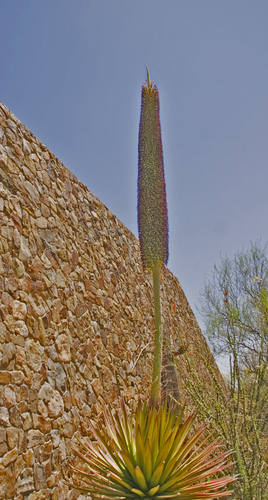
Agave pelona is one of the most unusual agaves of the Sonoran Desert: its leaves completely lack marginal teeth, giving the plant an unarmed appearance. The leaves are stiff, bright glaucous-green with white margins and a reddish terminal spine. The solitary rosette reaches up to 90 cm in diameter. The species is monocarpic: it blooms only once in its lifetime (spring–summer), producing a showy reddish-purple flower spike up to 4 m tall, then dies. It is critically endangered, confined to three small mountain ranges of extremely arid northwestern Sonora.
chevron_right edit_note Proposed edits auto-approved at +3 net votes
No pending proposals for this section.
Overview
| Category | Classification |
|---|---|
| Family | Asparagaceae |
| Genus | Agave |
| Growth Habit | Solitary acaulescent rosette, no offsets; slow-growing on steep rocky slopes. |
| Conservation Status | Critically Endangered (CR) – IUCN. Extremely restricted range limited to three mountain ranges in Sonora; threatened by grazing, illegal collection, and climate change. |
| pH Target | 7.0 – 8.0 |
| Type | Rocky-stony, well-drained soils with low organic content; calcareous or volcanic slope. |
Origin & Habitat
Morphology
Rigid, linear-lanceolate, 35–45 cm long × 3–5 cm wide; lustrous glaucous-green; margins entirely smooth (toothless); reddish terminal spine 2–3 cm long.
ecoTubular-campanulate, 55–70 mm long, deep red to purple; grouped in umbellate panicle atop a 3–4 m scape; pollinated mainly by bats and hummingbirds.
ecoAcaulescent (stem very reduced); floral scape erect, robust, up to 4 m tall, with triangular bracts.
ecoFibrous, shallow and extensive root system; adapted to capture scarce rainfall in rocky substrates.
ecochevron_right edit_note Proposed edits auto-approved at +3 net votes
No pending proposals for this section.
Requirements
Soil & Substrate
Type
Rocky-stony, well-drained soils with low organic content; calcareous or volcanic slope.
groups Beneficial Associations
chevron_right edit_note Proposed edits auto-approved at +3 net votes
No pending proposals for this section.
Propagation Strategy
G
O
Every 3–5 years or when roots fill the container; preferably in spring.
Minimal fertilization: one application of diluted low-nitrogen fertilizer in spring.
Uses & Applications
Precautions / Toxicity
Leaves contain calcium oxalates and saponins; the terminal spine can cause puncture wounds. No serious systemic toxicity known.
chevron_right edit_note Proposed edits auto-approved at +3 net votes
No pending proposals for this section.
Plant Health
Root rot (Phytophthora spp.) – high risk from overwatering or poor drainage.
Mealybugs (Pseudococcus spp.) – attacks leaf bases; treat with neem oil.
Agave snout weevil (Scyphophorus acupunctatus) – lethal borer that destroys the piña; no effective cure, remove infected plant.
chevron_right edit_note Proposed edits auto-approved at +3 net votes
No pending proposals for this section.
"Described by Howard Scott Gentry in 1972. The only species in the Deserticolae group completely lacking marginal teeth, distinguishing it from all other Sonoran agaves. Critical status: fewer than 2,000 wild plants estimated."
chevron_right edit_note Proposed edits auto-approved at +3 net votes
No pending proposals for this section.
Scientific Integrity
🟡 MediumVote to help validate this record
Sources
Loading…
Discussion
Disclaimer
This species record is provided for educational and informational purposes only. Jardín Roca Negra does not guarantee the accuracy or completeness of the data. Content is community-curated and may be subject to revision; it should not replace advice from a qualified botanist. This species may be toxic, invasive, or subject to legal restrictions — verify before handling or cultivating. Jardín Roca Negra accepts no liability for any harm arising from reliance on this information. Images are reproduced under Creative Commons or equivalent free licenses; credits are noted below each image.