
Agave murpheyi F.Gibson
Murphy's Agave
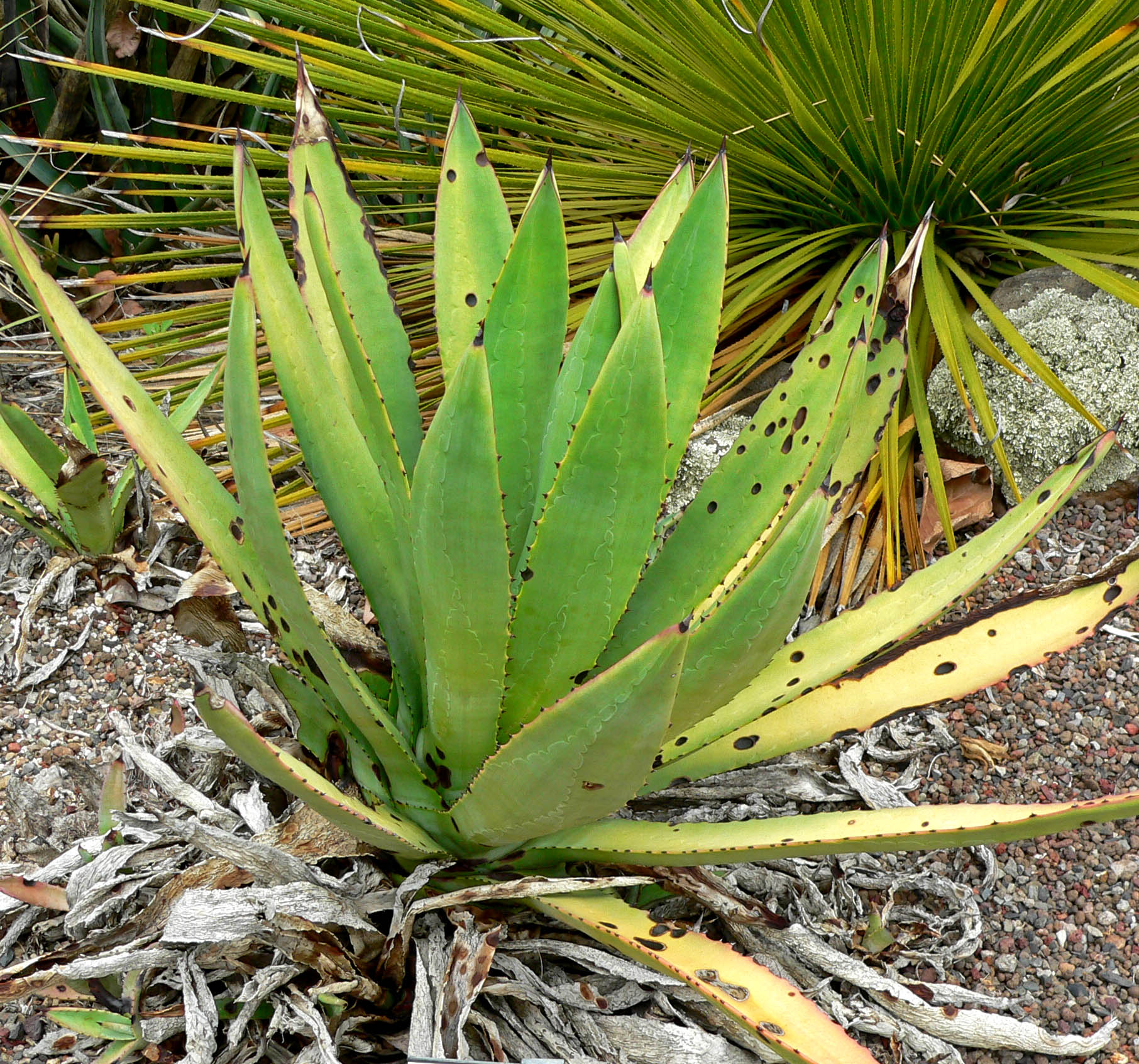
Agave murpheyi is a rare species of tremendous archaeobotanical importance. It was extensively cultivated by the Hohokam people of the Sonoran Desert for over a thousand years as a source of fiber, food, and fermented beverage. It is distinguished from other regional agaves by pronounced vivipary: rather than setting abundant seed, it produces fleshy bulbils along the entire length of the flower stalk, facilitating vegetative propagation and explaining its persistence at abandoned archaeological sites.
chevron_right edit_note Proposed edits auto-approved at +3 net votes
No pending proposals for this section.
Overview
| Category | Classification |
|---|---|
| Family | Asparagaceae |
| Genus | Agave |
| Growth Habit | Solitary or small-clustered rosette, slow-growing, with stiff erect leaves. Produces a monocarpic flower stalk up to 5 m tall densely covered in viviparous bulbils. |
| Conservation Status | Endangered in the wild; most known populations are associated with Hohokam archaeological sites, suggesting its current distribution largely reflects pre-Columbian cultivation rather than purely natural range. |
| pH Target | 6.0–7.5 |
| Type | Rocky or sandy volcanic soil, nutrient-poor, slightly acidic to neutral pH |
Origin & Habitat
Morphology
Lanceolate, 60–90 cm long and 8–12 cm wide, grey-green with faint cross-marks; margins bearing irregular horny teeth, grey-brown; stout terminal spine 3–5 cm long.
ecoYellowish-green, 5–6 cm long, arranged in umbels on a spike 4–5 m tall; in most plants bulbils replace or coexist with flowers, reducing viable seed production.
ecoVery short subterranean stem (caudex), with few rhizomes producing limited lateral offsets; the plant reproduces primarily via bulbils dropped from the flower spike.
ecoShallow and extensive root system adapted to capture scarce Sonoran Desert rainfall; fibrous roots anchor the plant in volcanic rocky soils.
ecochevron_right edit_note Proposed edits auto-approved at +3 net votes
No pending proposals for this section.
Requirements
Soil & Substrate
Type
Rocky or sandy volcanic soil, nutrient-poor, slightly acidic to neutral pH
groups Beneficial Associations
chevron_right edit_note Proposed edits auto-approved at +3 net votes
No pending proposals for this section.
Propagation Strategy
C
O
Every 3–5 years or when roots completely fill the pot
One application of low-nitrogen fertilizer (5-10-10) in early spring; no fertilization in autumn or winter
Uses & Applications
Precautions / Toxicity
Generally low toxicity; sap may cause mild skin irritation in sensitive individuals. Not toxic to humans under normal handling.
chevron_right edit_note Proposed edits auto-approved at +3 net votes
No pending proposals for this section.
Plant Health
Root rot (Phytophthora spp.) from excess substrate moisture
Mealybugs (Pseudococcus spp.) at leaf bases and collar zone
Agave snout weevil (Scyphophorus acupunctatus): primary threat; larvae destroy the heart
chevron_right edit_note Proposed edits auto-approved at +3 net votes
No pending proposals for this section.
"Wild populations of A. murpheyi are so sparse that some authors consider it a 'semi-domesticated' species that survived thanks to Hohokam human stewardship. Its bulbils, an evolutionary rarity within the genus, are key to ex situ conservation."
chevron_right edit_note Proposed edits auto-approved at +3 net votes
No pending proposals for this section.
Scientific Integrity
🟡 MediumVote to help validate this record
Sources
Loading…
Discussion
Disclaimer
This species record is provided for educational and informational purposes only. Jardín Roca Negra does not guarantee the accuracy or completeness of the data. Content is community-curated and may be subject to revision; it should not replace advice from a qualified botanist. This species may be toxic, invasive, or subject to legal restrictions — verify before handling or cultivating. Jardín Roca Negra accepts no liability for any harm arising from reliance on this information. Images are reproduced under Creative Commons or equivalent free licenses; credits are noted below each image.