
Haworthia cooperi Baker
Cooper's Haworthia
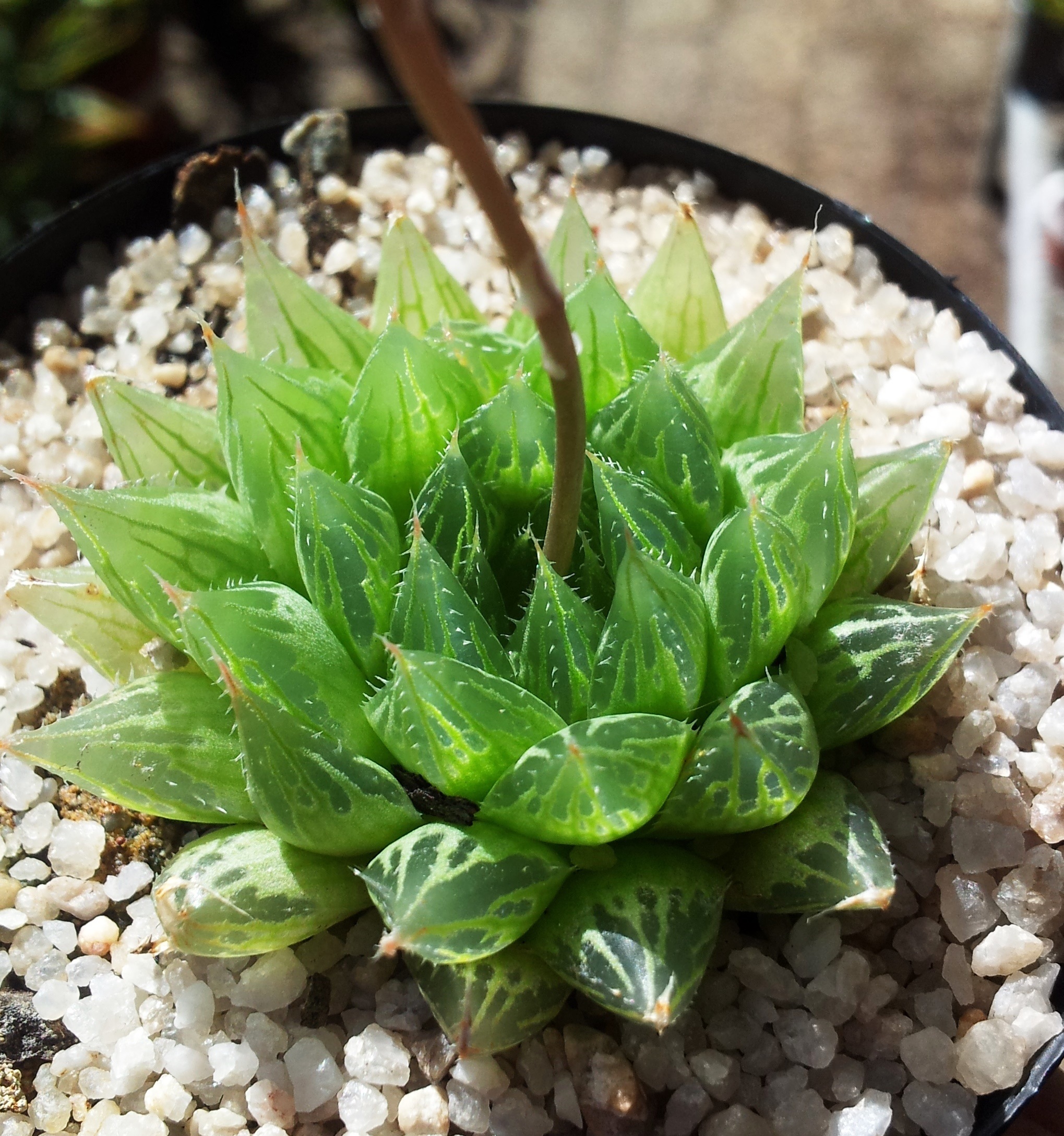
Haworthia cooperi is a botanical gem from the South African Eastern Cape, famous for the translucent tips of its leaves — the so-called 'windows' — which allow light to penetrate to the interior photosynthetic tissue, an evolutionary trick to survive semi-buried beneath the soil in arid habitats. Its compact 5–8 cm rosettes are highly elegant and much sought after by windowed-plant collectors. It is extremely sensitive to direct sun, which clouds and burns its delicate windows.
chevron_right edit_note Proposed edits auto-approved at +3 net votes
No pending proposals for this section.
© Abu Shawka
CC0
Overview
| Category | Classification |
|---|---|
| Family | Asphodelaceae |
| Genus | Haworthia |
| Growth Habit | Very compact acaulescent rosette, with leaves slightly incurved; forms clumps via basal offsets over time. |
| Conservation Status | Not threatened overall, though some local varieties are subject to illegal collection. Prefer legally cultivated specimens. |
| pH Target | 6.0 – 7.0 |
| Type | Ultra-porous substrate: coarse perlite + quartz sand + minimal cactus soil. Avoid any peat-containing substrate. |
Origin & Habitat
Morphology
Ovate to almost spherical leaves, 2–4 cm, succulent, light green to blue-green, with a retuse (flat or slightly concave) transparent apex forming the 'window' that captures light.
ecoWhite tubular flowers with pink or greenish veins on slender scapes 15–30 cm; little decorative value but attract small pollinators.
ecoPractically nonexistent; the rosette emerges almost at substrate level from a very short rhizome.
ecoRelatively thick fleshy roots, adapted to water retention during dry periods. Very sensitive to suffocation from excess moisture.
ecochevron_right edit_note Proposed edits auto-approved at +3 net votes
No pending proposals for this section.
Requirements
Soil & Substrate
Type
Ultra-porous substrate: coarse perlite + quartz sand + minimal cactus soil. Avoid any peat-containing substrate.
groups Beneficial Associations
chevron_right edit_note Proposed edits auto-approved at +3 net votes
No pending proposals for this section.
Propagation Strategy
- 1 Remove the mother plant from the pot carefully to avoid damaging fleshy roots.
- 2 Identify offsets with their own roots and separate them by hand or sterilized blade.
- 3 Let cuts dry for 1–2 days in shade and plant in ultra-porous substrate.
- 4 Water very lightly for the first time after 7–10 days.
Never expose to direct sun; a thin curtain or frosted glass protects the windows from burns.
Exposure to direct sun, which permanently bleaches and destroys the translucent windows.
Every 3 years in spring; haworthia does not require frequent repotting.
Quarter-strength succulent fertilizer once in spring and once in early summer; none for the rest of the year.
Uses & Applications
Precautions / Toxicity
Non-toxic to humans, dogs, and cats. Completely safe houseplant.
chevron_right edit_note Proposed edits auto-approved at +3 net votes
No pending proposals for this section.
Plant Health
Mealybugs (Planococcus citri): hard to detect among the tight leaves; inspect regularly and treat with isopropyl alcohol applied with a fine brush.
Root rot from overwatering; fleshy roots are especially susceptible; first symptom: basal leaves turn translucent and soft.
chevron_right edit_note Proposed edits auto-approved at +3 net votes
No pending proposals for this section.
"In its natural habitat, H. cooperi grows semi-buried with only the windowed tips exposed; these 'windows' function as biological optical fibers conducting light to the leaf mesophyll, maximizing photosynthesis with minimal exposure to radiation and desiccation."
chevron_right edit_note Proposed edits auto-approved at +3 net votes
No pending proposals for this section.
Scientific Integrity
🟡 MediumVote to help validate this record
Sources
Loading…
Discussion
Disclaimer
This species record is provided for educational and informational purposes only. Jardín Roca Negra does not guarantee the accuracy or completeness of the data. Content is community-curated and may be subject to revision; it should not replace advice from a qualified botanist. This species may be toxic, invasive, or subject to legal restrictions — verify before handling or cultivating. Jardín Roca Negra accepts no liability for any harm arising from reliance on this information. Images are reproduced under Creative Commons or equivalent free licenses; credits are noted below each image.