
Agave isthmensis García-Mendoza & F.Palma
Isthmus Agave
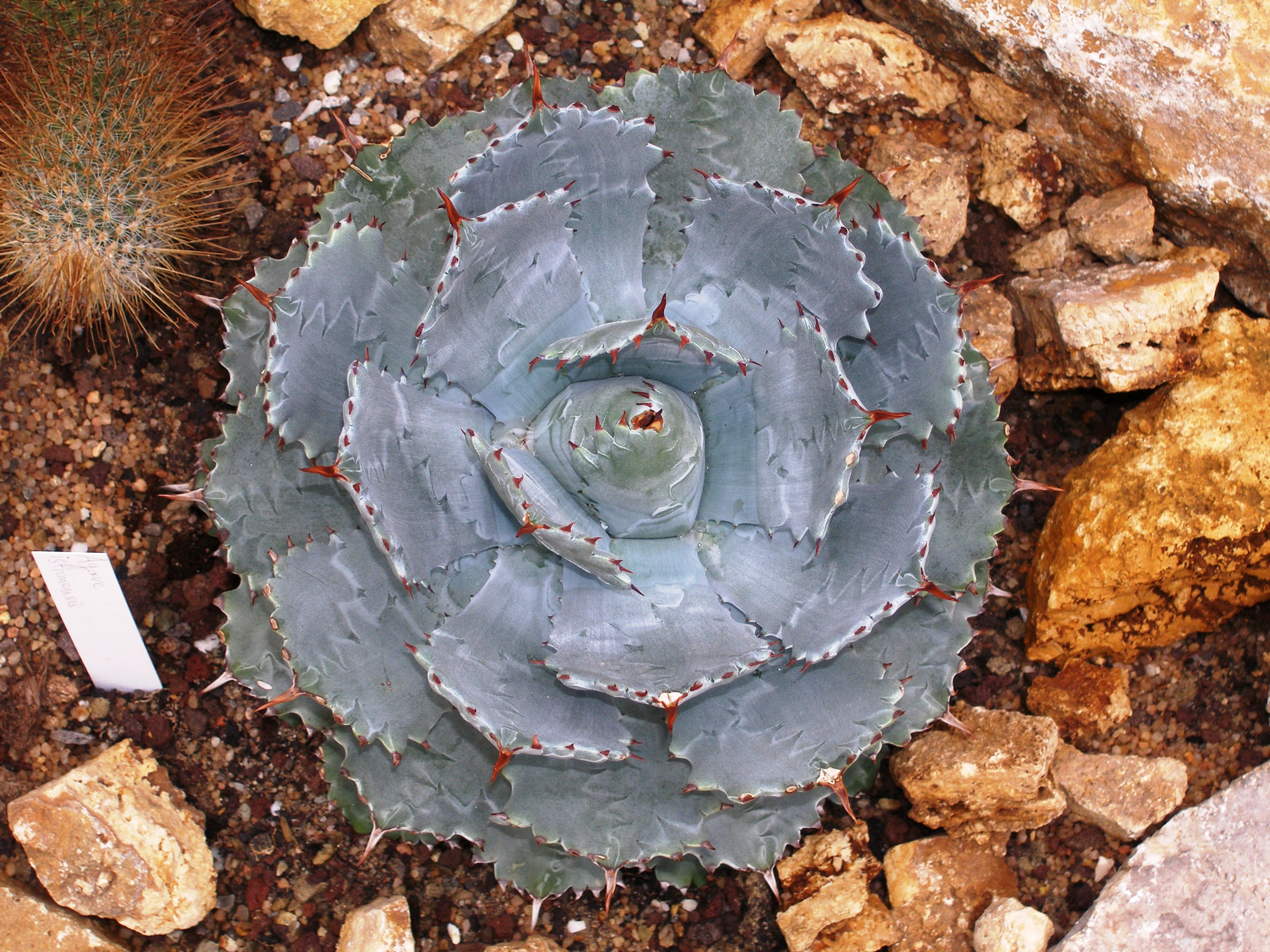
Agave isthmensis is one of the most popular dwarf agaves in ornamental horticulture worldwide. Native to the hot, arid Isthmus of Tehuantepec in Oaxaca, it forms compact, symmetrical rosettes of only 15–30 cm in diameter, with greyish or glaucous-green leaves adorned with prominent red or brown lateral teeth and distinctive leaf impressions that leave decorative patterns on each leaf's surface. Its small size makes it ideal for pots, rock gardens, and succulent collections in limited spaces. Despite its delicate appearance, it is extremely resistant to drought and intense heat.
chevron_right edit_note Proposed edits auto-approved at +3 net votes
No pending proposals for this section.
Overview
| Category | Classification |
|---|---|
| Family | Asparagaceae |
| Genus | Agave |
| Growth Habit | Dwarf, compact and very symmetrical, acaulescent, monocarpic rosette. Typical diameter 15–30 cm. Produces offsets with moderate frequency. |
| Conservation Status | Data Deficient (DD) – IUCN. Its natural range is restricted and pressure from ornamental collection could be a risk factor. |
| pH Target | 6.5–7.5 |
| Type | Sandy-mineral, highly draining, low in organic matter |
Origin & Habitat
Morphology
Broad, ovate to oblanceolate, 10–18 cm long and 4–7 cm wide, grey-green to blue-grey. Margin with very prominent red to brown teeth (3–8 mm long) on prominent mamilae. Rigid terminal spine 1.5–3 cm. Very decorative leaf impression marks on the adaxial surface.
ecoYellow to reddish, 5–7 cm long, on a scape 2–4 m tall (disproportionately tall relative to the plant size). Dense panicle. May produce viviparious bulbils.
ecoCompletely acaulescent; the rosette forms at ground level. Small but dense piña with good sugar content. Very slow-growing plant.
ecoShallow, fibrous and well-branched root system. Adapted to highly draining soils and sparse rainfall of the Isthmus of Tehuantepec.
ecochevron_right edit_note Proposed edits auto-approved at +3 net votes
No pending proposals for this section.
Requirements
Soil & Substrate
Type
Sandy-mineral, highly draining, low in organic matter
groups Beneficial Associations
chevron_right edit_note Proposed edits auto-approved at +3 net votes
No pending proposals for this section.
Propagation Strategy
I
O
Every 2–3 years; the plant prefers to be slightly snug in its pot.
Very low fertilization: cactus fertilizer diluted to half strength, once in spring and once in summer.
Uses & Applications
Precautions / Toxicity
Low to moderate. The marginal teeth are very sharp and can cause physical injury. Sap contains calcium oxalate at low concentrations.
chevron_right edit_note Proposed edits auto-approved at +3 net votes
No pending proposals for this section.
Plant Health
Root rot (Fusarium spp., overwatering)
Mealybugs (Pseudococcus spp.)
Agave snout weevil (Scyphophorus acupunctatus)
chevron_right edit_note Proposed edits auto-approved at +3 net votes
No pending proposals for this section.
"One of the gems of dwarf agave collections. Extremely popular among succulent collectors for its perfect symmetry and decorative teeth. Numerous horticultural forms exist with variations in tooth colour and leaf tone. Species endemic to a very restricted area in the Isthmus of Tehuantepec."
chevron_right edit_note Proposed edits auto-approved at +3 net votes
No pending proposals for this section.
Scientific Integrity
🟡 MediumVote to help validate this record
Sources
Loading…
Discussion
Disclaimer
This species record is provided for educational and informational purposes only. Jardín Roca Negra does not guarantee the accuracy or completeness of the data. Content is community-curated and may be subject to revision; it should not replace advice from a qualified botanist. This species may be toxic, invasive, or subject to legal restrictions — verify before handling or cultivating. Jardín Roca Negra accepts no liability for any harm arising from reliance on this information. Images are reproduced under Creative Commons or equivalent free licenses; credits are noted below each image.