
Agave hookeri K.Koch
Hooker's Agave
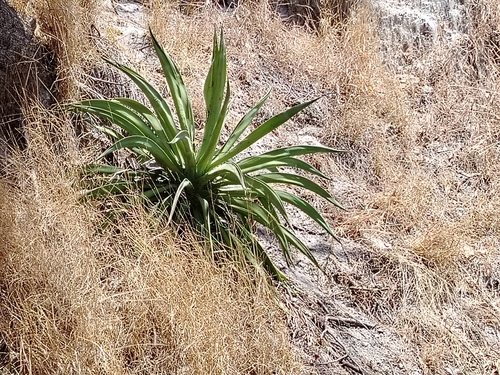
Agave hookeri is a large, robust agave native to the montane slopes and ravines of Michoacán, Jalisco, and Guerrero in Mexico. It forms an imposing rosette of stiff grey-green leaves that can exceed 2 metres in diameter on mature specimens. It has traditional economic importance: its piñas are used for artisanal mezcal production and its leaf fibres are harvested for ropes and textiles. Being monocarpic, it flowers only once at the end of its life (typically 15–25 years), producing a monumental floral spike that can exceed 8 metres, after which the mother plant dies leaving offsets.
chevron_right edit_note Proposed edits auto-approved at +3 net votes
No pending proposals for this section.
Overview
| Category | Classification |
|---|---|
| Family | Asparagaceae |
| Genus | Agave |
| Growth Habit | Acaulescent or short-stemmed rosette, monocarpic, large in stature (1.5–2.5 m diameter). Grows slowly and produces abundant basal offsets. |
| Conservation Status | Least Concern (LC) – IUCN. Populations are stable within its native range, though habitat loss from agriculture poses a localized threat. |
| pH Target | 6.0–7.5 |
| Type | Sandy-loam to rocky, with excellent drainage |
Origin & Habitat
Morphology
Lanceolate, rigid, 80–130 cm long and 10–16 cm wide at the base, grey-green to blue-green. Margin with dark-brown corneous teeth spaced 2–4 cm apart, and a robust terminal spine 4–7 cm long.
ecoYellow to yellow-green, tubular, 7–9 cm long, arranged in dense panicles on a scape 6–9 m tall. Flowers only once in its lifetime. Pollinated by bats and moths.
ecoPractically acaulescent in most specimens; the rosette forms directly from the base with no visible stem. The central piña accumulates large carbohydrate (sugar) reserves exploited in mezcal production.
ecoShallow and extensive root system, adapted to capturing sparse rainfall and runoff water. Fibrous roots extend radially up to 3 m from the plant base.
ecochevron_right edit_note Proposed edits auto-approved at +3 net votes
No pending proposals for this section.
Requirements
Soil & Substrate
Type
Sandy-loam to rocky, with excellent drainage
groups Beneficial Associations
chevron_right edit_note Proposed edits auto-approved at +3 net votes
No pending proposals for this section.
Propagation Strategy
S
O
Every 3–4 years or when the plant outgrows the container. Prefers to grow in the ground.
Minimal fertilization: apply a low-nitrogen fertilizer (5-10-10) once a year in spring.
Uses & Applications
Precautions / Toxicity
Moderate. Fresh sap contains saponins and calcium oxalate crystals that can cause skin and eye irritation. Wear gloves when handling.
chevron_right edit_note Proposed edits auto-approved at +3 net votes
No pending proposals for this section.
Plant Health
Root rot (Phytophthora spp.)
Mealybugs (Pseudococcus spp.)
Agave snout weevil (Scyphophorus acupunctatus)
chevron_right edit_note Proposed edits auto-approved at +3 net votes
No pending proposals for this section.
"Species frequently confused with Agave inaequidens in nurseries and collections; distinguished by its broader leaf bases and more robust, regularly spaced marginal teeth. Key species for traditional mezcal production in the Trans-Mexican Volcanic Belt region."
chevron_right edit_note Proposed edits auto-approved at +3 net votes
No pending proposals for this section.
Scientific Integrity
🟡 MediumVote to help validate this record
Sources
Loading…
Discussion
Disclaimer
This species record is provided for educational and informational purposes only. Jardín Roca Negra does not guarantee the accuracy or completeness of the data. Content is community-curated and may be subject to revision; it should not replace advice from a qualified botanist. This species may be toxic, invasive, or subject to legal restrictions — verify before handling or cultivating. Jardín Roca Negra accepts no liability for any harm arising from reliance on this information. Images are reproduced under Creative Commons or equivalent free licenses; credits are noted below each image.