
Agave delamateri W.C.Hodgson & Slauson
Delamater's Agave
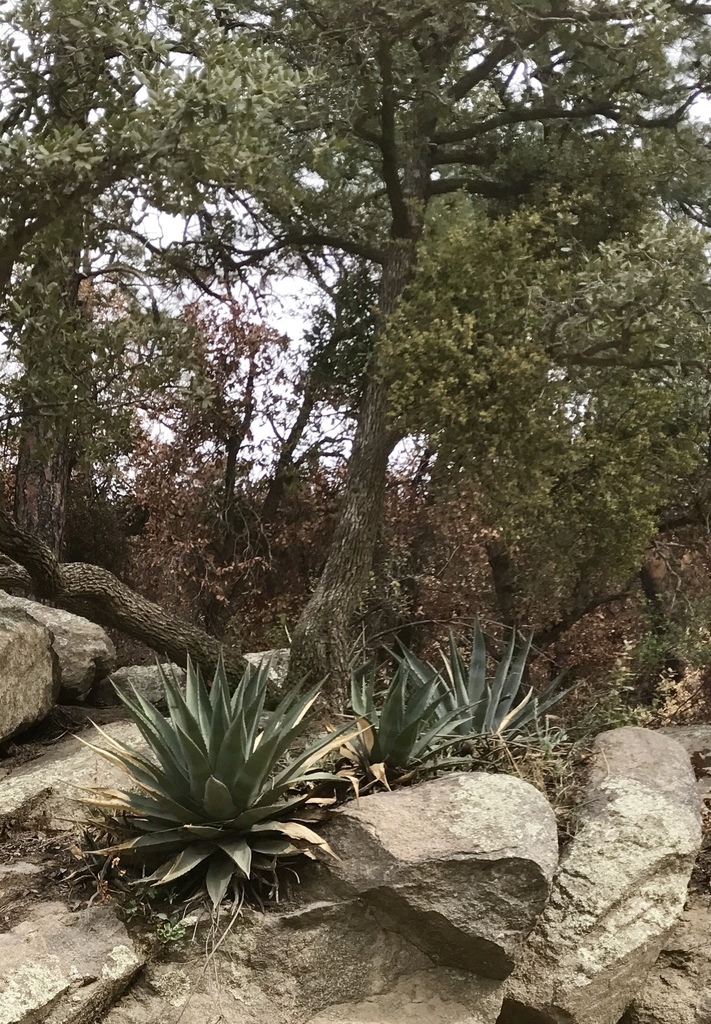
Agave delamateri is a species endemic to Yavapai County, in north-central Arizona, described by W.C. Hodgson and Slauson in 1995. It inhabits the margins of pine-juniper forests and manzanita chaparrals at elevations of 1100–1800 m above sea level. It is one of the highest-altitude agaves in the southwestern United States and shows notable adaptations to the winter cold that characterizes the Arizona plateau. The IUCN classifies it as a threatened species due to its extremely restricted distribution and pressure from extensive livestock grazing on its wild populations.
chevron_right edit_note Proposed edits auto-approved at +3 net votes
No pending proposals for this section.
Overview
| Category | Classification |
|---|---|
| Family | Asparagaceae |
| Genus | Agave |
| Growth Habit | Medium to large rosette, solitary or forming small groups. Moderately erect leaves forming a characteristic crown. Life cycle of 15–30 years until flowering. |
| Conservation Status | Threatened according to IUCN criteria; included on the Prescott National Forest sensitive plants list. Threats: grazing, illegal collection, climate change. |
| pH Target | 6.5–8.0 |
| Type | Loamy, clay-loam, rocky |
Origin & Habitat
Morphology
Gray-green to blue-green, lanceolate, 60–100 cm long and 10–15 cm wide, with slightly concave surface. Margins with rhombic gray to black teeth spaced 1–3 cm apart, and a robust apical spine of 4–7 cm.
ecoYellow to yellow-orange, in a panicle 4–7 m tall with spreading lateral branches. Flowering is the plant's final act; pollinators include bats and hummingbirds.
ecoShort and robust, acaulescent. Leaf bases mark a compact spiral pattern. Before flowering it may develop a caudex up to 40 cm.
ecoDeep fibrous and extensive lateral roots. Deep root penetration allows it to exploit subsurface moisture during summer drought periods.
ecochevron_right edit_note Proposed edits auto-approved at +3 net votes
No pending proposals for this section.
Requirements
Soil & Substrate
Type
Loamy, clay-loam, rocky
groups Beneficial Associations
chevron_right edit_note Proposed edits auto-approved at +3 net votes
No pending proposals for this section.
Propagation Strategy
S
E
Every 4–6 years; prefers wide and deep containers.
Very limited fertilization: a small dose of low-nitrogen fertilizer once in spring.
Uses & Applications
Precautions / Toxicity
Long robust apical spines pose a risk of eye and skin injury. Handle with adequate protection.
chevron_right edit_note Proposed edits auto-approved at +3 net votes
No pending proposals for this section.
Plant Health
Root rot (Phytophthora cinnamomi) from waterlogging in winter
Mealybug (Pseudococcus spp.) in cultivation conditions
Agave snout weevil (Scyphophorus acupunctatus) — primary threat in natural habitat
chevron_right edit_note Proposed edits auto-approved at +3 net votes
No pending proposals for this section.
"Discovered and described relatively late for the genus Agave (1995). Collection for private gardens has decimated some local populations. Cultivation in botanical gardens is crucial as ex situ insurance."
chevron_right edit_note Proposed edits auto-approved at +3 net votes
No pending proposals for this section.
Scientific Integrity
🟡 MediumVote to help validate this record
Sources
Loading…
Discussion
Disclaimer
This species record is provided for educational and informational purposes only. Jardín Roca Negra does not guarantee the accuracy or completeness of the data. Content is community-curated and may be subject to revision; it should not replace advice from a qualified botanist. This species may be toxic, invasive, or subject to legal restrictions — verify before handling or cultivating. Jardín Roca Negra accepts no liability for any harm arising from reliance on this information. Images are reproduced under Creative Commons or equivalent free licenses; credits are noted below each image.