
Agave datylio F.A.C.Weber
Date Agave
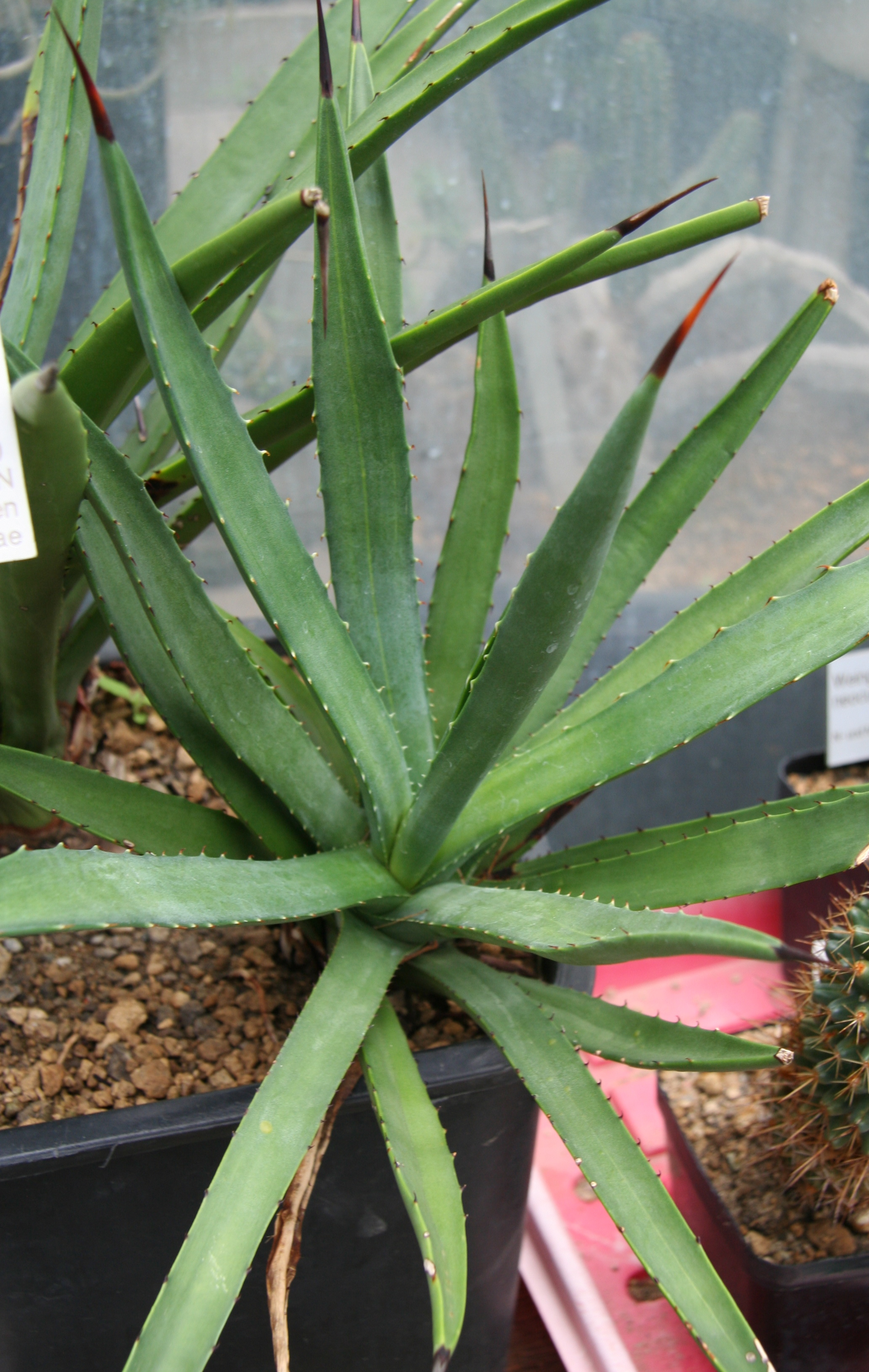
Agave datylio, described by French pharmacist and botanist Frédéric Albert Constantin Weber, is a medium-sized agave endemic to the Los Cabos region of Baja California Sur, Mexico. Its shiny dark green leaves with well-defined marginal teeth give it an elegant appearance. It inhabits coastal scrublands and rocky slopes of the Baja California Peninsula, coexisting with the characteristic xeric flora of that region. Its variety vexans is also cultivated in European botanical gardens.
chevron_right edit_note Proposed edits auto-approved at +3 net votes
No pending proposals for this section.
Overview
| Category | Classification |
|---|---|
| Family | Asparagaceae |
| Genus | Agave |
| Growth Habit | Compact rosette, usually solitary or with few offsets. Semi-arborescent habit at maturity. Slow growing. |
| Conservation Status | Not formally evaluated by IUCN; its restricted distribution in Los Cabos makes it vulnerable to habitat loss from tourist development. |
| pH Target | 6.5–8.0 |
| Type | Sandy, gravelly, volcanic |
Origin & Habitat
Morphology
Shiny dark green, lanceolate, 60–100 cm in length, with margins armed with well-spaced black corneous teeth and a robust dark brown terminal spine of 3–5 cm.
ecoYellow to yellow-green, in a dense panicle that can reach 4–6 m. Flowering occurs at the end of the life cycle, typically after 20–40 years.
ecoShort and acaulescent during most life stages. In mature specimens it may develop a short trunk up to 50 cm before producing the floral scape.
ecoExtensive shallow fibrous roots that take advantage of seasonal rains. The root system adapts to the rocky and sandy substrates of the Pacific coast.
ecochevron_right edit_note Proposed edits auto-approved at +3 net votes
No pending proposals for this section.
Requirements
Soil & Substrate
Type
Sandy, gravelly, volcanic
groups Beneficial Associations
chevron_right edit_note Proposed edits auto-approved at +3 net votes
No pending proposals for this section.
Propagation Strategy
P
W
Every 3–5 years, at the start of spring.
Minimal spring fertilization with low-nitrogen, high-potassium fertilizer.
Uses & Applications
Precautions / Toxicity
Terminal spines and marginal teeth cause puncture wounds. Sap may irritate skin and eyes.
chevron_right edit_note Proposed edits auto-approved at +3 net votes
No pending proposals for this section.
Plant Health
Root rot (Fusarium spp.) from excessive watering or poor drainage
Citrus mealybug (Planococcus citri) in leaf axils
Agave snout weevil (Scyphophorus acupunctatus) — damage to central crown
chevron_right edit_note Proposed edits auto-approved at +3 net votes
No pending proposals for this section.
"Variety vexans is distinguished by more prominent marginal teeth and more open rosettes. Both forms deserve in situ conservation given the accelerated urban development of Los Cabos."
chevron_right edit_note Proposed edits auto-approved at +3 net votes
No pending proposals for this section.
Scientific Integrity
🟡 MediumVote to help validate this record
Sources
Loading…
Discussion
Disclaimer
This species record is provided for educational and informational purposes only. Jardín Roca Negra does not guarantee the accuracy or completeness of the data. Content is community-curated and may be subject to revision; it should not replace advice from a qualified botanist. This species may be toxic, invasive, or subject to legal restrictions — verify before handling or cultivating. Jardín Roca Negra accepts no liability for any harm arising from reliance on this information. Images are reproduced under Creative Commons or equivalent free licenses; credits are noted below each image.