
Aloe brevifolia Mill.
Short-leaved Aloe
Aloe brevifolia, the 'Short-leaved Aloe', is a compact and robust succulent from the South African Western Cape, characterized by its dense rosettes of blue-grey triangular leaves with prominent white teeth that give it an armed, elegant appearance. Its modest dimensions (10–15 cm) and full-sun resistance make it one of the most useful aloes for xeriscape gardens, rock gardens, and outdoor pots. It produces showy orange-red tubular flowers in spring, very attractive to hummingbirds.
chevron_right edit_note Proposed edits auto-approved at +3 net votes
No pending proposals for this section.
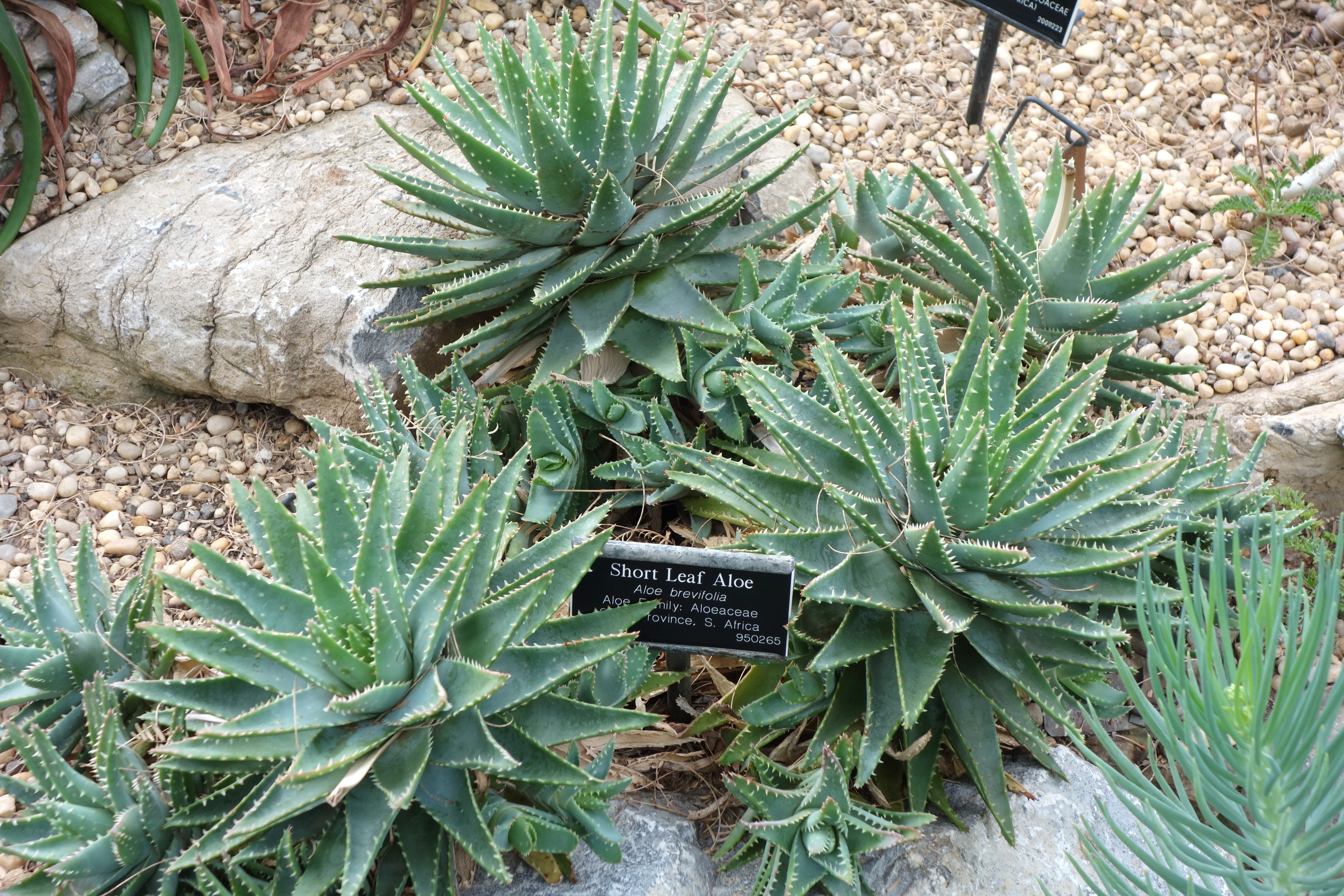
© Daderot
CC0
Overview
| Category | Classification |
|---|---|
| Family | Asphodelaceae |
| Genus | Aloe |
| Growth Habit | Compact acaulescent rosette 10–15 cm; produces abundant offsets forming dense, spreading colonies. |
| Conservation Status | Species not threatened overall; relatively common in the Western Cape. Widely cultivated. Nursery specimens recommended. |
| pH Target | 6.0 – 7.5 |
| Type | Sandy loam with excellent drainage; tolerates nutrient-poor soils and slightly alkaline pH. |
Origin & Habitat
Morphology
Short, triangular leaves, 6–10 cm, blue-grey or grey-green with pinkish tinge under solar stress; with rigid white teeth on the margin and small warts on the surface.
ecoOrange to orange-red tubular flowers 3 cm long in compact racemes on scapes 30–50 cm. Blooms in spring, very attractive to hummingbirds and carpenter bees.
ecoPractically nonexistent in young specimens; a short stem may appear with age as offsets form colonies around it.
ecoFibrous, robust root system; tolerates prolonged drought thanks to reserves in the fleshy leaves.
ecochevron_right edit_note Proposed edits auto-approved at +3 net votes
No pending proposals for this section.
Requirements
Soil & Substrate
Type
Sandy loam with excellent drainage; tolerates nutrient-poor soils and slightly alkaline pH.
groups Beneficial Associations
chevron_right edit_note Proposed edits auto-approved at +3 net votes
No pending proposals for this section.
Propagation Strategy
- 1 Separate offsets from the mother when they are at least 3–4 cm in diameter.
- 2 Use a sterilized blade; preserve the offset's roots if present.
- 3 Let the cut dry for 2–3 days and plant in well-drained substrate.
- 4 Water lightly after 7 days.
Plant on slopes or gravel gardens to take advantage of its colonizing capacity and erosion control.
Watering too frequently in winter, when the plant is in semi-dormancy.
Every 2–3 years in spring; take the opportunity to separate accumulated offsets.
Half-strength cactus fertilizer once a month in spring and summer; none in autumn–winter.
Uses & Applications
Precautions / Toxicity
Toxic if ingested; contains anthraquinones. Causes gastrointestinal irritation in humans, dogs, and cats. Not suitable for consumption.
chevron_right edit_note Proposed edits auto-approved at +3 net votes
No pending proposals for this section.
Plant Health
Mealybugs between offsets and leaf bases; inspect regularly and treat with alcohol or systemic insecticide.
Root rot from waterlogging; the first sign is loss of turgidity in leaves; improve substrate drainage.
chevron_right edit_note Proposed edits auto-approved at +3 net votes
No pending proposals for this section.
"Aloe brevifolia produces offsets so prolifically that in its natural Western Cape habitat it creates dense mats that stabilize slopes and reduce soil erosion; this colonizing capacity makes it a valuable ally for restoring degraded soils in Mediterranean ecosystems."
chevron_right edit_note Proposed edits auto-approved at +3 net votes
No pending proposals for this section.
Scientific Integrity
🟡 MediumVote to help validate this record
Sources
Loading…
Discussion
Disclaimer
This species record is provided for educational and informational purposes only. Jardín Roca Negra does not guarantee the accuracy or completeness of the data. Content is community-curated and may be subject to revision; it should not replace advice from a qualified botanist. This species may be toxic, invasive, or subject to legal restrictions — verify before handling or cultivating. Jardín Roca Negra accepts no liability for any harm arising from reliance on this information. Images are reproduced under Creative Commons or equivalent free licenses; credits are noted below each image.