
Agave ferdinandi-regis A.Berger
King Ferdinand's agave
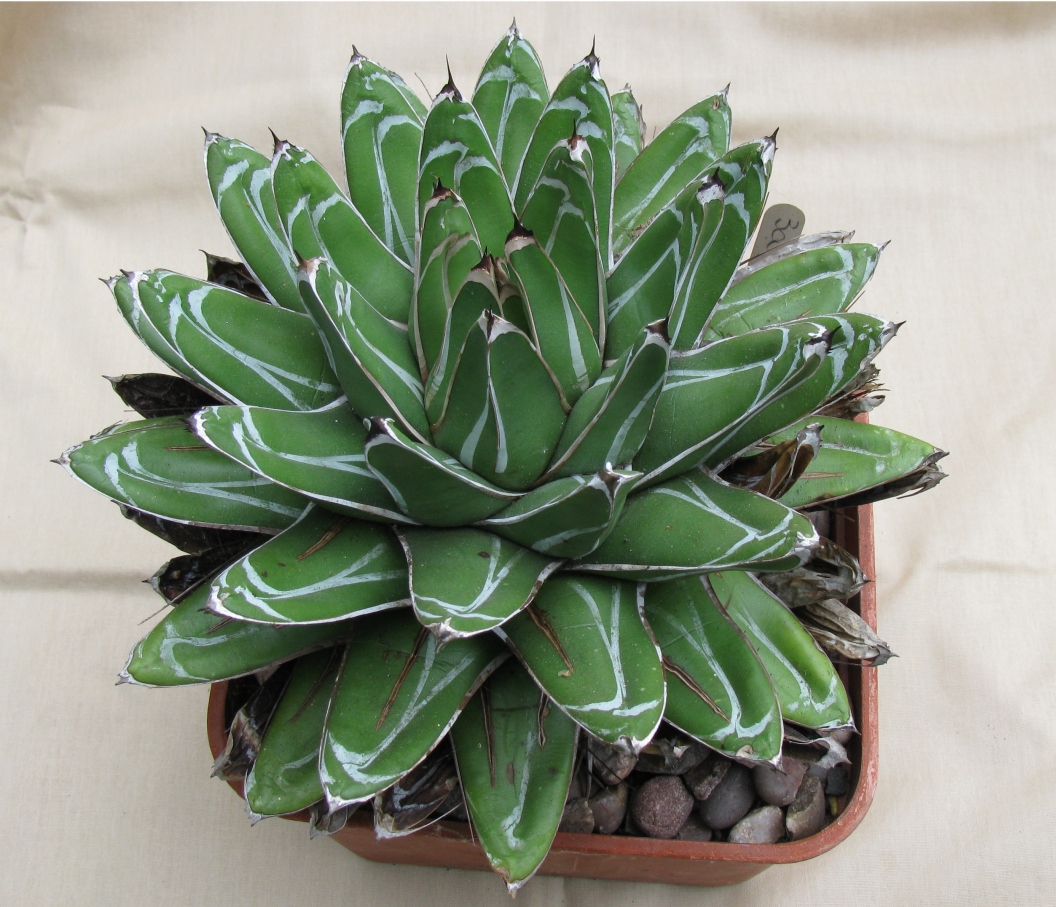
Agave ferdinandi-regis is one of the jewels of the Agavaceae family, closely related to Agave victoriae-reginae. This monocarpic succulent, native to limestone canyon walls and rocky cliffs of the Sierra Madre Oriental (Nuevo León and Coahuila, Mexico), is remarkable for its dense, perfectly symmetrical rosette with dark green leaves decorated with white linear bud-print markings on the adaxial surface — a result of leaf contact during growth. It was named in honour of King Ferdinand of Spain by A. Berger. It is highly prized as an ornamental for its elegant symmetry and distinctive leaf markings.
chevron_right edit_note Proposed edits auto-approved at +3 net votes
No pending proposals for this section.
Overview
| Category | Classification |
|---|---|
| Family | Asparagaceae |
| Genus | Agave |
| Growth Habit | Dense, compact, highly symmetrical acaulescent rosette; very slow-growing; monocarpic |
| Conservation Status | Vulnerable (VU) – Endemic to the Sierra Madre Oriental; habitat fragmented by human activities |
| pH Target | 7.0–8.0 |
| Type | Calcareous, stony, very well-drained; tolerates nutrient-poor and slightly alkaline soils |
Origin & Habitat
Morphology
Triangular-lanceolate leaves 15–30 cm long, rigid, dark green, with white or greyish horny margins, a 2–3 cm terminal spine, and characteristic white linear bud-print markings on the upper surface resulting from contact with adjacent leaves during growth.
ecoTubular yellow-green or reddish flowers grouped in a dense spike on a 3–5 m tall stalk. Terminal flowering occurs only once, typically after 15–30 years.
ecoVery short, nearly subterranean stem, elongating only when producing the flowering stalk. Leaves are inserted in a tight spiral forming a perfectly globose rosette.
ecoRelatively fleshy, spreading roots adapted to highly drained calcareous soils and rock fissures. Sensitive to waterlogging.
ecochevron_right edit_note Proposed edits auto-approved at +3 net votes
No pending proposals for this section.
Requirements
Soil & Substrate
Type
Calcareous, stony, very well-drained; tolerates nutrient-poor and slightly alkaline soils
groups Beneficial Associations
chevron_right edit_note Proposed edits auto-approved at +3 net votes
No pending proposals for this section.
Propagation Strategy
G
O
Every 4–6 years; prefer unglazed terracotta pots to favour evaporation
Low-nitrogen, high-potassium mineral fertiliser (NPK 5-5-15) once in spring; never fertilise in autumn or winter
Uses & Applications
Precautions / Toxicity
Mildly toxic; sap may irritate skin. The terminal spine and horny margins are physically hazardous.
chevron_right edit_note Proposed edits auto-approved at +3 net votes
No pending proposals for this section.
Plant Health
Crown and root rot (Fusarium spp. / Phytophthora spp.)
Mealybugs (Pseudococcus spp.)
Agave snout weevil (Scyphophorus acupunctatus)
chevron_right edit_note Proposed edits auto-approved at +3 net votes
No pending proposals for this section.
"A. ferdinandi-regis was described by Alwin Berger in the early 20th century and is often confused with A. victoriae-reginae, with which it forms a close phylogenetic group. The main differences are the more prominent white bud-print markings and the slightly more open rosette. Its slow growth rate makes it valuable to collectors but vulnerable to illegal collection."
chevron_right edit_note Proposed edits auto-approved at +3 net votes
No pending proposals for this section.
Scientific Integrity
🟡 MediumVote to help validate this record
Sources
Loading…
Discussion
Disclaimer
This species record is provided for educational and informational purposes only. Jardín Roca Negra does not guarantee the accuracy or completeness of the data. Content is community-curated and may be subject to revision; it should not replace advice from a qualified botanist. This species may be toxic, invasive, or subject to legal restrictions — verify before handling or cultivating. Jardín Roca Negra accepts no liability for any harm arising from reliance on this information. Images are reproduced under Creative Commons or equivalent free licenses; credits are noted below each image.