
Agave felgeri Gentry
Felger's agave
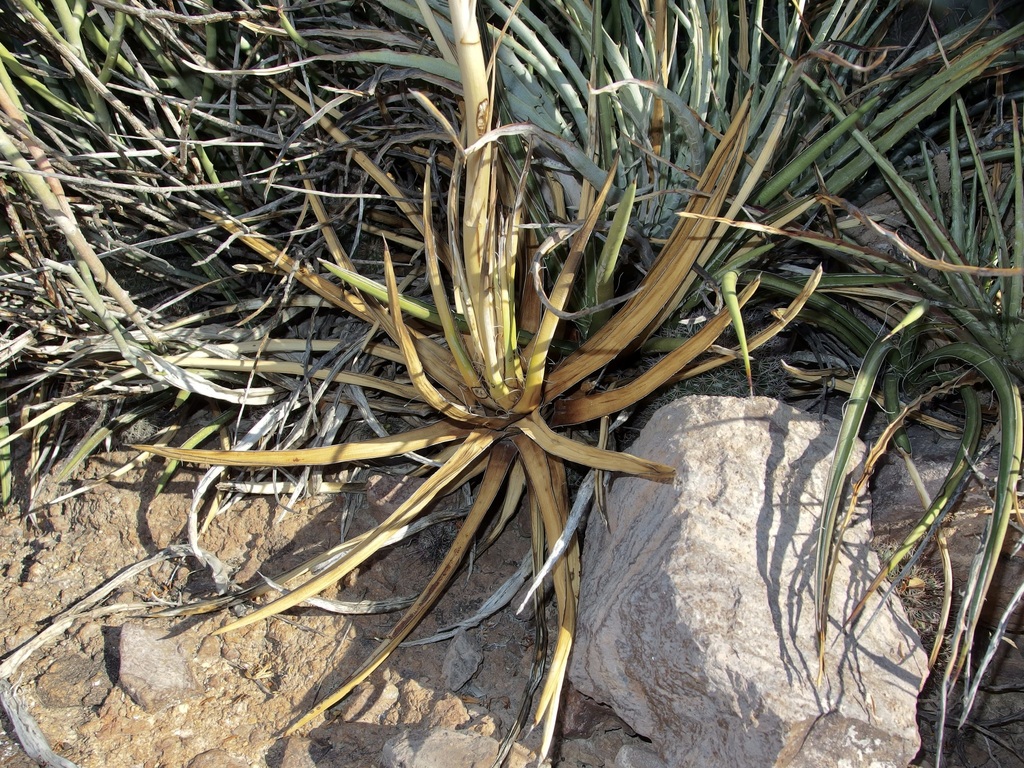
Agave felgeri is a monocarpic succulent forming small to medium rosettes, endemic to the coastal desert of Sonora (Mexico) and Tiburón Island in the Sea of Cortez. It was described by Howard Scott Gentry and named for botanist and conservationist Richard S. Felger. It is distinguished by its relatively narrow, grey-green leaves with fine marginal teeth and a sharp terminal spine. It inhabits coastal xerophilous scrubland, tolerating extreme heat, prolonged drought, and saline soils. It is one of the few agave species restricted to insular environments in northwestern Mexico.
chevron_right edit_note Proposed edits auto-approved at +3 net votes
No pending proposals for this section.
Overview
| Category | Classification |
|---|---|
| Family | Asparagaceae |
| Genus | Agave |
| Growth Habit | Small to medium acaulescent rosette; slow-growing; monocarpic |
| Conservation Status | Data Deficient (DD) / Vulnerable per regional assessments; endemic to Sonora and Tiburón Island |
| pH Target | 6.5–8.0 |
| Type | Coastal sandy, stony or alluvial soil; tolerates moderate salinity |
Origin & Habitat
Morphology
Narrow-lanceolate leaves 25–50 cm long, grey-green, with fine, well-spaced marginal teeth and a grey-brown conical terminal spine 2–4 cm long.
ecoTubular yellow-green flowers in panicles on a 3–5 m tall stalk. Terminal flowering occurs only once after several years of vegetative growth.
ecoVery short to nearly absent stem; extends only when developing the flowering stalk during the reproductive phase.
ecoShallow, fibrous and extensive roots adapted to coastal sandy and stony soils with low moisture retention.
ecochevron_right edit_note Proposed edits auto-approved at +3 net votes
No pending proposals for this section.
Requirements
Soil & Substrate
Type
Coastal sandy, stony or alluvial soil; tolerates moderate salinity
groups Beneficial Associations
chevron_right edit_note Proposed edits auto-approved at +3 net votes
No pending proposals for this section.
Propagation Strategy
G
O
Every 3–5 years or when roots appear through drainage holes
Diluted low-nitrogen mineral fertiliser (NPK 5-10-10) once in spring; never in autumn or winter
Uses & Applications
Precautions / Toxicity
Mildly toxic; sap may irritate skin and mucous membranes. Terminal spine causes puncture wounds.
chevron_right edit_note Proposed edits auto-approved at +3 net votes
No pending proposals for this section.
Plant Health
Root rot (Phytophthora spp. / Fusarium spp.)
Mealybugs (Pseudococcus spp.)
Agave snout weevil (Scyphophorus acupunctatus)
chevron_right edit_note Proposed edits auto-approved at +3 net votes
No pending proposals for this section.
"Described by Gentry in 1972, A. felgeri has a range restricted to mainland Sonora and Tiburón Island. Its rarity and insular endemism make it vulnerable to habitat disturbance and the introduction of feral herbivores. Its phylogenetic proximity to A. subsimplex warrants further taxonomic research."
chevron_right edit_note Proposed edits auto-approved at +3 net votes
No pending proposals for this section.
Scientific Integrity
🟡 MediumVote to help validate this record
Sources
Loading…
Discussion
Disclaimer
This species record is provided for educational and informational purposes only. Jardín Roca Negra does not guarantee the accuracy or completeness of the data. Content is community-curated and may be subject to revision; it should not replace advice from a qualified botanist. This species may be toxic, invasive, or subject to legal restrictions — verify before handling or cultivating. Jardín Roca Negra accepts no liability for any harm arising from reliance on this information. Images are reproduced under Creative Commons or equivalent free licenses; credits are noted below each image.