
Agave eborispina Hester
Ivory-spined agave
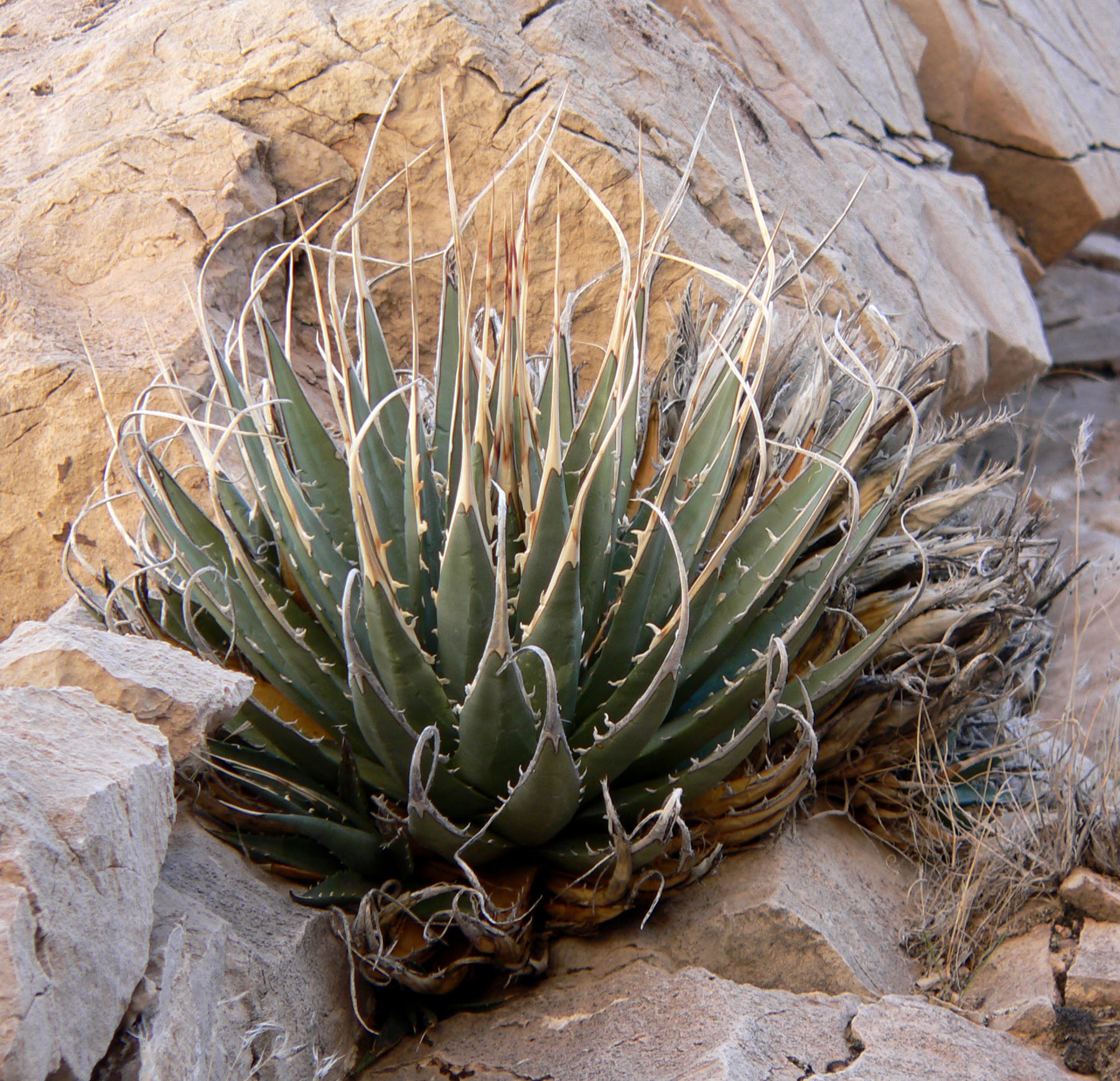
Agave eborispina, now recognised as a variety of Agave utahensis, is a monocarpic succulent native to the arid zones of Baja California (Mexico) and southern Nevada (USA). Its name refers to its characteristic ivory-white terminal spine, which contrasts elegantly with the blue-grey leaves of the rosette. It is one of the most striking varieties in the utahensis group for this distinctive apical colouration. It grows on rocky slopes and stony canyons at low to mid elevation, tolerating hard winter frosts and extreme summer heat.
chevron_right edit_note Proposed edits auto-approved at +3 net votes
No pending proposals for this section.
Overview
| Category | Classification |
|---|---|
| Family | Asparagaceae |
| Genus | Agave |
| Growth Habit | Dense, compact acaulescent rosette; very slow-growing; monocarpic, flowers only once |
| Conservation Status | Not independently assessed as a variety (A. utahensis: Least Concern – IUCN); endemic to Baja California and southern Nevada |
| pH Target | 6.0–7.5 |
| Type | Rocky, stony, very well-drained soil; tolerates nutrient-poor soils |
Origin & Habitat
Morphology
Linear-lanceolate leaves 20–40 cm long, rigid, blue-grey, with small horny marginal teeth and a distinctive ivory-white terminal spine 3–6 cm long that gives the species its scientific name.
ecoTubular yellow flowers arranged in panicles atop a 2–4 m flowering stalk. Flowering occurs only once in the plant's lifetime, typically after 15–25 years.
ecoVery short or virtually absent stem under normal conditions, elongating only during production of the terminal flowering stalk.
ecoExtensive, shallow root system adapted to rapidly capture water from scarce and irregular rainfall in rocky, well-drained soils.
ecochevron_right edit_note Proposed edits auto-approved at +3 net votes
No pending proposals for this section.
Requirements
Soil & Substrate
Type
Rocky, stony, very well-drained soil; tolerates nutrient-poor soils
groups Beneficial Associations
chevron_right edit_note Proposed edits auto-approved at +3 net votes
No pending proposals for this section.
Propagation Strategy
S
O
Every 3–4 years or when roots completely fill the container
Diluted balanced mineral fertiliser (NPK 10-10-10) once in spring and once in summer; never in autumn or winter
Uses & Applications
Precautions / Toxicity
Mildly toxic; the sap can cause skin and eye irritation in sensitive individuals. The terminal spine poses a physical hazard.
chevron_right edit_note Proposed edits auto-approved at +3 net votes
No pending proposals for this section.
Plant Health
Root rot (Phytophthora spp.)
Mealybugs (Pseudococcus spp.)
Agave snout weevil (Scyphophorus acupunctatus)
chevron_right edit_note Proposed edits auto-approved at +3 net votes
No pending proposals for this section.
"Agave eborispina was described by Hester in 1941 from Baja California material. It was later synonymised with A. utahensis as variety eborispina. The ivory terminal spine is a reliable diagnostic character to distinguish it in the field from other varieties of the utahensis complex."
chevron_right edit_note Proposed edits auto-approved at +3 net votes
No pending proposals for this section.
Scientific Integrity
🟡 MediumVote to help validate this record
Sources
Loading…
Discussion
Disclaimer
This species record is provided for educational and informational purposes only. Jardín Roca Negra does not guarantee the accuracy or completeness of the data. Content is community-curated and may be subject to revision; it should not replace advice from a qualified botanist. This species may be toxic, invasive, or subject to legal restrictions — verify before handling or cultivating. Jardín Roca Negra accepts no liability for any harm arising from reliance on this information. Images are reproduced under Creative Commons or equivalent free licenses; credits are noted below each image.