
Agave desmetiana Jacobi
Smooth agave
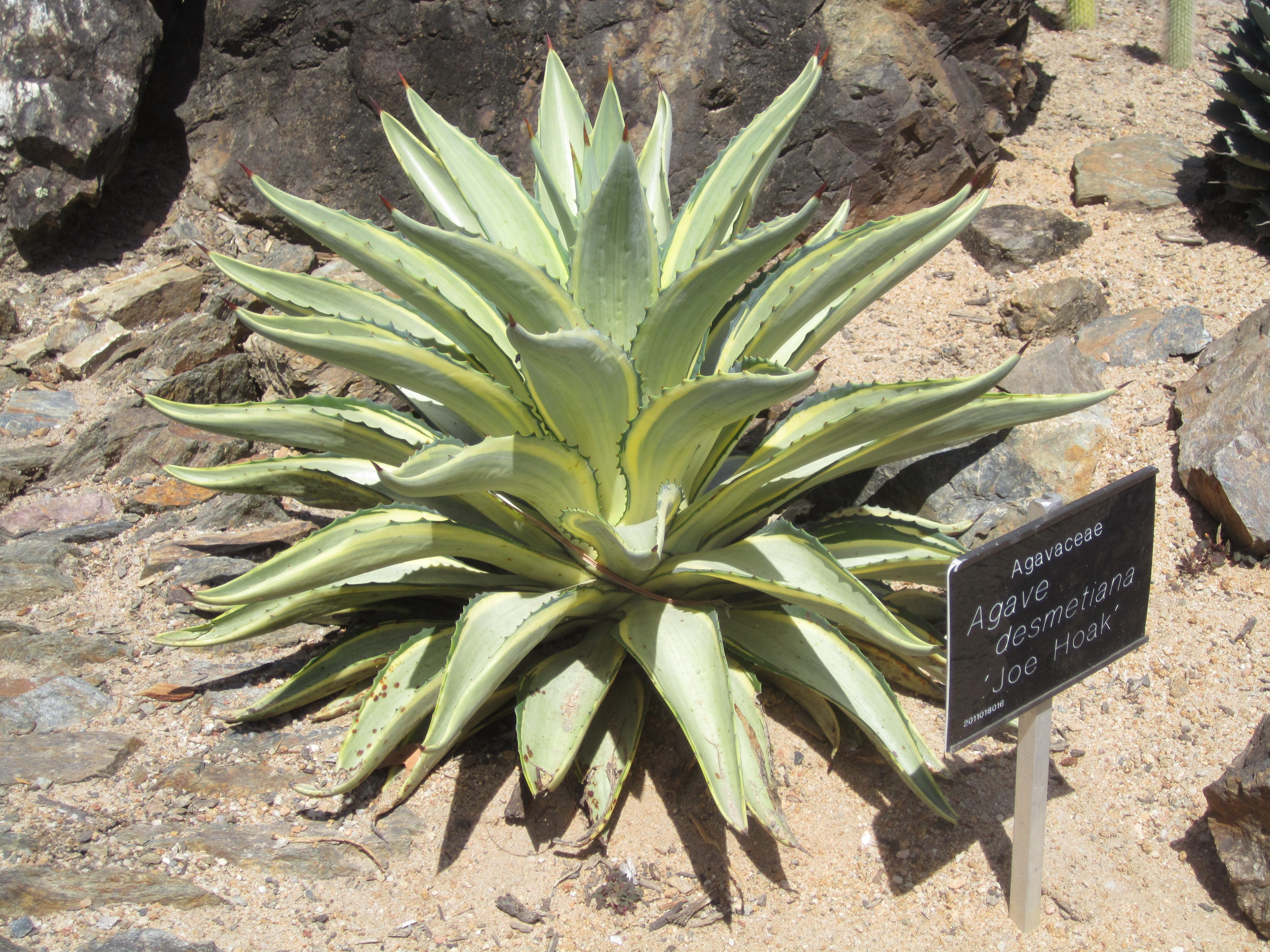
Smooth agave is an agave native to the Yucatán region of Mexico, prized for its leaves that lack marginal teeth (or have very reduced ones), making it significantly safer to handle than most agaves. Its foliage is soft to the touch, light green to blue-grey, with a modest terminal spine. It is widely cultivated as an ornamental in tropical, Mediterranean, and subtropical gardens worldwide, both in the ground and in containers. Nomenclatural note: *Agave desmetiana* Jacobi (1867) is the accepted name; *A. desmetiana* hort. ex Baker is an illegitimate synonym.
chevron_right edit_note Proposed edits auto-approved at +3 net votes
No pending proposals for this section.
Overview
| Category | Classification |
|---|---|
| Family | Asparagaceae |
| Genus | Agave |
| Growth Habit | Solitary rosette or with few basal offsets, moderate growth rate. Monocarpic: flowers between 10 and 20 years and dies after seed production. Produces abundant bulbils on the flower stalk. |
| Conservation Status | Not evaluated (IUCN NE) independently. Widely cultivated; wild populations in Yucatán are sparse and poorly studied. |
| pH Target | 6.0–8.0 |
| Type | Sandy loam to calcareous, well-drained |
Origin & Habitat
Morphology
Linear to spatulate, 60–120 cm long and 5–10 cm wide, light green to blue-grey, smooth or with undulate margins lacking teeth. Terminal spine slender, 1–3 cm, dark brown.
ecoBranched panicle inflorescence 3–5 m tall. Flowers pale yellow to cream, 5–7 cm. Abundant viviparous bulbils are produced on the inflorescence branches.
ecoShort to nearly stemless (up to 30 cm visible). The piña is compact and less fibrous than in mezcal agaves, with watery tissue and a slightly bitter flavour.
ecoModerate, shallow root system. Thick fleshy roots at the basal zone, with more extensive secondary fibrous roots for rainfall absorption.
ecochevron_right edit_note Proposed edits auto-approved at +3 net votes
No pending proposals for this section.
Requirements
Soil & Substrate
Type
Sandy loam to calcareous, well-drained
groups Beneficial Associations
chevron_right edit_note Proposed edits auto-approved at +3 net votes
No pending proposals for this section.
Propagation Strategy
B
O
Every 2–3 years in a large container; permanent outdoor planting is preferable.
Diluted balanced fertilizer (10-10-10) once in spring and once in summer.
Uses & Applications
Precautions / Toxicity
Low. Without marginal teeth, the risk of physical injury is minimal. Sap may cause mild skin irritation in sensitive individuals.
chevron_right edit_note Proposed edits auto-approved at +3 net votes
No pending proposals for this section.
Plant Health
Root and crown rot (Erwinia spp., Phytophthora spp.) especially in wet winter
Mealybugs (Pseudococcus spp.) and scale (Diaspis bromeliae) on leaves and base
Agave snout weevil (Scyphophorus acupunctatus) — larvae bore into the piña causing total collapse
chevron_right edit_note Proposed edits auto-approved at +3 net votes
No pending proposals for this section.
"The absence of marginal teeth makes this species an ideal choice for gardens with frequent pedestrian traffic or children. Abundant viviparous bulbil production at flowering allows easy multiplication even before the plant dies. Not to be confused with *Agave attenuata*, whose leaves are even softer and lack a terminal spine."
chevron_right edit_note Proposed edits auto-approved at +3 net votes
No pending proposals for this section.
Scientific Integrity
🟡 MediumVote to help validate this record
Sources
Loading…
Discussion
Disclaimer
This species record is provided for educational and informational purposes only. Jardín Roca Negra does not guarantee the accuracy or completeness of the data. Content is community-curated and may be subject to revision; it should not replace advice from a qualified botanist. This species may be toxic, invasive, or subject to legal restrictions — verify before handling or cultivating. Jardín Roca Negra accepts no liability for any harm arising from reliance on this information. Images are reproduced under Creative Commons or equivalent free licenses; credits are noted below each image.