
Agave capensis Gentry
Cape agave, Golden cape agave
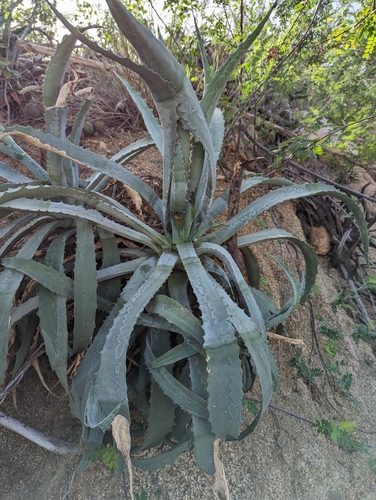
Agave capensis is an agave endemic to the Cape Region of Baja California Sur, Mexico, where it grows on volcanic slopes and arid bajadas at the southern tip of the peninsula. It is prized in cultivation for its unusual coloration: under full sun and limited water, leaves develop golden to yellow-orange tones that visually distinguish it from almost any other agave in the genus. It grows in poor volcanic soils with sparse summer rainfall, in areas with an arid Mediterranean-type climate.
chevron_right edit_note Proposed edits auto-approved at +3 net votes
No pending proposals for this section.
Overview
| Category | Classification |
|---|---|
| Family | Asparagaceae |
| Genus | Agave |
| Growth Habit | Medium-sized acaulescent rosette, monocarpic; produces offsets moderately |
| Conservation Status | Data Deficient (DD) — IUCN; endemic to restricted range, impacted by tourist development in Los Cabos |
| pH Target | 6.5–8.0 |
| Type | Basaltic volcanic soils, arid peninsular lithosols, stony bajada substrates |
Origin & Habitat
Morphology
Oblongo-lanceolate leaves 40–70 cm long and 8–12 cm wide, yellowish-green to golden in full sun, with curved horny brown-golden teeth and a terminal spine 3–5 cm long.
ecoPanicle inflorescence 4–6 m tall; yellow to yellowish-green flowers in dense clusters. Single flowering at the end of the life cycle (15–25 years).
ecoShort or subterranean stem; moderately developed piña rich in fermentable carbohydrates.
ecoFibrous, extensive and shallow root system adapted to capture summer rains in the permeable volcanic soils of the Baja California peninsula.
ecochevron_right edit_note Proposed edits auto-approved at +3 net votes
No pending proposals for this section.
Requirements
Soil & Substrate
Type
Basaltic volcanic soils, arid peninsular lithosols, stony bajada substrates
groups Beneficial Associations
chevron_right edit_note Proposed edits auto-approved at +3 net votes
No pending proposals for this section.
Propagation Strategy
V
W
Every 3–5 years; tolerates some root compression
Minimal annual fertilization: very diluted cactus fertilizer once in spring
Uses & Applications
Precautions / Toxicity
Mildly irritating sap; sharp terminal spines. No documented systemic toxicity.
chevron_right edit_note Proposed edits auto-approved at +3 net votes
No pending proposals for this section.
Plant Health
Root rot (Fusarium spp., Phytophthora spp.) — main threat in cultivation from overwatering
Mealybug (Pseudococcus spp.) — infests leaf bases under high humidity conditions
Agave snout weevil (Scyphophorus acupunctatus) — silent attack on the heart; preventive control with imidacloprid
chevron_right edit_note Proposed edits auto-approved at +3 net votes
No pending proposals for this section.
"The golden coloration of A. capensis intensifies notably under controlled water stress and maximum solar irradiation. In temperate zone cultivation, protection from prolonged frost is necessary. It belongs to the group of Baja Californian agaves described by Howard Scott Gentry, the greatest monographer of the genus in the 20th century, in his seminal work 'Agaves of Continental North America' (1982)."
chevron_right edit_note Proposed edits auto-approved at +3 net votes
No pending proposals for this section.
Scientific Integrity
🟡 MediumVote to help validate this record
Sources
Loading…
Discussion
Disclaimer
This species record is provided for educational and informational purposes only. Jardín Roca Negra does not guarantee the accuracy or completeness of the data. Content is community-curated and may be subject to revision; it should not replace advice from a qualified botanist. This species may be toxic, invasive, or subject to legal restrictions — verify before handling or cultivating. Jardín Roca Negra accepts no liability for any harm arising from reliance on this information. Images are reproduced under Creative Commons or equivalent free licenses; credits are noted below each image.